Wednesday, 24 July 2013

The BIG LIE: Sceptics Funded by Big Oil -no, the Alarmists are.


Image: Cartoons by Josh
How often do you see articles (eg LINK) saying that “sceptics are funded by BigOil?” 

 OK, please BigOil, we NEED funds, we have not received our share. Where are they?

(see Hey Big Oil! Where's our $$$$s?) 

 “Sceptics are lavishly funded by BigOil.”

Well, no! The Wall Street Journal last year exposed this to be a lie. (link)

When did it become received media wisdom that global warming skepticism was all the work of shadowy right-wing groups lavishly funded by oil companies? As best we can tell, it started with a 1995 Harper's magazine article claiming to expose this "high-powered engine of disinformation." Today anyone who raises a doubt about the causes of global warming is accused of fronting for, say, Exxon, whatever the facts.
  
We know that BigOil sponsors the influential “progressive” think tank of Pew Charitable Trusts thanks to Joanne Nova (link) and also, from the same link, we know that the Heartland institute does NOT depend on BigOil funding even though that has constantly been an assertion. 
The favorite target of global warming alarmists is the group of big international oil companies. Big Oil is accused of generously funding the global warming skeptics, like The Heartland Institute.  (link)

We also have recently had a paper by Cook et al (2013) claiming a “consensus on anthropogenic global warming in the scientific literature.”

Among abstracts expressing a position on AGW, 97.1% endorsed the consensus position that humans are causing global warming. 
This paper has been rebutted everywhere, including by Lord Christopher Monckton

0.3% CONSENSUS, 

NOT 97.1%

 Also by Anthony Watts: (link)

You’d think such simple elementary errors in data would have been caught in peer review, after all, that is what peer review is for. 

I think that there was a goal by Cook and his crowd, and that goal was to match the 97% number that has become a popular meme in the literature and the media. This intent seems confirmed by a recent statement by one of the co-authors, Dana Nuccitilli in a media argument that 97% global warming consensus meets resistance from scientific denialism
The above-mentioned Dana Nuccitelli describes himself as "a blogger on environmentalguardian.co.uk. He is an environmental scientist and risk assessor and also contributes to (UN)SkepticalScience.com." (LINK)  

(UN)SkepticalScience is a blog run by the aforementioned John Cook. Of  Cook’s blog, Realist Scientist  and author John Droz Jr writes: (link)
I started with the assumption that Mr. Cook was a competent and well-intentioned person. After some looking around there, here’s what I found out and concluded.
The first red flag is the fact that Science (by definition) is skeptical, so why the repetition in the name? It’s something like naming a site “The attractive fashion model”.
Of more concern is the fact that (c0ntrary to what one might be led to believe by the title) the site is actually focused against skeptical scientists — specifically those who have the temerity to question anthropogenic global warming (AGW). Hmmm.

Anthony Watts recently put Dana Nuccitelli under the search light and found….uh oh! He is payed by BigOil. That’s right – this alarmist blogger and contributor to (UN)Skeptical Science is in the pay of BigOil.

His Linkedin page (Link) describes him as an Environmental Scientist at Tetra Tech.


Alex Jones reveals more of the Alarmists funded by BigOil: (link)

WWF 
‘s recent article entitled, The WWF’s Vast Pool of Oil Money chronicles the rise the globalist green charity – seeded with funding from global petroleum giant Royal Dutch Shell, who’s former President of 15 years, John Loudon, later served as president of WWF International for four years after that. 
Greenpeace:
Greenpeace dictate on their own website that the idea of free speech no longer applies when it comes to the climate debate, and will often attack climate skeptics based on their alleged connections to ‘Big Oil’.
However.....
Their own militant stance makes it all the more interesting that Greenpeace itself is funded by Standard Oil money, and so is Sierra Club – according to the watchdog website Activist Cash
Rockefeller Brothers Foundation
Greenpeace $1,080,000.00 1997 – 2005
Sierra Club $710,000.00 1995 – 2001
ACORN $10,000.00 2002 – 2002 
Rockefeller Family Fund
Greenpeace $115,000.00 2002 – 2005
Sierra Club $105,000.00 1996 – 2002
ACORN $25,000.00 1998 – 1998 
Rockefeller Foundation
Greenpeace $20,285.00 1996 – 2001
Rockefeller Philanthropy Advisors
Sierra Club $38,250.00 1997 – 2000 
Suffice to say that the neither of these champions of climate change and global government – the WWF and Greenpeace, would exist without all that juicy Big Oil Money.
and, lest we forget, Al Gore sold his TV Channel to .....yep....BigOil. (link)
“He’s supposed to be the face of clean energy and just sold [the channel] to very big oil, the emir of Qatar! Current never even took big oil advertising—and Al Gore, that bulls***ter sells to the emir?”
Yet these hypocrites and their supporter still continue their relentless lies.  Carbon Sense Coalition's Viv Forbes was attacked on Menzies House.(Link) e.g.
#8. As Viv Forbes is a coal miner, he will be ripping far more carbon (coal) out of the ground to be burned to form CO2, than Tony Abbott could ever bury to offset an increase in CO2 levels.
To detractors Viv replied: (link)
We have spent our lives in productive tax-paying endeavours, mainly in activities related to farming and mining. We were both reared on farms, me a dairy farm near Warwick, and Judy a cattle grazing property near Mackay. We have overseen the operations of large beef properties, and owned two farms ourselves – one a hobby farm, one a real cattle and sheep operation where we have lived for the last 23 years. 
I have also spent a lot of my life in exploration, financial analysis, consulting and management involving base metals, oil/gas and coal, mainly in northern Australia.
Those who would like to silence me will accuse me of being an apologist for the coal industry. It is true that I am a non-executive director of a small coal exploration company and we hold shares in it. But this company does not produce coal and is largely unaffected by what the politicians are doing now. My experience in the coal business does mean that I understand the science and politics of coal.
Well done, Viv for standing up to the real science and opposing the falsified AGW hypothesis.

Thanks to Dale for the heads-up.


Tuesday, 23 July 2013

The Macabre Beauty of Medical Photographs

Smithsonian


Cross post under Smithsonian.com Terms of Use 
First published at Collage of Arts and Sciences blog site


Meneingioma, brain tumor. Image from Hidden Beauty.


Norman Barker was fresh out of the Maryland Institute College of Art when he got an assignment to photograph a kidney. The human kidney, extracted during an autopsy, was riddled with cysts, a sign of polycystic kidney disease.

“The physician told me to make sure that it’s ‘beautiful’ because it was being used for publication in a prestigious medical journal,” writes Barker in his latest book, Hidden Beauty: Exploring the Aesthetics of Medical Science. “I can remember thinking to myself; this doctor is crazy, how am I going to make this sickly red specimen look beautiful?”

Thirty years later, the medical photographer and associate professor of pathology and art at the Johns Hopkins University’s School of Medicine will tell you that debilitating human diseases can actually be quite photogenic under the microscope, particularly when the professionals studying them use color stains to enhance different shapes and patterns.

“Beauty may be seen as the delicate lacework of cells within the normal human brain, reminiscent of a Jackson Pollock masterpiece, the vibrant colored chromosomes generated by spectral karyotyping that reminded one of our colleagues of the childhood game LITE-BRITE or the multitude of colors and textures formed by fungal organisms in a microbiology lab,” says Christine Iacobuzio-Donahue, a pathologist at the Johns Hopkins Hospital who diagnoses gastrointestinal diseases.

Barker and Iacobuzio-Donahue share in interest in how medical photography can take diseased tissue and render it otherworldly, abstract, vibrant and thought-provoking. Together, they collected nearly 100 images of human diseases and other ailments from more than 60 medical science professionals for Hidden Beauty, a book and accompanying exhibition. In each image, there is an underlying tension. The jarring moment, of course, is when viewers realize that the subject of the lovely image before them is something that can cause so much pain and distress.


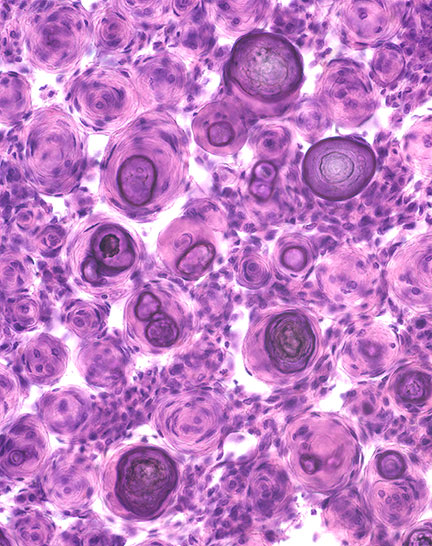
Research shows that close to 50 percent of those over 85 years in age have Alzheimer’s, a degenerative neurological disorder that causes dementia. Diagnosing the disease can be tough—the only true test to confirm that a patient has Alzheimer’s is done post-mortem. A doctor collects a sample of brain tissue, stains it and looks for abnormal clusters of protein called amyloid plaques and neurofibrillary tangles. In this sample (shown right) of brain tissue, the brown splotches are amyloid plaques.


A person’s stomach produces acids to help digest food, but if those acids enter the esophagus, one can be in for a real treat: raging heartburn. Gastroesophageal reflux, in some cases, leads to Barrett’s esophagus, a condition where cells from the small intestine start popping up in the lower esophagus, and Barrett’s esophagus can be a precursor to esophageal cancer. The biopsy (left) of the lining of an esophagus has dark blue cells, signaling that this person has Barrett’s.


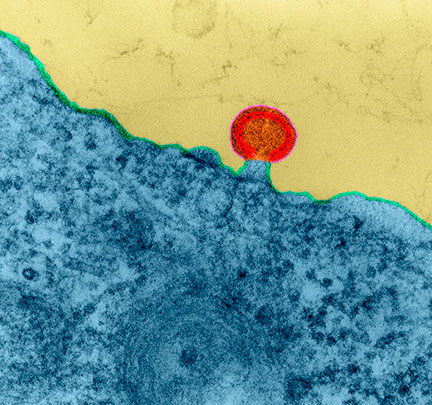
The electron micrograph (right) shows what happens in the circulatory system of someone with human immunodeficiency virus (HIV). The blue in the image is a white blood cell, referred to as a CD4 positive T cell, and the cell is sprouting a new HIV particle, the polyp shown here in red and orange.


This pile (left) of what might look like nuts, fossils or even corals is actually of gallstones. Gallstones can form in a person’s gall bladder, a pear-shaped organ positioned under the liver; they vary in shape and size (from something comparable to a grain of salt to a ping pong ball), depending on the specific compounds from bile that harden to form them.


According to estimates, about 2 billion people in the world have Hepatitis B virus (shown right), or HBV. Those who have contracted the virus, through contact with a carrier’s blood or other bodily fluids, can develop the liver disease, Hepatitis B. When chronic, Hepatitis B is known to cause cirrhosis and liver cancer.


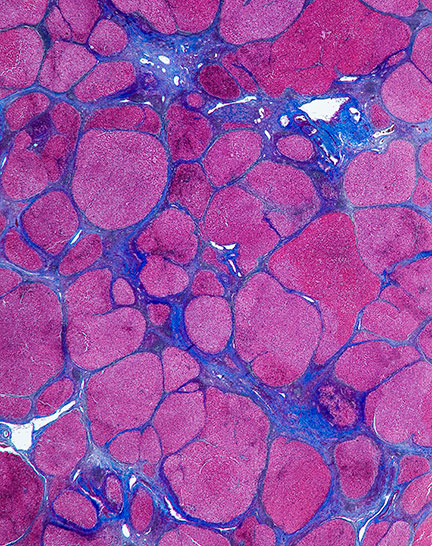
When a person develops cirrhosis, typically from drinking alcohol in excess or a Hepatitis B or C infection, his or her liver tissue (shown left, in pink) is choked by fibrous tissue (in blue). The liver, which has a remarkable ability to regenerate when damaged, tries to produce more cells, but the restricting web of fibrous tissues ultimately causes the organ to shrink.


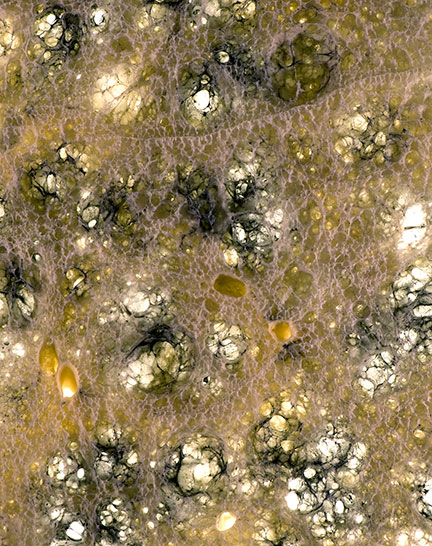
Emphysema (shown right, in a smoker’s lung) is the unfortunate side effect of another unhealthy
Smoker’s lung. Image from Hidden Beauty.
habit, smoking. With the disease, what happens is that big gaps (seen as white spots in the image) develop in the lung tissue, which disrupt the exchange of oxygen and carbon dioxide and result in labored breathing. The black coloration on this sample is actual carbon that has built up from this person smoking packs and packs of cigarettes over a stretch of many years.


First Published: http://blogs.smithsonianmag.com/artscience/2013/07/the-macabre-beauty-of-medical-photographs/#ixzz2ZolIgyiH
.

Saturday, 20 July 2013

Tony Abbott's agony


Can fracking cause bigger, more frequent earthquakes?

By Dougal Jerram, Professor II at CEED at University of Oslo
Cross post under The Conversation republishing guidelines            The Conversation

Injecting fluids into the Earth, whether to recover natural gas or to obtain thermal energy from the planet, can cause earthquakes. New reports that look at American fracking, deep waste-water injection and geothermal activities suggest there are big risks and thus a need to develop strong regulatory framework to deal with them.

The most striking indication of human-induced earthquakes is provided by the graph below, which shows the cumulative number of earthquakes in the central and eastern US that were greater than or equal to magnitude 3.0 on Richter scale. The clear increase from 2005 coincides with the rapid increase of shale gas wells and associated increased deep waste-water injection. Between 2005 and 2012, the shale gas industry in the US grew by 45%
William L Ellsworth/Science each year.


Three reports have been published this month in the journal Science that add to our limited but growing data on the causal link between fluid injections and earthquakes.

Pumping of fluids into the ground changes how ground water travels through the porous rock systems. This can affect the rock in two ways. First, these injected fluids can leak directly into faults, which are fractures in rocks, and change pore pressure along the fault, causing failure. Second, they can alter the mass or volume of the rocks that overlie a fault, which changes how much loading the layers underneath have to bear. In this case the fluids do not interact with the fault directly, but cause it to fail by changing its surroundings.
William L Ellsworth/Science
 

In the first report, a review article, William Ellsworth of the US Geological Survey points out that earthquakes are occurring in unusual locations in North America and Europe. He looks at activities where injecting fluids into the ground may cause earthquakes — such as mining for minerals and coal, oil and gas exploration/production, as well as the building of reservoirs and large waste-water disposal sites. Ellsworth examines three case studies of deep injection, which are particularly convincing

.In 1961, fluid was being injected to a depth of 3.6 km at a Colorado chemical plant for disposing hazardous chemicals. By early 1962, nearby residents started reporting earthquakes. By 1966, 13 such earthquakes had been recorded in that area with magnitude 4.0 or more.

In 1969, the US Geological Survey also started injecting fluids at another site in Colorado. This time, their aim was to understand how fluid pressure could influence earthquakes. They noticed that whenever the fluid pressure went beyond a critical threshold, more earthquakes were observed. This indicated that earthquakes could potentially be controlled if the pressure at which fluids are injected is controlled properly.

The most remarkable example, however, comes from injections in Paradox Valley in Colorado (still on-going). In that area, during the period of 1985 to 1996, only three tectonic earthquakes were recorded within 15km of the site chosen for injection. Between 1991 and 1995, when the injection tests were conducted, hundreds of induced earthquakes were detected within 1km of the site, but few were detected beyond 3km from the site and all were below magnitude 3.0. This situation, however, changed because of continuous injection activities. In 2000, there was an earthquake of the magnitude 4.3 which was recorded 8km from the site and earlier this year there was one of magnitude 3.9 recorded equally far away. This shows that long term injection can lead to expansion of the seismically active area and trigger bigger earthquakes.

In the second report, Emily Brodsky and Lia Lajoie of the University of California at Santa Cruz, look at the Salton Sea Geothermal Field in California. They track the total volume of fluid injected and extracted to extract heat from earth’s core, and find it correlates to the number and magnitude of earthquakes. So it’s not just injection, but also extraction needs to be paid attention to.

The last report is by Nicholas van der Elst of Cornell University and his colleagues. This study tracked induced earthquakes that are triggered by much larger natural earthquakes that occur far away. Injection of water in the deep ground elevates pore pressures and makes the faults and fracture networks in the rocks more vulnerable, so that a distant event can push the system over the edge and to cause earthquakes around the injection sites.

The fact that human activity alters the landscape in a way that can cause earthquakes is not surprising given the scale of activities. The mud volcano “Lusi” (Sidoarjo mud flow) in Indonesia is a striking example of what can potentially happen when drilling interacts with the subsurface with dramatic results, and even there debate lingers as to the “human trigger” for the event. At Lusi, a mud volcano erupted shortly after drilling for gas and as the ongoing disaster developed, it covered the surrounding houses, displacing some 13,000 families and closing 30 factories and hundreds of small businesses.

Humans are aware of the fact that earthquakes can be induced by fluid injection, and we are now increasingly understanding how they cause them. It is perhaps then, as Ellsworth concludes, high time to intervene with a clear regulatory framework to mitigate the risk.


Dougal Jerram does not work for, consult to, own shares in or receive funding from any company or organisation that would benefit from this article, and has no relevant affiliations.
The Conversation
          Read the original article [here]
       

Friday, 19 July 2013

The circus around CO2

Letter to the editor - The circus around CO2

From Leon Ashby - NO CARBON TAX Climate Sceptics

Image: Toonpool
Friday 19th July

Dear Sir / Madam,

It's good to see Tony Abbott has recognised CO2 is an invisible gas. 

The Greens and the ABC display colour manipulated pictures of steam coming out of power stations, trying to make it look like its CO2 . Funnily steam is white not black. Those darkened pictures are to con us and say CO2 is black and evil.

 We cannot see CO2 as its transparent and it's a good guy (being plant food).

The climate deceivers say CO2 will cause droughts, extinctions, malaria everywhere, dams empty, ice sheets totally gone, no more snow, butterflys that won`t be able to find a mate - you name it and they blame it (on CO2)

 But let's give credit where its due - Abbott is correct saying an ETS and a Carbon Tax are bad for the economy and will do nothing for the planet.

Rudd is correct saying Abbott's $85 Billion Direct Action plan is also a dud.

It's a circus with the clowns swapping insults and picking our pockets simultaneously.

Leon Ashby

Senate Candidate for the NO CARBON TAX Climate Sceptics 

Thursday, 18 July 2013

‘Mining captures politics’ – author claims


By John Mikkelsen

GOVERNMENTS change but the politics surrounding mining and resource developments don’t, according to the author of a controversial  new book about to be launched in Gladstone.

‘Road to Exploitation’ subtitled ‘Political Capture by Mining in Queensland’ follows years of pains-taking research and writing by  long-term environmental activist and former Mt Larcom resident, Alec Lucke.

 It will be released at an invitational and public book launch party at the Gladstone Art Gallery, 2 pm  Friday (July 19). Lucke describes his work as partly autobiographical, and human interest. He said yesterday:

“This historical account and social commentary on mining and industrialisation is a once in a lifetime publication.

Author and activist, Alec Lucke.


“The book authenticates not only landholders’ concerns about coal and CSG's unacceptable impacts upon their strategic cropping land and aquifers, but also concerns about damage to Gladstone Harbour's ecology through examples of sweetheart deals entered into by Cabinet that bound the government's regulatory and administrative agencies to policies of minimum compliance, lack of regulatory enforcement, false benchmarking of the science and eventually, abandonment of co-existence with behind the scenes resignation of unavoidable impacts.

“The book's contents and documentation justify the title and demonstrate this principle: Capture executive government in Queensland and the regulatory and administrative processes are captured as well”.

Lucke  says the book serves as both an historical record and  a ‘precautionary manual’. By example, it  authenticates current concerns about the Coal Seam Gas and Gladstone Harbour controversies while delving back to  Mt Larcom district’s pioneering era and the later development of limestone mining  in the 1970’s.

“The Mt Larcom Mining Protest Group opposed the entry of an open cut limestone mine and cement facility into their dairying and farming district.

“With the limestone resource prioritised for cement manufacture and wider industrial applications, mining began in 1979 and the protest group ceased to function in the early 1980s”.

From 1980 to 1995, the book provides social commentary on  industrialisation, local politics, regional organisations and individual public profiles.

“In 1995, the government cancelled Queensland Cement Ltd's coral dredging leases in Moreton Bay and committed to an incentive package for trebling of the East End Mine, a railway line and new cement kiln at Fisherman's landing.
              
“A fast-tracked  Impact Assessment Study for a  $220m expansion triggered the formation of  the East End Mine Action Group (EEMAG) and coincided with  rookie Independent Member for Gladstone Hon Liz Cunningham’s  balance of power support for the Borbidge coalition government.

 “With the water monitoring data collected but not analysed for 15 years, EEMAG challenged the State's pre-emptive approvals and as controversy raged, local real estate values and saleability collapsed as landholders contested the science and  fought for compensation and replacement water supplies under 'make good' provisions.

“This narrative explores the dynamics of protest groups and reflects upon the dogged persistence and commendable social justice ideals of experts independent of the government or company whose professional opinions were officially disregarded.

“It tells of landholder's conflict with industrial development and their distress as their  precious water was discharged continuously as waste; it outlines the group's philosophical commitments, negotiations and legal and political dilemma as they won replacement water supplies and sought recognition that their small farms, lifestyles and the environment were irreversibly damaged. It chronicles the demise of farming and the ironic circumstances that eventually restored district values… 


“The EEMAG / East End Mine / Regulating Agencies dispute continues with the interests of the Gladstone industrial model and a mine privately owned by the world's largest cement company placed ahead of other stakeholders, the district's progress and the environment,” Lucke claims.

His narrative in print and ebook versions quotes from 170 documents many obtained under FOI, and provides electronic links to 74 otherwise publicly unavailable files.


Tuesday, 16 July 2013

Where's Wally?

A pictorial follow up to the post, Cockatoos smart enough. This photo of Corellas hanging on the power lines was taken outside the Longreach post office in western Queensland. Spot the single galah
.
Photo sourced from ABC Western Queensland


Galahs on a communications aerial - Australian birds
Just to prove that galahs do congregate together with their own kind
Photo sourced from Graeme Chapman
Fig. 1. Illustrations of eight adult male cockatoo species showing variation in plumage and morphology; (A) Palm Cockatoo (Probosciger aterrimus); (B) Gang-gang Cockatoo (Callocephalon fimbriatum); (C) Galah (Eolophus roseicapillus); (D) Sulphur-crested Cockatoo (Cacatua galerita); (E) Western Corella (Cacatua pastinator); (F) Baudin’s Black-cockatoo (Calyptorhynchus baudinii); (G) Glossy Black-cockatoo (Calyptorhynchus lathami); and (H) Cockatiel (Nymphicus hollandicus). Images provided by artist J.N. Davies
Source Science Direct

happily grazing together: 3 species of Cockatoo-Galahs, Sulphur-crested Cockatoos & Little Corellas at Glengarry
Photo sourced from Na nEan's blogspot


Photo sourced from Canberra Times article, Cockies are back, with their mischief