Showing posts with label IPA. Show all posts

Wednesday, 12 June 2013

IPA: Big implications in council vote

First published West Australian 11th June, 2013
Cross post subject to IPA copyright 


The Federal Government is pitching its case for local government recognition in the Australian Constitution as "small" and "modest" change.

The reality is that the effect of this proposal, to be put to the public in a referendum at the September election, would be large and immodest, most notably because it will exacerbate centralising tendencies in our Federal system.

The proposal is that local government bodies be added to Section 96 of the Constitution, which presently enables Federal Parliament to grant financial assistance to the States on terms and conditions it thinks fit.

To appreciate why this proposal is dangerous to the integrity of Australian Federalism, one only need recognise that the best predictor for future political behaviour is past political behaviour.
Since the early 1920s, successive Commonwealth governments have used Section 96 to intrude into the affairs of WA and other States, by imposing increasingly prescriptive conditions on State governments as a condition of funding.

Federal politicians have used Section 96 grants to dictate to States the policy objectives to be pursued, specifications of service targeting and delivery standards, and even administrative structures which must be put in place.

National Partnership Payments, introduced under former prime minister Kevin Rudd, are arguably even more intrusive, since States can now only receive funds if they adhere to Federally dictated milestones or performance benchmarks.


Image sourced from Parliamentary Education Office
 

The effects of these arrangements on the quality of our public governance have been dramatic, with voters finding it increasingly difficult to identify which level of government is responsible for failures in policy performance or service delivery.

Federal and State politicians have capitalised on this blurring of democratic accountability by fomenting blame games against each other, much to the frustration of average voters.
So far, the financial relationship between the Commonwealth and 565 councils has been on a much smaller scale.

However, the problems bedevilling Federal-State relations will become a reality for local governments should Canberra receive a constitutional green light to fund councils on any terms and conditions it thinks fit.

About 83 per cent of the $2.6 billion in Federal funding to councils is given in accordance with Section 96, with funds sent to each State on the proviso that they then pass the funds on to their local government authorities.

However, the remaining Federal funding, which flows directly to local government bypassing the States altogether, remains controversial and has come under greater scrutiny in recent years.
In 2001 the Howard government introduced the Roads to Recovery program, which is today the single largest direct funding program to local governments, costing $335 million last year.
Prior to his election as a parliamentarian in 2010, economist Andrew Leigh found evidence of pork-barrelling within this program, as the funding distribution favoured councils in coalition regional electorates.

In the Pape and Williams cases of 2009 and last year respectively, High Court judges ruled that the Commonwealth could not directly appropriate funds unless explicitly supported by powers explicitly stated in the Constitution.

The Gillard Government is now proposal asking the public to enshrine local government financial recognition in the Constitution, to allegedly allow the imperilled Roads to Recovery and other direct funding programs to continue.

However, just last year the Government passed the Financial Framework Legislation Amendment Bill (No. 3) 2012, authorising it to spend on local government, and 414 other areas of public policy, without having to ask Parliament for future authorisation.

The referendum proposal is left politically exposed for what it truly is: a plea by Canberra's political class for an unprecedented ability to interfere in local community affairs, with a good dose of pork-barrelling for votes along the way.

It is no coincidence that referendum proponents argue the proposal would somehow reduce Australian over-government, claiming that channelling most Federal funding to local governments through the State middlemen is a needless exercise.

Such assertions do not stand up to scrutiny, in that the States are legally obligated to pass on the full amount of relevant funding to councils without undue delay.

Federal funding of councils through the States is generally agreed to be constitutionally valid, and allows State politicians to scrutinise these Federal funds flowing through to their local government administrations.

This funding methodology also pays respects to the reality that councils are administrative sub-units of State governments, and are recognised as such within State constitutions.

Indeed, there is no good argument for the Commonwealth to not direct every last cent of its funding to councils through the States, on democratic accountability and financial probity grounds.

The Australian people resoundingly rejected two similar constitutional amendment proposals in 1974 and 1988, and the argument against allowing Canberra to infiltrate every town hall remains as valid this year as it was in the past.
.

Wednesday, 29 May 2013

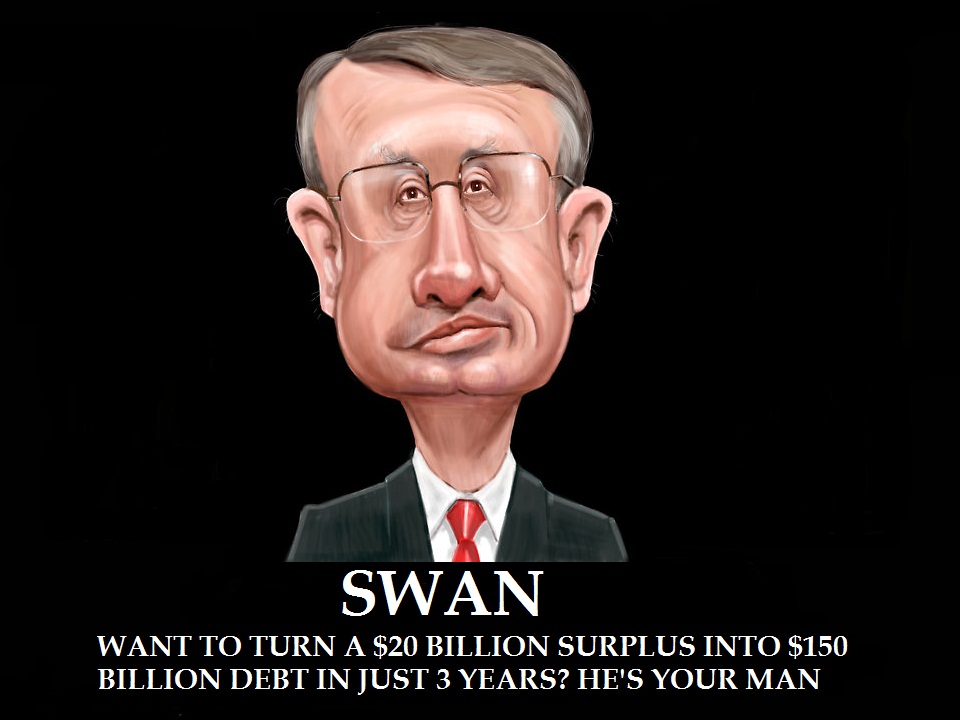
Swan grabbing unattented nest eggs


It shows the desperation of the Federal government led by Prime minister Julia Gillard and treasurer Wayne Swan that they are grabbing funds out of people's private bank accounts if they have not been used for three years. These accounts include money placed in children's accounts and pensioners who have set aside funds in case of a medical emergency.

Image sourced from barnabyisright.com


Regular contributor to this site, Peter Neilsen in the Open Thread page brought our attention to a newspaper article which tells of a pensioner coming home from hospital from heart surgery to find that a heartless federal government had emptied his account.
Peter writes
The robbery has begun early.
Although the legislation to steal all money held in bank accounts that have been inactive for 3 years does not come into effect until after May 31st, the Government have jumped the gun and have already taken money from bank accounts which would be illegal prior to legislation coming into effect.

http://www.couriermail.com.au/money/money-matters/queensland-pensioner-emerged-from-heart-surgery-to-find-bank-had-emptied-account-and-given-it-to-federal-government/story-fn3hskur-1226647919220

This is the link to just one typical story about the theft of money from peoples accounts prior to the commencement date of the legalisation of theft in Australia.

There are numerous reports coming forward now about this theft, including a report of $6 dollars being stolen from an account held by a child. Bloody hell they must be really getting desperate to rob little kids.
Also In the Courier Mail the article, Government grab nets boys' savings, tells of two little boys piggy bank saving have been taken by the federal government.
Ms Hadfield's sons' accounts were set up by the boys' grandparents when they were born. Grandmother Sandra Hodgson said the grab was disgusting.
"We should be able to leave the money in the accounts for the boys until they want it," she said.
The Coburg family did not realise the accounts had been closed until they got a letter. "I think there are lots of people like us who will get caught out," Ms Hadfield said.
Queensland pensioner Adrian Duffy was another victim.
He emerged from a quintuple heart bypass to find $22,000 had been emptied from his Suncorp bank account.
The 77-year-old had spent 14 years saving the cash with his wife, to help pay for major health-related costs.
Savings
Seamus and Eamon Hadfield, whose savings were seized. Picture: Ian Currie Source: Sunday Herald Sun
In this media release, Gillard government seizure of inactive bank accounts is an attack on property rights, back in February Simon Breheny of the IPA warned of the consequences of the federal governments then proposed actions. Although now some months old this media release is still very relevant.
"The Gillard government's plan to take money from dormant bank accounts is a shameful grab for cash and a significant attack on property rights," said Simon Breheny, director of the Legal Rights Project at free market think tank the Institute of Public Affairs.
The Treasury Legislation Amendment (Unclaimed Money and Other Measures) Act 2012 amends the Banking Act 1959 to lower the threshold for "unclaimed moneys", which are transferred from banks that hold the accounts to the Australian Securities and Investments Commission. Previously this was defined as any money in bank accounts that had been inactive for a period of seven years, but the new laws require inactivity for only three years.
"People should be able to leave money in bank accounts for as long as they wish without the fear that the government might come along and steal it from them. To do so is an arbitrary acquisition of property by the government," said Mr Breheny.
"Parents saving for their children's education, young people saving for a home and others putting money aside for retirement are all at risk of losing their savings as a result of these changes," said Mr Breheny.
"The changes could have a number of unintended consequences. Such a regime provides a disincentive to saving money with a bank and may encourage people to hide their money under the mattress and away from the hands of government," said Mr Breheny.
"The government is desperately attempting to shore up its financial position before the budget is handed down in May 2013," said Mr Breheny.
"Tony Abbott and the Coalition must commit to repealing these changes if elected to government," said Mr Breheny. 
.

Friday, 10 May 2013

IPA: Let farmers do what they do best

By
First published [here] by the Institute of Public Affairs
Cross posted under the terms & conditions of IPA's copyright


The Colac Otway Shire council has faced local outrage over the proposed new laws that will place “draconian” restrictions on how farmers manage their land.  The council encompasses some of the great Western district farming areas of Colac, Cressy and Beeac, including the popular coastal destinations of Wye River and Apollo Bay.


The Shire has brought in the new laws to keep it in step with the Department of Environment and Primary Industries plans to remap the biodiversity and native vegetation maps across Victoria, leading some to warn that other councils may follow suit.

The Weekly Times notes that the proposed overlays on private property “can restrict ploughing of native grass, removal of fallen tree limbs for use as firewood, timber harvesting from purpose-planted native trees and even removal of rocks.”   What is perhaps the most galling about the proposed rules is that it in fact punishes farmers who have striven to be good conservationists by planting and caring for native species on their properties, and yet those who have stripped the land back will have no restrictions placed on them at all.  Local Beech Forest cattle breeder and business man, Ray Cooper, explains that farmers have been less considerate in their treatment of  the land “won’t end up having these overlays because they don’t have the native trees.”
Beeac farmer and former president of the Colac Shire, John Daffy, states that this is a prohibitive intrusion into private citizens’ lives.
What it means is they’ve got control of your property…Their fines are so prohibitive that you could be nearly forced off your property…
Concern has been so great that Daffy has formed a local action group to try and prevent the changes.  Yesterday’s deadline for the public outcry to the proposed changes illustrated that
Agriculture is the primary economic driver [for the Shire]. Why would you crucify your farmers?
Furthermore, it will affect the local economy, as farmers and businesses will be driven to trade in different areas as the new law will make it “very, very difficult for people to do business.”  The Institute of Public Affairs has written before on the impact that native vegetation and environmental laws have: please read them here and here.  The end result of making the good conservationist practices that Australian farmers are renowned for prohibitively expensive and overly regulated, will be to actively discourage the preservation of native species.  Perhaps more importantly though, it will decimate local farming communities, as people flee to make an easier, less micro-managed, career and businesses elsewhere


About Vivienne Crompton

Vivienne Crompton is a Researcher for the Legal Rights Project. Undertaking her Bachelor of Arts at the University of Melbourne, she majored in both History and Archaeology, focusing on Medieval and Early Modern Europe. Furthering her studies, Vivienne undertook the Juris Doctor, the University of Melbourne’s new graduate degree in law.
.

Saturday, 29 December 2012

IPA : Anti-Discrimination Bill


There has been some worrying comment about the Human Rights and Anti-Discrimination Bill that the Federal Gillard Labor government wishes bring into effect. A series of articles in The Australian newspaper and elsewhere has given a number of reasons to be concerned.
Today the Institute of Public Affairs has released its submission to the Senate Legal and Constitutional Affairs Legislation Committee. Printed below is the Executive Summary from IPA’s submission. To read the entire submission go to the following web address http://ipa.org.au/library/publication/1356055327_document_211212_submission_-_anti-discrimination.pdf 


The exposure draft of the Human Rights and Anti-Discrimination Bill 2012 [“the draft Bill”] represents a dramatic and radical attack on Australians’ fundamental freedoms under the guise of reforming anti-discrimination law.
The draft Bill makes government the arbiter of behaviour within a substantial range of private political and personal activities. The draft Bill would politicise and regulate private interpersonal relationships in a way they never have been in Australia.
In a very real sense, these laws are not anti-discrimination laws. They are laws designed to give the government authority over our lives in completely new and unjustifiable arenas. This is an excessive and indefensible increase in state power.
The proposed laws give the government explicit power to interfere in almost all facets of human interaction including eighteen areas of public and private life, such as political opinion, religion and social origin. The government is also required to decide what falls into these categories, making the state the total and final arbiter on our most fundamental liberties.
By redefining discrimination to be anything which “offends, insults or humiliates” the proposed law will extend the infamous provisions of the Racial Discrimination Act that led to the Andrew Bolt case to almost every area of public and private life. By expanding the grounds on which people can claim to be discriminated against to include areas such as “political opinion” the law will stifle genuine discussion on almost every topic for fear of legal consequences.
This draft Bill has deservedly been criticised from across the political spectrum as a massive overreach and an unjustified curtailment of individual freedoms.
Democratic governments rely on the free exchange of opinion for their legitimacy. This draft Bill, if enacted, would dramatically limit freedom of speech in Australia.
This submission also raises other concerning elements of the draft Bill. The draft Bill substantially reverses the burden of proof onto the defendant. It introduces a large amount of uncertainty and ambiguity into anti-discrimination law.
The draft Bill introduces a subjective test for decisions about whether the law has been breached. Subjective tests are impossible to comply with and should never be used by the courts.

There is no justification for such a dramatic overhaul of anti-discrimination law, and no place for such extraordinary limits on freedom of speech.