

EVACUATION GROUNDS - - - - WELCOME to an online home, open to all, whose main focus (not exclusively) is regional and rural Australia.
Friday, 14 June 2013
State award for Gladstone seafood critic
As reported in the Queensland Telegraph at http://issuu.com/queenslandmedia/docs/june_15_web/17?e=7826289/3366192


Wednesday, 12 June 2013
IPA: Big implications in council vote
By Julie Novak
First published West Australian 11th June, 2013Cross post subject to IPA copyright

The Federal Government is pitching its case for local government recognition in the Australian Constitution as "small" and "modest" change.
The reality is that the effect of this proposal, to be put to the public in a referendum at the September election, would be large and immodest, most notably because it will exacerbate centralising tendencies in our Federal system.
The proposal is that local government bodies be added to Section 96 of the Constitution, which presently enables Federal Parliament to grant financial assistance to the States on terms and conditions it thinks fit.
To appreciate why this proposal is dangerous to the integrity of Australian Federalism, one only need recognise that the best predictor for future political behaviour is past political behaviour.
Since the early 1920s, successive Commonwealth governments have used Section 96 to intrude into the affairs of WA and other States, by imposing increasingly prescriptive conditions on State governments as a condition of funding.
Federal politicians have used Section 96 grants to dictate to States the policy objectives to be pursued, specifications of service targeting and delivery standards, and even administrative structures which must be put in place.
National Partnership Payments, introduced under former prime minister Kevin Rudd, are arguably even more intrusive, since States can now only receive funds if they adhere to Federally dictated milestones or performance benchmarks.
Image sourced from Parliamentary Education Office
The effects of these arrangements on the quality of our public governance have been dramatic, with voters finding it increasingly difficult to identify which level of government is responsible for failures in policy performance or service delivery.
Federal and State politicians have capitalised on this blurring of democratic accountability by fomenting blame games against each other, much to the frustration of average voters.
So far, the financial relationship between the Commonwealth and 565 councils has been on a much smaller scale.
However, the problems bedevilling Federal-State relations will become a reality for local governments should Canberra receive a constitutional green light to fund councils on any terms and conditions it thinks fit.
About 83 per cent of the $2.6 billion in Federal funding to councils is given in accordance with Section 96, with funds sent to each State on the proviso that they then pass the funds on to their local government authorities.
However, the remaining Federal funding, which flows directly to local government bypassing the States altogether, remains controversial and has come under greater scrutiny in recent years.
In 2001 the Howard government introduced the Roads to Recovery program, which is today the single largest direct funding program to local governments, costing $335 million last year.
Prior to his election as a parliamentarian in 2010, economist Andrew Leigh found evidence of pork-barrelling within this program, as the funding distribution favoured councils in coalition regional electorates.
In the Pape and Williams cases of 2009 and last year respectively, High Court judges ruled that the Commonwealth could not directly appropriate funds unless explicitly supported by powers explicitly stated in the Constitution.
The Gillard Government is now proposal asking the public to enshrine local government financial recognition in the Constitution, to allegedly allow the imperilled Roads to Recovery and other direct funding programs to continue.
However, just last year the Government passed the Financial Framework Legislation Amendment Bill (No. 3) 2012, authorising it to spend on local government, and 414 other areas of public policy, without having to ask Parliament for future authorisation.
The referendum proposal is left politically exposed for what it truly is: a plea by Canberra's political class for an unprecedented ability to interfere in local community affairs, with a good dose of pork-barrelling for votes along the way.
It is no coincidence that referendum proponents argue the proposal would somehow reduce Australian over-government, claiming that channelling most Federal funding to local governments through the State middlemen is a needless exercise.
Such assertions do not stand up to scrutiny, in that the States are legally obligated to pass on the full amount of relevant funding to councils without undue delay.
Federal funding of councils through the States is generally agreed to be constitutionally valid, and allows State politicians to scrutinise these Federal funds flowing through to their local government administrations.
This funding methodology also pays respects to the reality that councils are administrative sub-units of State governments, and are recognised as such within State constitutions.
Indeed, there is no good argument for the Commonwealth to not direct every last cent of its funding to councils through the States, on democratic accountability and financial probity grounds.
The Australian people resoundingly rejected two similar constitutional amendment proposals in 1974 and 1988, and the argument against allowing Canberra to infiltrate every town hall remains as valid this year as it was in the past.
.
Tuesday, 11 June 2013
Cows, Cars, and the Ethanol Con
by Viv Forbes
First published in Blues Magazine, April 2013.

Consider a paddock of corn. Most of the carbon in the growing plant comes from carbon dioxide in the air which is converted to plant material using solar energy via the magic of photosynthesis. Other minor carbon compounds come from the atmosphere via busy microbes in the soil.
Image from forbes
All cows, cars and people then use an internal digestion/combustion process to extract the energy collected and stored by the corn plants.
In every case, this process produces gaseous emissions, mainly carbon dioxide.
In cattle and people, some of the plant’s carbon is stored for a while in flesh and bones. The rest is emitted as the natural gases carbon dioxide and methane. This methane is soon oxidised in the atmosphere to produce carbon dioxide.
In cars, virtually every atom of carbon in the ethanol burned produces one molecule of carbon dioxide.
Over the life of a cow running on corn or a car running on ethanol, they both produce exactly the same carbon emissions from exactly the same plant input. Every atom of carbon extracted from the air by the green plant eventually returns to the atmosphere as carbon dioxide, the plant food. This is the natural carbon-based cycle of life.
It is therefore scientific incompetence or deliberate fraud by global warming alarmists, vested interests and “scientists” to claim that consuming ethanol in cars is good and should be subsidised but consuming the same plant material in cows must be rationed and taxed.
We are told that ethanol is a “renewable” energy. Closer inspection shows it ties up a lot of good cropping land; uses a lot of motor fuel to plant, harvest and transport the grain; and then a lot more energy to ferment, distil and distribute it to make up its mandated proportion of motor fuel. Even more energy is used to make, transport and apply fertiliser. Growing corn for ethanol is a zero sum game at best.
We can surely learn from history.
Back in 2005,US US US US
Such foolishness has done NOTHING for the climate, but has increased food prices, put more land under cultivation, increased nitrogen fertiliser use, and caused starvation in countries dependent onUS
And to cap the foolishness, ethanol production consumes more energy than it produces. It is an inferior motor fuel, producing lower km/litre and also damaging some engines.
An ethanol industry propped up by subsidies and mandates is un-sustainable. It increases the tax burden and pushes up the cost of grains, beef, pork, eggs, milk and cereals. Subsidising ethanol brings no benefits for the climate or the environment and harms the poor and hungry of the world.
And should the world move into a period of natural global cooling, which is at least as likely as a resumption of last century’s gentle warming, food production will plummet and a world-wide food crisis will be upon us.
It is time to end the ethanol con.
No more forcing motorists to buy it. No more tax breaks for construction of ethanol plants. No more subsidies or special protection for ethanol speculators. Let ethanol production compete fairly with all other sources of transport energy.
And let’s have no more slander about emissions of the livestock industry which, when all is considered, is greener than the ethanol industry.
Sensible politicians need to stop pandering to the green lobby, stop posturing on the world green stage, learn some carbon chemistry, and stop burning food for fuel
.
Why are emissions from cows digesting grain classed as bad, whereas the same emissions from cars burning grain ethanol are lauded as green and good?
Consider a paddock of corn. Most of the carbon in the growing plant comes from carbon dioxide in the air which is converted to plant material using solar energy via the magic of photosynthesis. Other minor carbon compounds come from the atmosphere via busy microbes in the soil.
This plant material, either biomass or grain, can be fed to cattle or other livestock, made into ethanol for motor fuel, or made into food for people.
All cows, cars and people then use an internal digestion/combustion process to extract the energy collected and stored by the corn plants.
In every case, this process produces gaseous emissions, mainly carbon dioxide.
In cattle and people, some of the plant’s carbon is stored for a while in flesh and bones. The rest is emitted as the natural gases carbon dioxide and methane. This methane is soon oxidised in the atmosphere to produce carbon dioxide.
In cars, virtually every atom of carbon in the ethanol burned produces one molecule of carbon dioxide.
Over the life of a cow running on corn or a car running on ethanol, they both produce exactly the same carbon emissions from exactly the same plant input. Every atom of carbon extracted from the air by the green plant eventually returns to the atmosphere as carbon dioxide, the plant food. This is the natural carbon-based cycle of life.
It is therefore scientific incompetence or deliberate fraud by global warming alarmists, vested interests and “scientists” to claim that consuming ethanol in cars is good and should be subsidised but consuming the same plant material in cows must be rationed and taxed.
We are told that ethanol is a “renewable” energy. Closer inspection shows it ties up a lot of good cropping land; uses a lot of motor fuel to plant, harvest and transport the grain; and then a lot more energy to ferment, distil and distribute it to make up its mandated proportion of motor fuel. Even more energy is used to make, transport and apply fertiliser. Growing corn for ethanol is a zero sum game at best.
We can surely learn from history.
Back in 2005,
Such foolishness has done NOTHING for the climate, but has increased food prices, put more land under cultivation, increased nitrogen fertiliser use, and caused starvation in countries dependent on
Ethanol madness has magnified the effects of the drought - twenty US
And to cap the foolishness, ethanol production consumes more energy than it produces. It is an inferior motor fuel, producing lower km/litre and also damaging some engines.
An ethanol industry propped up by subsidies and mandates is un-sustainable. It increases the tax burden and pushes up the cost of grains, beef, pork, eggs, milk and cereals. Subsidising ethanol brings no benefits for the climate or the environment and harms the poor and hungry of the world.
And should the world move into a period of natural global cooling, which is at least as likely as a resumption of last century’s gentle warming, food production will plummet and a world-wide food crisis will be upon us.
It is time to end the ethanol con.
No more forcing motorists to buy it. No more tax breaks for construction of ethanol plants. No more subsidies or special protection for ethanol speculators. Let ethanol production compete fairly with all other sources of transport energy.
And let’s have no more slander about emissions of the livestock industry which, when all is considered, is greener than the ethanol industry.
Sensible politicians need to stop pandering to the green lobby, stop posturing on the world green stage, learn some carbon chemistry, and stop burning food for fuel
.
Saturday, 8 June 2013
REDEX Peugeot rerun - the road repairs
Today, Saturday 8th June, the 60th Anniversary Peugeot Redex Rerun is on its last day after leaving Maitland on May 14th travelling to far north Queensland, across to Darwin, down to Port Augusta, across the south coast before the final run into Sydney.
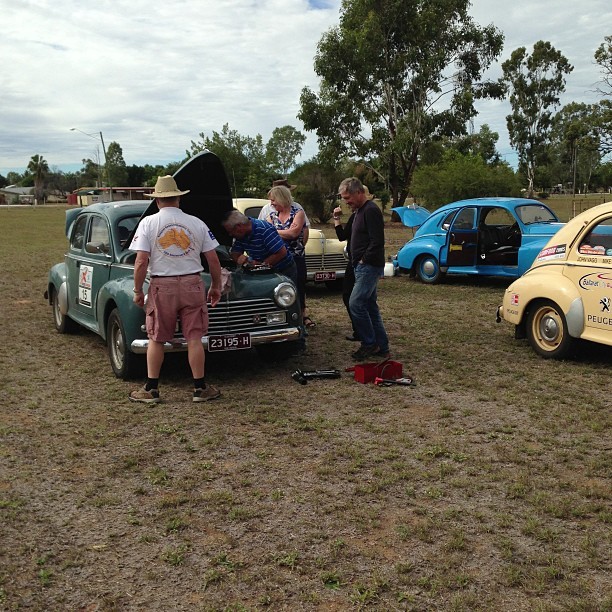
We have been able to follow the progress of this adventure through the words of friend & contributor of this site, Ian Hampton, in his The Peugeot #53 Diaries
This is a long trip in a modern car but how did the old Peugeot's handle it. From Ian's dairy we can gain the following insights of the mechanical repairs along the road.
Photos sourced from Ian Hampton
Fri May 17 - Day 4 Bundaberg
Day started just fine, although there was a rattle from the front of the engine, interpreted as a lose timing chain- rattling….. Anyhow - “not so serious” - so blast away in a north-west direction heading for Mount Morgan for lunch - 205 km…. no problem…..
SHOCKER #1 - didn’t miss a pothole on right side and immediately a squeak rattle emanating from left rear… s**t… -skilfully diagnosed at Bororen as “shot” lever arm type shock absorber by guru John Vagg… will have to disconnect the lever arm to test, and most likely replace (spares are available)… OK, not so bad….
SHOCKER #2 - gained advice at railway station lunch that adjusting loose timing chain is easy - done from the outside - don’t even have to remover fan belt…. but on the way driving WEST to Mount Morgan…. The rattle becomes more and more intrusive, and THEN there are rain drops on the windscreen on a sunny-warm day… s***t, know the signs -looks like water pump is “gone”… Not so, thermostat improperly fitted in top radiator hose has caused the fan belt to rub on and cut through the hose… But Peter (super mechanic) very unhappy with wobbly front pulley of water pump - crap not looking good… So - Peter does temporary fox including temporary fix includes removing cooling fan and tightening the front bolt on the water pump pulley and fitting old-ish replacement top radiator hose….. drive on but the front rattle sounds more and more like a death rattle… So FULL STOP… And really quick roadside replacement of dead water pump by Peter, assisted by Stephen Waddington and Josh Frttichot driving the spare parts truck

Day 6 Longreach
Brothers Boyd had solidarity and bonding session replacing busted diff in Keith’s 203 Van
Day 8 Mt Isa
Next task - needed repairs at one stage nearly every Pug along our row of cabins had body and two legs sticking out from under jacked up rear ends…. funny, quaint
Apart from car fixing and tours and looking around the town, our guys spent a great deal of time talking cars, cars, cars - lots of really knowledgeable car guys here, lots of guys who are/have worked in the business…
Day 9 Tennant Creek
Car feels strong…. Annoying rattle from right at but we know is NON structural…. Roll on MB….
Repeat again - what a great event this is…. PCCV take a bow…. The whole thing - the love of the old cars, the little bit of history, the landscapes, the places and the interest of these places, the camaraderie and fun… All priceless…. This event could not be purchased for any money and I expect is not for sale….
Day 12 - maintenance in Darwin day
We have been able to follow the progress of this adventure through the words of friend & contributor of this site, Ian Hampton, in his The Peugeot #53 Diaries
This is a long trip in a modern car but how did the old Peugeot's handle it. From Ian's dairy we can gain the following insights of the mechanical repairs along the road.
Photos sourced from Ian Hampton
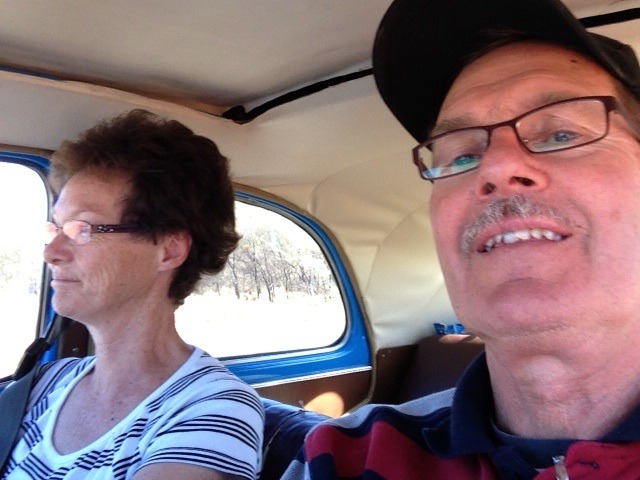
Fri May 17 - Day 4 Bundaberg
Day started just fine, although there was a rattle from the front of the engine, interpreted as a lose timing chain- rattling….. Anyhow - “not so serious” - so blast away in a north-west direction heading for Mount Morgan for lunch - 205 km…. no problem…..
SHOCKER #1 - didn’t miss a pothole on right side and immediately a squeak rattle emanating from left rear… s**t… -skilfully diagnosed at Bororen as “shot” lever arm type shock absorber by guru John Vagg… will have to disconnect the lever arm to test, and most likely replace (spares are available)… OK, not so bad….
SHOCKER #2 - gained advice at railway station lunch that adjusting loose timing chain is easy - done from the outside - don’t even have to remover fan belt…. but on the way driving WEST to Mount Morgan…. The rattle becomes more and more intrusive, and THEN there are rain drops on the windscreen on a sunny-warm day… s***t, know the signs -looks like water pump is “gone”… Not so, thermostat improperly fitted in top radiator hose has caused the fan belt to rub on and cut through the hose… But Peter (super mechanic) very unhappy with wobbly front pulley of water pump - crap not looking good… So - Peter does temporary fox including temporary fix includes removing cooling fan and tightening the front bolt on the water pump pulley and fitting old-ish replacement top radiator hose….. drive on but the front rattle sounds more and more like a death rattle… So FULL STOP… And really quick roadside replacement of dead water pump by Peter, assisted by Stephen Waddington and Josh Frttichot driving the spare parts truck
Day 6 Longreach
Brothers Boyd had solidarity and bonding session replacing busted diff in Keith’s 203 Van
Day 8 Mt Isa
Next task - needed repairs at one stage nearly every Pug along our row of cabins had body and two legs sticking out from under jacked up rear ends…. funny, quaint
Apart from car fixing and tours and looking around the town, our guys spent a great deal of time talking cars, cars, cars - lots of really knowledgeable car guys here, lots of guys who are/have worked in the business…
Day 9 Tennant Creek
Car feels strong…. Annoying rattle from right at but we know is NON structural…. Roll on MB….
Repeat again - what a great event this is…. PCCV take a bow…. The whole thing - the love of the old cars, the little bit of history, the landscapes, the places and the interest of these places, the camaraderie and fun… All priceless…. This event could not be purchased for any money and I expect is not for sale….
Day 12 - maintenance in Darwin day
Today was designated as a rest day and car maintenance day in Darwin
In the case of Maggie Bleu (MB), this turned out to be a pretty long day of toil including one really unwanted event…. Replace water pump - now for the fourth time. MB not the first or only one on this rally/tour…. Opinion is that main reason is that as many of us are running with alternators, there is extra load on the old water pump bearings leading to failures. This was pretty serious work for the apprentice mechanic now without mechanic mentor Peter D. Anyhow he got some help and completed that task along with change engine oil +filter, top up gearbox oil (200 ml), check diff oil level (no problem), and grease as many grease nipples as possible - some refusing to take-on grease. Guru opinion is that this is unlikely to be terminal…
 Day 14 Wycliffe Wells
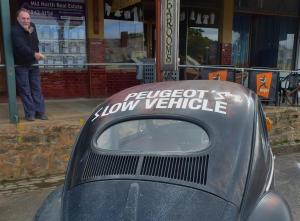
At the meeting this night - there is some talk about Rod Farrell’s “famous” 1957 VW Beetle, now adorned with a sign on the back window “Peugeot Tow Vehicle”. Most of the talk is from Rod himself.
Day 15 Alice Springs
And now we return to the Rod Farrell VW - confidently styled and labelled by its owner the previous day as the “Peugeot Tow Vehicle”…. How the mighty can “fall” - a stopped VW cannot tow the skin of a banana…. Today Rod loudly blamed some bad fuel purchased the previous day - sourced from near the bottom of the fuel storage tank…. nevertheless he had the great sense to have spare fuel filter/s…. A number of incredibly sympathetic Pug drivers stopped to offer help and sympathy :-)
Day 16 - 17 Yulara
KEEPING THE OLD CARS rolling
The organisers have provided a spare parts truck which rolls along in the midst of the cars, with just about everything once could think of, just about an engine re-build could be attempted…. There are also another 3 vehicles carrying the officials - 2 later model Pugs and a Toyota Prado which has an a-frame towing device which can be used to tow a vehicle to the next end control/overnight stop. These people are great - always with advice, really expert helping hands and spare parts as/when required…. We are also able to put some our stuff in the truck to create space/lighten the load on the old cars. Net result - lots of amazing major maintenance rebuilds and just about all the cars are still rolling…. Only one complete retirement (I think) - the John Vagg/Mike Jolley P203 with burnt out engine valves….
Maggie Bleu/Number 53 woes
There has been a rattle and some clack clack noise from the rear end of the car since “hitting” a pothole - way back in the early days of the rally. This has defied a few attempts to find what the real problem is…. Graham Wallis advised last night - he thinks is the rear end structure of the car where the shock absorbers are attached (well known weakness in the early 203s
First thing was to remove carpet from boot and find evidence of ,the crack in right rear shocker mount. Then off to Ayers Rock Automotive to line up a welding fix… back to campsite - remove the shock absorber - back to Ayers Rock automotive for a good weld along the crack, some grinding for better fit, quick spray paint job and refit the shocker
Day 21 - Mon 3 June, Barossa Valley Rest Day
BUSH MECHANICS AT WORK
Keeping these old girls rolling and powering along over 8,000 km so far has taken a fair amount of work on nearly every car…. this has been facilitated by the spare parts truck and its personnel (spare parts, tools and expert help), by Darwin Auto Club making available their excellent workshop facilities for the rest day/maintenance day in Darwin, and by people on the rally freely volunteering and providing expert advice and assistance whenever required. Some outstanding work has been done along the road, in motel and caravan park yards, and in workshops.
 Some of the outstanding mechanical repairs done so far has included:
> Keith and Geoff Boyd replacing differential in Keith’s Peugeot 203 van
» Douglas Fernie and Rowland Tidd replacing gearbox in Doug’s rally P203 in Darwin
»> Peter Nash and Phil Challinor straightening body of Peter’s “true believers” P203 with two pieces of timber and a jack after collision with kangaroo (see photograph) - OUTSTANDING
»» Geoff Boyd and Flash Flanagan replacing throw out bearing in thrust plate of the pressure plate (clutch) in Darwin (required removing the engine) of Geoff’s canary yellow (yellow peril) P203, they also replaced a fuel pump as the key part of the fix for a series of confusing and apparently serious engine problems.
»»> Dave Rowell and Suzanne Moor replacing rear horse shoe mount at the back of gear box which required removing the differential.
»»» This afternoon - Geoff Boyd and Flash Flanagan are replacing their brake booster and re-kitting a front brake calliper.
»»»> As well as the above - a number of water pumps have been replaced, including on MB on the road, in the dark by Peter Dowling with some able assistance, including by Josh from the Spare Parts Truck who also provided a decent fluorescent light to work by.
There are a lot more photos on the official site - 60th Anniversary Peugeot Redex Rerun
Look forward to Ian filling us in with more on what must have been an adventure of a lifetime
Previous related posts60th Anniversary REDEX Peugeot Rerun. - Day 1
REDEX Peugeot Rerun. - Days 6 & 7
REDEX Peugot rerun, Day 11, to Darwin
.
In the case of Maggie Bleu (MB), this turned out to be a pretty long day of toil including one really unwanted event…. Replace water pump - now for the fourth time. MB not the first or only one on this rally/tour…. Opinion is that main reason is that as many of us are running with alternators, there is extra load on the old water pump bearings leading to failures. This was pretty serious work for the apprentice mechanic now without mechanic mentor Peter D. Anyhow he got some help and completed that task along with change engine oil +filter, top up gearbox oil (200 ml), check diff oil level (no problem), and grease as many grease nipples as possible - some refusing to take-on grease. Guru opinion is that this is unlikely to be terminal…

At the meeting this night - there is some talk about Rod Farrell’s “famous” 1957 VW Beetle, now adorned with a sign on the back window “Peugeot Tow Vehicle”. Most of the talk is from Rod himself.
Day 15 Alice Springs
And now we return to the Rod Farrell VW - confidently styled and labelled by its owner the previous day as the “Peugeot Tow Vehicle”…. How the mighty can “fall” - a stopped VW cannot tow the skin of a banana…. Today Rod loudly blamed some bad fuel purchased the previous day - sourced from near the bottom of the fuel storage tank…. nevertheless he had the great sense to have spare fuel filter/s…. A number of incredibly sympathetic Pug drivers stopped to offer help and sympathy :-)
Day 16 - 17 Yulara
KEEPING THE OLD CARS rolling
The organisers have provided a spare parts truck which rolls along in the midst of the cars, with just about everything once could think of, just about an engine re-build could be attempted…. There are also another 3 vehicles carrying the officials - 2 later model Pugs and a Toyota Prado which has an a-frame towing device which can be used to tow a vehicle to the next end control/overnight stop. These people are great - always with advice, really expert helping hands and spare parts as/when required…. We are also able to put some our stuff in the truck to create space/lighten the load on the old cars. Net result - lots of amazing major maintenance rebuilds and just about all the cars are still rolling…. Only one complete retirement (I think) - the John Vagg/Mike Jolley P203 with burnt out engine valves….
Maggie Bleu/Number 53 woes
There has been a rattle and some clack clack noise from the rear end of the car since “hitting” a pothole - way back in the early days of the rally. This has defied a few attempts to find what the real problem is…. Graham Wallis advised last night - he thinks is the rear end structure of the car where the shock absorbers are attached (well known weakness in the early 203s
First thing was to remove carpet from boot and find evidence of ,the crack in right rear shocker mount. Then off to Ayers Rock Automotive to line up a welding fix… back to campsite - remove the shock absorber - back to Ayers Rock automotive for a good weld along the crack, some grinding for better fit, quick spray paint job and refit the shocker
Day 21 - Mon 3 June, Barossa Valley Rest Day
BUSH MECHANICS AT WORK
Keeping these old girls rolling and powering along over 8,000 km so far has taken a fair amount of work on nearly every car…. this has been facilitated by the spare parts truck and its personnel (spare parts, tools and expert help), by Darwin Auto Club making available their excellent workshop facilities for the rest day/maintenance day in Darwin, and by people on the rally freely volunteering and providing expert advice and assistance whenever required. Some outstanding work has been done along the road, in motel and caravan park yards, and in workshops.
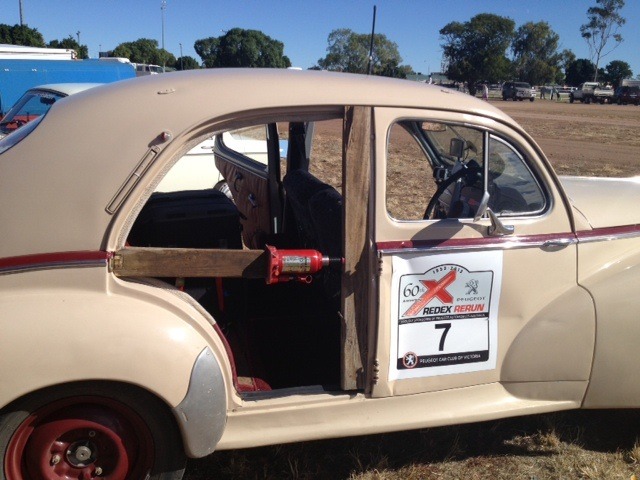 Some of the outstanding mechanical repairs done so far has included:
> Keith and Geoff Boyd replacing differential in Keith’s Peugeot 203 van
» Douglas Fernie and Rowland Tidd replacing gearbox in Doug’s rally P203 in Darwin
»> Peter Nash and Phil Challinor straightening body of Peter’s “true believers” P203 with two pieces of timber and a jack after collision with kangaroo (see photograph) - OUTSTANDING
»» Geoff Boyd and Flash Flanagan replacing throw out bearing in thrust plate of the pressure plate (clutch) in Darwin (required removing the engine) of Geoff’s canary yellow (yellow peril) P203, they also replaced a fuel pump as the key part of the fix for a series of confusing and apparently serious engine problems.
»»> Dave Rowell and Suzanne Moor replacing rear horse shoe mount at the back of gear box which required removing the differential.
»»» This afternoon - Geoff Boyd and Flash Flanagan are replacing their brake booster and re-kitting a front brake calliper.
»»»> As well as the above - a number of water pumps have been replaced, including on MB on the road, in the dark by Peter Dowling with some able assistance, including by Josh from the Spare Parts Truck who also provided a decent fluorescent light to work by.
There are a lot more photos on the official site - 60th Anniversary Peugeot Redex Rerun
Look forward to Ian filling us in with more on what must have been an adventure of a lifetime
Previous related posts60th Anniversary REDEX Peugeot Rerun. - Day 1
REDEX Peugeot Rerun. - Days 6 & 7
REDEX Peugot rerun, Day 11, to Darwin
.
Friday, 7 June 2013
Family farmers fight back
Farmers on a daily basis are the providers of welfare for the animals under their care. Their ability to provide this care and provide food for people worldwide is under constant scrutiny of radical animal rights activists with unrealistic expectations, ignorant of animal production systems and a worldview that gives animals human emotion and reasoning.
 This last week there was a significant skirmish between the farming community and Animals Australia (AA) and the supermarket giant, Coles. Farmers rightly took umbrage at Coles aligning itself with AA by contributing funding for this animals rights group that has a record of attacking family farmers.
Farmers are notorious for not working together not only between the different agricultural sectors but even within. This lack of unity has often made the farming community easy pickings by those who wish to attack them. This last week has been a lesson of what can be achieved when the farming community pulls together. It also clearly demonstrates the power of social media. It was not only those directly under attack in AA's latest campaign, the pork and poultry industries, but farmers right across all farming production system rose up and said enough is enough.
Below is a snapshot of the last week from four different sources.
The truth about Australian animal welfare by Fiona Lake
This a good article that answers well the reaction of Lyn White of AA after Coles were forced to back down . Fiona has her blog article copyright protected which means that it can't be copied and pasted to here. I encourage you to follow the link and read Fiona's article.

This last week there was a significant skirmish between the farming community and Animals Australia (AA) and the supermarket giant, Coles. Farmers rightly took umbrage at Coles aligning itself with AA by contributing funding for this animals rights group that has a record of attacking family farmers. Farmers are notorious for not working together not only between the different agricultural sectors but even within. This lack of unity has often made the farming community easy pickings by those who wish to attack them. This last week has been a lesson of what can be achieved when the farming community pulls together. It also clearly demonstrates the power of social media. It was not only those directly under attack in AA's latest campaign, the pork and poultry industries, but farmers right across all farming production system rose up and said enough is enough.
Below is a snapshot of the last week from four different sources.
Animals Australia - The Wolf Amongst the Sheep by Bess Gairns
Coles retreats at bush boycott by: SUE NEALES, Rural reporter From: The AustralianAnimals Australia has waged open and unrelenting campaigns against Australia’s agricultural sector as well as the culture and history of our rural communities.
Currently 10 of the 16 campaigns that Animals Australia are engaged in are directly aimed at Rural Australia. From the banning of culls and controls of feral animals such as foxes, cats and pigs, to the use of kangaroos for meat and hide, the use of sheep for wool, right through to their greatest conquest to date, Live Export.
So what’s the big deal? Why do farmers cry ‘wolf’ every time Animals Australia appears on 4 corners?
Most farmers would agree that Animals Australia gets up their nose for two big, undeniable reasons…
Firstly, they are a lobby group. All the funds raised by animals Australia are poured directly back into more marketing, advertising and political lobbying. Animals Australia DO NOT have a single animal shelter or refuge. They DO NOT promote education within our community or abroad, instead their funds are utilised to carry out ‘undercover’ investigations and to spread propaganda through the community. Animals Australia make no effort to work with industries or communities in advocating better animal welfare practices instead they advocate for blanket bans and legislation changes directly to government, whilst louering the wider community along with them.
Secondly, their vegetarian/vegan agenda. Farmers, like all Australians, believe in a person’s right to choose vegetarianism, but they are trying to fight a battle against a group that wants Australian’s to lose their right to CHOOSE to be omnivorous. Animals Australia is admittedly one of the biggest proponents of veganism in this country. They have their own vegetarian website www.whyveg.com that asks all of us to ‘Pledge to go Veg’ and this is where the real agenda behind the vendetta becomes blaringly obvious. Animals Australia don’t lobby for change in agriculture because they aim for better welfare, they do it because their long term goal is to force the hand of government to phase out animal farming for the uses of meat, dairy and bi-products. They are every bit the wolf that farmers see them for, despite wearing grannies nightgown.
COLES is expected today to deliver farmers their first victory in their battle with the supermarket giants, pulling from sale shopping bags supporting Animals Australia.
Angry beef and fat lamb producers yesterday called for a mass boycott of Coles supermarkets because of their partnership with the animal rights group, saying the retail giant was deeply "anti-farming".
Sheep producers who supply Coles with thousands of lambs a year yesterday announced a blackban on sales to the chain. The moves follow outrage within farming circles at the decision to sell the Animals Australia bags at 500 of its stores this month.
Queensland cattleman Stuart Ogg said he was appalled at Coles's misjudgment and would make sure none of his Brahman-cross cattle ended up as prime beef steaks in its stores. "Coles always seem to be looking for a point of difference or a cheap publicity stunt and don't care who they hurt in the process," the Carnarvon Gorge grazier said. "We have a very solid and sustainable industry; Coles siding with Animals Australia is a slap in the face for industry -- it's like them saying they don't think we are producing our meat properly."One of NSW's biggest prime-lamb producers, Andrew Freshwater, announced he would be halting the supply of thousands of lambs a year to Coles until it reversed its stance.Mr Freshwater said five other suppliers -- all the major producers in the eastern states -- were backing his stance, while other farmers intended to stop buying fertiliser and insurance from Wesfarmers. "I've had a gutful; (it's time) to make Coles sit up and take notice," he said.NFF chief executive Matt Linnegar said Coles could not have it both ways -- it could not claim to be the best friend of farmers and a strong supporter of homegrown produce while supporting Animals Australia and its extremist anti-farming campaigns.
The truth about Australian animal welfare by Fiona Lake
This a good article that answers well the reaction of Lyn White of AA after Coles were forced to back down . Fiona has her blog article copyright protected which means that it can't be copied and pasted to here. I encourage you to follow the link and read Fiona's article.
If farmers fold by Glenda Grey
Wednesday, 5 June 2013
Fishers 'lucky to have survived toxic algae'
(Second in a series on evidence to a Senate select committee as published in the Queensland Telegraph
http://www.queenslandtelegraph.com/bacterial-infection-linked-to-dredging/
 Looking up Gladstone Harbour towards The Narrows with Curtis Island towards the top of picture.

By John Mikkelsen
EVIDENCE that two Gladstone fishers were lucky
to have survived an encounter with toxic algae, was presented to a Senate
committee hearing into a proposed new bill to halt development in environmentally sensitive Reef
waters.
Serious
health concerns had coincided with the outbreak of disease in fish and
other marine life claimed to be associated with the massive dredging project in
Gladstone Harbour, the committee heard.
The Telegraph last week reported the Environment
and Communications Legislation Committee had been told of a ‘cluster’ of rare bacterial infections, by environmental medicine specialist Dr Andrew
Jeremijenko.
Evidence was given later of other fishermen who
were hospitalized, “two by ambulance,on morphine drips, who were lucky to have
survived”.
Replying to a question from committee chair,
Sen Doug Cameron, aquatic disease vetinarian Dr Matt Landos, said he was aware
of the shewanella bacteria referred to previously by Dr Jeremijenko. He said
there were two human health concerns that had arisen from the harbour
development process.
“ Around 50 people became ill in a very short
time which coincided with all the animals in the harbour becoming ill and
dying.
“There were two things that happened. They
started dredging without any
sediment control before re-suspension. It is
possible, when you dredge, to minimise how far all of that sediment that you
stir up goes. It is like putting a blender into the bottom, and you can either
put a net around your blender and hold all the suspended sediment in, or you
can just let it run with the tide.
“In Gladstone, they just let it run with the
tide. Unfortunately, the tides are four metres and they run at four or five
knots. So the satellite images show we have a 34 kilometre dredge plume of
uncontrolled, re-suspended, toxic sediment going throughout the harbour.
“Harbour sediments contain nutrient, so what we
have done is fertilise the harbour.” This generated more bacteria and toxic
algal blooms. The toxic algal bloom appeared to have been the reason why the
harbour was shut to all fishing at that time.
“Several of the fishermen were hospitalised
and, as a result of the advice I gave them, through to their GP, they
identified that algal toxins were being inhaled off their nets.
“Two of those people had to be immediately
taken to hospital by ambulance on morphine drips and are lucky to have
survived.
“The reason the algal bloom happened was not
natural. It was driven by the increased flux of nutrient from uncontrolled
re-suspension. It was not just chance that it happened when it did.
“It also drove these infections with Shewanella
that Andrew
Jeremijenko spoke about.
“Some of those people are still sick and have
lost the use of limbs as a result of these
infections,” Dr Landos said.
Sen Cameron:
“Are you aware of any action by the Queensland health authorities on
this?
Dr Landos:
“No, their action has been largely to suggest that there is no problem
with eating the fish, there is no
problem with eating the crabs and the water is fine. They have supported, with
Gladstone Ports Corporation, sponsoring a $1.2 million media program locally to
say, 'The water's fine, go out and use the harbour; everything's
great.'
He said the idea that all the problems were
caused by a flood was “somewhat fanciful”.
The problem with approval of projects like
Gladstone’s and other ports
projects now in the pipeline, was that there were ‘multiple beneficiaries’
including government.
“With the government then managing the project,
we have an issue with the independence of management; and, with the proponent
running the science program, we have an issue with the management of the
science,” Dr Landos said.


A four metre tiger shark washed up on Tannum Beach, January 2011. Dredging started in September- October 2010.
Tuesday, 4 June 2013
Locking out fishing industry
This is occurring today 4th June, 2013.
Minister Tony Burke, Minister for the Environment in the worst Federal Government we have ever known, is trying to push through the locking up more of the waters around Australia to the fishing industry in parliament today.
This is to please the green lobbyists all around the world. I heard on radio that there were so many thousands of people who took part in the consultation process. Most of those names when I saw them months ago were from people on the other side of the world who obviously only have their green ideologies uppermost in their minds and do not care what they do to people who are actually living in the areas around our coastline. Most of them probably do not even know where Australia is.
The current group of Ministers of this Labor minority government (supported by the Independents) is trying to do as much damage to Australia before they get kicked out as they can.
This will be another nail in Australia's coffin if someone cannot stop the rot.
Please listen to this video.
http://www.youtube.com/watch?feature=player_detailpage&v=9W_wpvwhP38
Warning video does contain some political campaign footage
Bev Prescott
Minister Tony Burke, Minister for the Environment in the worst Federal Government we have ever known, is trying to push through the locking up more of the waters around Australia to the fishing industry in parliament today.
This is to please the green lobbyists all around the world. I heard on radio that there were so many thousands of people who took part in the consultation process. Most of those names when I saw them months ago were from people on the other side of the world who obviously only have their green ideologies uppermost in their minds and do not care what they do to people who are actually living in the areas around our coastline. Most of them probably do not even know where Australia is.
The current group of Ministers of this Labor minority government (supported by the Independents) is trying to do as much damage to Australia before they get kicked out as they can.
This will be another nail in Australia's coffin if someone cannot stop the rot.
Please listen to this video.
http://www.youtube.com/watch?feature=player_detailpage&v=9W_wpvwhP38
Warning video does contain some political campaign footage
Bev Prescott
Subscribe to:
Posts (Atom)