Showing posts with label IPCC. Show all posts

Wednesday, 11 June 2014

Cooling Temperature Trend Establishing Across Northeastern Australia


Reblogged (with permission) fromJennifer Marohasy.com

The Hon Greg Hunt MP,
Minister for the Environment.
Dear Minister Hunt,
I wrote to you on 4th March 2014 with concerns that the claims made by the Bureau of Meteorology that 2013 was Australia’s hottest year on record, are somewhat deceptive. In that letter I explained that the official temperature record has been truncated to begin in 1910 (thereby excluding the hot years of the Federation drought) and that the method used to calculate the annual average temperature for Australia is not transparent.
I’ve since come to understand that the annual average temperature for 2013, which the Bureau claimed was a record, is in fact a wholly contrived valued based on modeling of temperatures, rather than the averaging of actual recorded values. That is, careful scrutiny of the Bureau’s methodology shows that recorded temperatures at locations across Australia are submitted to a two-step homogenization process that can have the effect of changing the entire temperature trend at specific locations. A weighted mean of these ‘homogenized’ values is then used in the calculation of the Australian annual mean temperature. In turn, the ‘homogenized’ values are used by the Intergovernmental Panel on Climate Change (IPCC), which gives advice back to the Australian government on global and Australian temperature trends.
A problem with this approach is that it can deliver an impression of climate change which accords wholly with expectations. But, it is reality that Australians should be planning for, so it would be better if the Bureau used real data, rather than modeled output when reporting temperature trends. Indeed to quote Aldous Huxley, ‘Facts don’t cease to exist because they are ignored.’
At the invitation of the Sydney Institute, I will be giving a talk on 25th June 2014, that shows the detail of how this methodology is applied, using the locations of Bourke in western NSW and Amberley in Queensland as case studies. I encourage attendance from the Bureau to scrutinize my presentation for accuracy. Indeed, all Australians should have a clear understanding of the nature of the data used in the calculation of important and highly publicized temperature statistics. All Australians should also have access to a realistic assessment of current temperature trends.
Very recently it was brought to my attention that Graham Williamson wrote to Rob Vertessy, Director of Meteorology at the Bureau, also querying the claimed increase in temperatures. Mr Williamson, in his letter of 27th May 2014, specifically asked why the Bureau of Meteorology did not acknowledge the 15-year hiatus in global warming as detailed in the recent report from the Intergovernmental Panel on Climate Change (IPCC, Chapter 10, AR5). In reply to Mr Williamson, Neil Plummer from the Bureau has suggested that the IPCC is simply referring to a slow down in the rate of global warming, rather than a pause as such. Given the IPCC reports are based on temperature trends derived from ‘homogenized’ data, rather than real observational records, I am concerned that they may also not be giving a true picture of recent climate change. To reiterate, even the IPCC is using modeled output rather than real data.
As part of ongoing research into natural rainfall patterns in Queensland, Professor John Abbot and I have been studying the temperature record for northeastern Australia, as temperature is a key input variable in our neural network models (e.g. Abbot and Marohasy 2014). Considering the data from the late 1800s until 1960, a cooling trend is evident, followed by warming between 1960 and 2001. In contrast, the last 12 years show quite dramatic cooling, Table 1. All three periods have occurred while greenhouse gases, particularly carbon dioxide, have been increasing in concentration in the atmosphere.
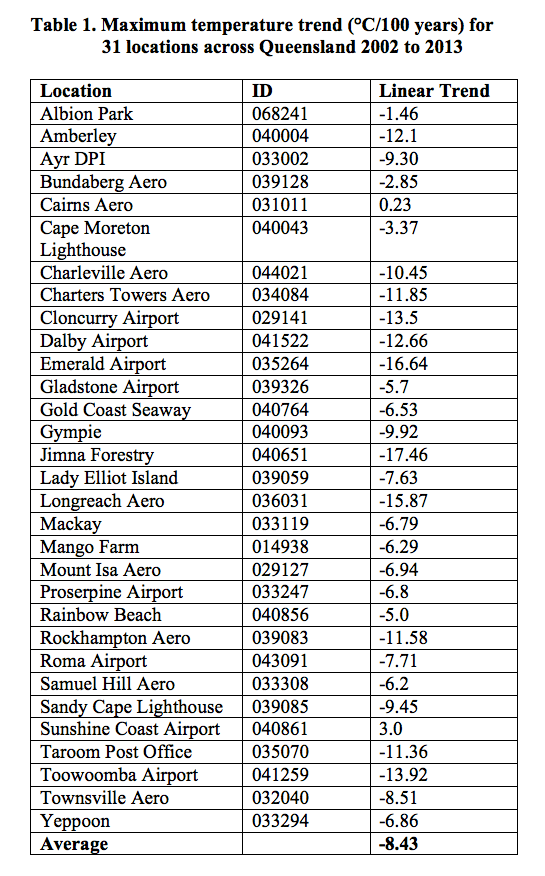
temps
Our analysis of the maximum temperature trend for the years 2002 to 2013 is based, not on the modeled temperature values used to generate official temperature statistics, but on the unadjusted observed temperatures also available from the Bureau of Meteorology website. The thirty-one sites across Queensland were chosen on the basis that there is a continual temperature record for the period 2002 to 2013 at each of the locations. We choose 2002 as the start date, as the data suggests a change in trend at about this year from warming to cooling. This is consistent with published studies by astrophysicists and physicists (e.g. Nicola Scafetta 2010, Abdussamatov 2012, and Lu 2013) and closely follows the timing of the last solar maximum (eg. NASA update 02/05/2014,http://solarscience.msfc.nasa.gov/predict.shtml). While Table 1 is limited to Queensland, preliminary assessment of data from NSW, Victoria and the Northern Territory also suggests the onset of a cooling trend.
This information is in stark contrast to the information in the State of the Climate Report 2014 recently published by the Bureau and also CSIRO. The report states that “warming over Australia has been consistent” and temperatures are “projected to continue to increase, with more hot days and fewer extremely cool days.”
In order to reconcile the information in Table 1, with the claims in the State of the Climate Report 2014, it is important to realize that, like the calculation of the annual mean temperature for Australia, data present in the report is based wholly on modeled output. That is observed temperature values have been first passed through a two-step homogenization process involving the application of complex mathematical algorithms.
It is important to make a distinction between output from a computer model and real data. In his bookScience and Public Policy: The virtuous corruption of virtual environmental science Aynsley Kellow, Professor and Head of the School of Government at the University of Tasmania, shows through many examples, including from climate science, how a reliance on computer models over the last 30 years as well as the infusion of values, has produced a preference for virtual over observational data. But the Australian public and Australian industry deserve much better from the Bureau.
As an Australian scientist with a keen interest in public policy and temperature records, I ask you as the Minister ultimately responsible for the activities of the Australian Bureau of Meteorology, to consider how you might reconcile increasing atmospheric concentrations of carbon dioxide with a falling temperature trend, and what needs to be done if we are to adequately prepare as a nation for the possible onset of a period of sustained cooling.
Yours sincerely
Dr Jennifer Marohasy
Adjunct Research Fellow
Central Queensland University
Links/References
Letter from Jennifer Marohasy to Minister Greg Hunt, 4th March 2014
http://jennifermarohasy.com/questions-for-the-australian-bureau-of-meteorology/
John Abbot and Jennifer Marohasy, 2014. Input Selection and optimization for monthly rainfall forecasting in Queensland, Australia, using artificial neural networks, Atmospheric Research, Volume 138, Pages 166-178.
Nicola Scafetta, 2010. Empirical evidence for a celestial origin of the climate oscillations and its implications, Journal of Atmospheric and Solar-Terrestrial Physics, Volume 72, Pages 951-970.
Habibullo I. Abdussamatov, 2012. Bicentennial decrease of the total solar irradiance leads to unbalanced thermal budget of the Earth and the Little Ice Age, Applied Physics Research, Volume 4. DOI: 10.5539/apr.v4n1p178
Qing-Bu Lu, 2013. Cosmic-ray driven reaction and greenhouse effect of halogenated molecules: culprits for atmospheric ozone depletion and global climate change, International Journal of Modern Physics B, Volume 27, DOI: 10.1142/S0217979213500732

Tuesday, 25 June 2013

Important Advance in Climate Science Teaching

Executive Director  of the International Climate Science Coalition has issued this press release:


ICSC ANNOUNCES IMPORTANT ADVANCE IN CLIMATE SCIENCE TEACHING FOR MIDDLE AND HIGH SCHOOLS

Teaching students how science works in the real world and how to come to their own evidence-based conclusions is more important than telling them who is right in controversial fields such as climate change 


Ottawa, Canada, June 24, 2013:  "As the ‘official science’ of the United Nations Intergovernmental Panel on Climate Change (IPCC) falls into disrepute, educators face an increasingly difficult decision when teaching climate science in middle and high schools," said Tom Harris, executive director of the Ottawa-based International Climate Science Coalition (ICSC).
"Should they act as if the science of climate change were somehow ‘settled’, as asserted by activists, and so create lesson plans based solely on IPCC material approved by school boards and provincial and state governments? Or should they also expose students to the politically incorrect but important perspectives of leading experts who conclude that climate change is mostly due to natural variability?"

ICSC Chief Science Advisor Professor Bob Carter, of James Cook University in Australia explains:
"There is now a third option, one that allows teachers to remain true to their profession, while also avoiding conflict with those to whom they report. Using ICSC lesson plans, educators can help students understand how science really works in a complex and rapidly evolving field, allowing them to discover for themselves that, at the frontier, science is a body of debate, not a body of established facts."
"The ICSC lesson plan guides young people to see critical thinking in action, driving the controversy in scientifically healthy ways, as competing hypotheses are proposed, criticized, and defended, according to the principles of the scientific method," said Professor Carter. "Throughout the lessons, teachers will guide students to think critically, to ask difficult questions, and seek answers to those questions. Students will learn to think, explore, and research."

Tom Harris gives some background: "ICSC’s lesson plans are being prepared in collaboration with top American education researchers following the Virginia Department of Education Standards of Learning that "the teaching puts the emphasis on the student seeking answers for themselves and helps them become creative problem solvers."

ICSC’s first climate science lesson plan is now complete and ready for use by middle school and high school science teachers at: http://tinyurl.com/lkm3h3a . Feedback from educators, students, administrators, scientists, and parents is most welcome. Teachers are invited to contact ICSC if they would like to be put on the distribution list for the rest of the lesson plans in the series as they are completed.

Educators and climate scientists have reviewed ICSC’s teaching strategy and our first lesson plan.

Here are samples of their comments:

Alex Harris, teacher—Science Department, Fellowes High School, Pembroke, Ontario, Canada:
"Students are introduced to an evolving body of scholarly research that seeks to broaden their understanding of debate amongst experts, the role of empirical research in achieving scientific consensus, and healthy skepticism; all are invaluable components of the process of scientific inquiry. Students are asked to question and reflect upon their personal beliefs and evidence used in establishing those beliefs. The materials used in the lesson are designed to stimulate the students' own thought processes and foster an appreciation for the process of scientific inquiry. This lesson is easy to implement and would be appropriate for learners in middle school through junior high school. Educators, exercise caution - this activity is sure to generate a lot of questions from curious minds!"

Lee C. Gerhard, PhD, Senior Scientist Emeritus, University of Kansas, past director and state geologist, Kansas Geological Survey, U.S.A.:
Encouraging students to challenge science-based "beliefs" by studying the actual debates among the experts is an excellent way to approach critical pathway thinking. Helping students develop analytical skills can be extremely helpful to them in their future endeavors, and to be educated voters. We live in a highly schooled but poorly educated society, where beliefs outweigh data. This lesson plan will help address that problem." 

Tad Murty, PhD, Professor, University of Ottawa, Previously Senior Research Scientist for Fisheries and Oceans Canada and former director of Australia's National Tidal Facility and professor of earth sciences, Flinders University, Adelaide, Ottawa, Canada:
Any course that challenges the students to think critically and use their own observational power to make deductions is extremely important because it provides opportunities for their mental development. With climate change being among the contemporary topics of global interest, this course is very timely.”

Don J. Easterbrook, PhD, Emeritus Professor of Geology, Western Washington University, Bellingham, Washington, U.S.A.:
“The new ICSC lesson plan for middle and high schools is an excellent approach to teach students how to acquire data on their own and use it to come to their own conclusions.  It thus teaches them not only the facts about certain topics but shows them a methodology that can be used for other topics.” 


Ross Hays, Meteorologist, NASA Columbia Scientific Balloon Facility, Palestine, Texas, U.S.A.:
"This looks like a great program that will let the students use their minds and make decisions of what seems to be the most logical theory on climate change as the planet continues to cycle between ice ages and warm periods with man’s written history minute compared to these time lines of climatology."

Brian Pratt, PhD, Professor of Geology (Sedimentology and Paleontology), University of Saskatchewan, Saskatoon, Saskatchewan, Canada
"It is apparent to all educators, be it in music or science or literature, that once the student has been provided with background and given guidance, students learn the most by exploring a subject for themselves. This way, students are able to discover the essence of a subject and its relationship to others, and by doing so learn how to ask questions that will lead to insight and advances. This kind of approach, challenging as it is, helps induce intellectual rigour, and enables students to understand what scholarship is all about.”

Taxing Air

Taxing Air

Taxing air 
Facts and fallacies about climate change
ISBN: 9780646902180                                                                                               by Bob Carter & John Spooner 
Full colour paperback, 288 pp                                                                                                      with Bill Kininmonth, Martin Feil, 
Distributed by Dennis Jones                                                                                                         Stewart Franks, Bryan Leyland
RRP: $30.00
Pub date: 1 July 2013

In this accessible and beautifully produced full colour book The Age's brilliant political cartoonist John Spooner and leading environmental scientist Professor Bob Carter combine with colleagues to answer a series of critical and highly controversial questions about the politics and science of climate change.

Are human industrial carbon dioxide emissions causing dangerous global warming? If so, then climate change would indeed represent one of the great moral challenges of our time.

But is it possible that instead the so-called consensus science around global warming - produced by lavishly funded research institutes, and with its own international political lobby organization, the United Nations Intergovernmental Panel on Climate Change (IPCC) - is wrong?

Could it be that the emperor has no clothes?


Accessible, clearly written and illustrated with simple scientifc illustrations, and accompanied by Spooner's wry and telling cartoons, Taxing Air answers — without the spin, evasions or propaganda that pollutes most offcial writing on climate change — every question you have about global warming but have been too intimidated by the oppressive ‘consensus’ to ask.


All you ever wanted to know about the
science and politics of global warming but were afraid to ask.


'I could not put Taxing Air down ... Responding to vested interests, western politicians have already wasted trillions of dollars to frighten people with lies about industrial carbon dioxide emissions.
In fact, today’s global temperature lies well within life’s limits – indeed, the present-day is cooler than much of previous geological time.The gas of life rather than a pollutant, atmospheric carbon dioxide has nurtured all the forms of organism on planet Earth for many hundreds of mil- lions of years, as is so clearly explained in this beautifully written and illustrated book.'
Professor David Bellamy, OBE, President, Conservation Foundation, UK; 
Trustee, World Land Trust (1992-2002)
'Taxing Air is an outstanding contribution to the growing literature that examines and calls to account the climate alarmism of the past two decades. ... it provides an accurate, easily understood explanation of the many scientific and technical issues that comprise today’s climate science.
Equally important, it examines the history and exposes the duplicity of some of the individuals and organisations who have vested interests in creating and maintaining horrific visions of an imagined global warming future. The book would make a splendid gift to certain members of the climate science establishment.'
Dr. Art Raiche, CSIRO chief research scientist (retired)

To request a review copy or arrange an interview with Bob Carter or John Spooner, please contact: (03) 9036 6390 or Robert at rmasters@robertmasters.com.au.


DID YOU KNOW?

Just 8,000 years ago, there was virtually 
no summer sea-ice in the Arctic Ocean

Sea-level rise is natural, and declining in rate 

Australian rainfall has not decreased over the last 100 years 

A previous Australian drought lasted 69 years

By catchment management, the Murray-Darling Basin now 
contains almost 3 times as much water as it held naturally

Global air temperature has not increased for the last 16 years, despite an 8% increase in CO2
Global ocean temperature is also steady or cooling slightly


Australian territory absorbs up to
20 times the amount of CO2 that we emit


The CO2 tax will cost about $1,000/person/year; and rising

The result of reducing Australian CO2 emissions by 5% 
by 2020 will be a theoretical (and unmeasurable) 
cooling of between 0.0007O and 0.00007O C by 2100

No scientist can tell you whether the world will be 
warmer or cooler than today in 2020

Just a selection of the fascinating facts provided in answer to more 
than 100 basic questions about global warming and climate change 
that are covered in the book.


Persons ordering prior to that date at www.taxingair.com
and prior to bookstore availability, will receive a 
personally signed copy of the book

Sunday, 12 May 2013

50 to 1 project: The true cost of 'action' on climate change.

50-to-1 has the potential to shift the climate debate for good!


Watch the video below to see how, or read on!

What if we could show you that trying to 'stop' climate change is 50 times more expensive than adapting to it?  And what if we could prove it using numbers and formulas accepted by the IPCC, CRU and other 'consensus' bodies?  Well that's exactly what 50-to-1 does.

The original calculations were done by Lord Christopher Monckton who has since presented his conclusions to audiences of scientists, economists and mathematicians all over the world.  You can see the calculations and a FULL LIST OF SOURCES here: 50 to 1 calculations and sources


To read more or donate, go to http://www.indiegogo.com/projects/50-to-1-project-the-true-cost-of-action-on-climate-change


From Gordon Alderson - Member of the NO CARBON TAX Climate Sceptics Management Committee:

My name is Gordon Alderson. As a Member of the Management Committee I am sending you this email on behalf of the No Carbon Tax Climate Sceptics party.

I am assisting Topher Field, an Australian film maker and activist, and Lord Christopher Monckton on a project called '50 to 1'.

It's all about the TRUE cost of trying to 'stop' climate change vs the cost of adapting to climate change as and if it happens.

I think it may be of interest to you.  

We are running a crowdfunding campaign to try and raise the required budget to make the project a reality.  We would be extremely grateful for your financial support and for any publicity, blogging, emailing of contacts etc which you could do so that the word gets out about the 50-to-1 Project.

Account details for donors willing for their support to be immediately available for the Project are:

ACCOUNT NAME: Lord Monckton Foundation

BSB: 083004

ACCOUNT: 125962000

REFERENCE:  50to1[Donor Name]

Please have a look at the link and do with it as you see fit.

Best Regards

Gordon Alderson 

Tuesday, 27 November 2012

The Real Climate

THE REAL CLIMATE

 NZCLIMATE TRUTH NEWSLETTER NO 301
by Dr Vincent Gray
 

NOVEMBER 22ND 2012

THE REAL CLIMATE

In several recent newsletters I have attacked the plausibility of the basic climate model promoted by the Intergovernmental Panel on Climate Change (IPCC.)

Its assumptions include the following:
  • The Earth is flat;
  • The sun shines all day and all night with equal intensity;
  • Energy interchange in the climate is almost entirely by radiation;
  • Energy flow parameters are constants with no variability;
  • Energy flow is "balanced" with input equal to output;
  • Change in this system is entirely caused by increasing human-induced trace gases in the atmosphere.

These assumptions are completely at odds with meteorological science.......

Read more HERE