Showing posts with label Jennifer Marohasy. Show all posts

Saturday, 13 December 2014

Tragedies under Kyoto 1 will be echoed under proposed Kyoto 2.

Republished from Australian Climate Sceptics blog (LINK)

But the Abbott Government is also in the middle of a new controversy at the Lima conference over the way Australia's emissions target will be calculated under the second commitment period of the Kyoto Protocol, the current global climate agreement, due to expire in 2020 and replaced by any new deal signed in Paris next year. 
With apologies to John Spooner.
Australia is seeking to use favourable rules around land clearing - originally agreed to under Kyoto in 1997 to establish an earlier target - in calculating its promised cut for 2020 under the protocol's second stage. 
If Australia is not allowed to include land use emissions to calculate its target it is estimated that it will increase the national 2020 goal by between 40 to 80 million tonnes of carbon emissions or up to 2.5 per cent. 
Australia is threatening that it will not ratify Kyoto again if it does not get its way on targets, and has won support from major developed nations and also Brazil. (bold added)
In 1998, under the Howard Government, the Science, Technology, Environment and Resources Group issued Current Issues Brief 10 (link) contained inter alia:

Allowance for emission reductions from land use changes was permitted in the base year in the Kyoto Protocol. Thus, reductions in greenhouse gas emissions from declining rates of land clearing or forestry can be used to meet target commitments. Similarly, removals of carbon dioxide from the atmosphere by absorption into biological systems can be used. These removals of carbon dioxide, for example the planting of forests, are referred to as 'sinks'. 
Ian Hampton writes of Australia's actions in Lima:
This is a carbon copy of the tactics adopted by the then Howard Government in the lead up to the 1997 Kyoto Protocol agreement. Australia's "success" in getting the "Australia Clause" in the Kyoto Protocol led directly to the Howard Government "engineering" the much more restrictive 2003 NSW Native Vegetation Legislation and similar legislation in Queensland.
Why Tony Abbott would pander to the loony lefties who read the SMH and watch "our" ABC is a mystery. Turning his back on the people who voted for him and bowing to  people who will never vote for him seems a suicide move.

SO, how did the Kyoto 1 Land Use Protocol work out for Australian Land holders. Let's look at two examples:
  • Farmer tried to work with the Land Use Protocol;
  • Farmer lost farm due to the Land Use Protocol. 

Farmer tried to work with the Land Use Protocol


Cate speaking to ABC radio May 20, 2014, about how carbon farming is a “good business strategy” at http://www.abc.net.au/news/2014-05-20/mount-morris-cate-stuart/5465060 . But the banks, for good reason, thought otherwise.
Cate Stuart among the mulga trees the Stuarts have used to create a
carbon-storage scheme with the help of Australian Carbon Traders.
Picture: Lyndon Mechielsen
 Source: News Corp Australia

Mark and Cate Stuart tried to work within the system and create a carbon sink. The sink was supposed to create income of $400,000 every 3 years. (link)
Cate and Mark Stuart will be evicted from their historic Charleville cattle station, Mount Morris, on Thursday after rural lender Rabobank last year called in the receivers Ferrier Hodgson to ­recoup an outstanding debt of $2.6 million. 
The Stuarts are heartbroken. But the tough outback family, which has run the 20,000ha far-west Queensland spread for the past six years, isn’t going without a fight. A very modern fight. 
They say the bank has failed to recognise their wild and sprawling home is more than just a cattle farm: it is a carbon bank. 
For the past four years, the ­Stuarts have worked with thespecialist carbon farming company Australian Carbon Traders to capture and store carbon on 5000ha of their mulga tree ­reserves. 
They planned to earn up to $400,000 every three years in valuable carbon credit payments.
Mt Morris is now for sale - See LINK.  The Stuarts have lost everything.

Cate has been featured before on the Australian Climate Sceptics blog, during the Convoy of No Confidence: LINK
Cate is now known as "Convoy Cate from Charleville." Listen to Cate on ABC's Counterpoint HERE.

Farmer lost farm due to the Land Use Protocol 


Readers of these pages should be aware of Peter Spencer: Our friend, Joanne Nova, has written a magnificent summary HERE
Peter Spencer’s story is one I didn’t think could happen in Australia. He is the farmer in New South Wales who bought a farm and then lost 80% of it when rules changed to stop people clearing native vegetation. Unable to use most of his property, he was slowly bankrupted. Though he broke no law, he lost his life’s work and his beloved farm in late 2010. There was no way out. He couldn’t sell the property — who would buy a piece of land that could not be used? Farmers all around Australia lost billions of dollars in assets as the value of their land and produce declined. 
It is this legislation and the resulting theft of the stored carbon in the resulting trees by the Commonwealth (enabling Australia to meet its Kyoto commitments) that is at the root of Peter Spencer's case against the Commonwealth and NSW. (link)

Read the trial notes in  "Peter Spencer: Court diary"

These are just two stories (from both sides of the boundary fence) of the myriad tragedies caused by Land Use Protocol under the original Kyoto Protocol.

Now, landholders (and all Australians)  should gear up for more tragedies IF the Abbott Government gets acceptance of their new Land Use Protocol.

Wednesday, 11 June 2014

Cooling Temperature Trend Establishing Across Northeastern Australia


Reblogged (with permission) fromJennifer Marohasy.com

The Hon Greg Hunt MP,
Minister for the Environment.
Dear Minister Hunt,
I wrote to you on 4th March 2014 with concerns that the claims made by the Bureau of Meteorology that 2013 was Australia’s hottest year on record, are somewhat deceptive. In that letter I explained that the official temperature record has been truncated to begin in 1910 (thereby excluding the hot years of the Federation drought) and that the method used to calculate the annual average temperature for Australia is not transparent.
I’ve since come to understand that the annual average temperature for 2013, which the Bureau claimed was a record, is in fact a wholly contrived valued based on modeling of temperatures, rather than the averaging of actual recorded values. That is, careful scrutiny of the Bureau’s methodology shows that recorded temperatures at locations across Australia are submitted to a two-step homogenization process that can have the effect of changing the entire temperature trend at specific locations. A weighted mean of these ‘homogenized’ values is then used in the calculation of the Australian annual mean temperature. In turn, the ‘homogenized’ values are used by the Intergovernmental Panel on Climate Change (IPCC), which gives advice back to the Australian government on global and Australian temperature trends.
A problem with this approach is that it can deliver an impression of climate change which accords wholly with expectations. But, it is reality that Australians should be planning for, so it would be better if the Bureau used real data, rather than modeled output when reporting temperature trends. Indeed to quote Aldous Huxley, ‘Facts don’t cease to exist because they are ignored.’
At the invitation of the Sydney Institute, I will be giving a talk on 25th June 2014, that shows the detail of how this methodology is applied, using the locations of Bourke in western NSW and Amberley in Queensland as case studies. I encourage attendance from the Bureau to scrutinize my presentation for accuracy. Indeed, all Australians should have a clear understanding of the nature of the data used in the calculation of important and highly publicized temperature statistics. All Australians should also have access to a realistic assessment of current temperature trends.
Very recently it was brought to my attention that Graham Williamson wrote to Rob Vertessy, Director of Meteorology at the Bureau, also querying the claimed increase in temperatures. Mr Williamson, in his letter of 27th May 2014, specifically asked why the Bureau of Meteorology did not acknowledge the 15-year hiatus in global warming as detailed in the recent report from the Intergovernmental Panel on Climate Change (IPCC, Chapter 10, AR5). In reply to Mr Williamson, Neil Plummer from the Bureau has suggested that the IPCC is simply referring to a slow down in the rate of global warming, rather than a pause as such. Given the IPCC reports are based on temperature trends derived from ‘homogenized’ data, rather than real observational records, I am concerned that they may also not be giving a true picture of recent climate change. To reiterate, even the IPCC is using modeled output rather than real data.
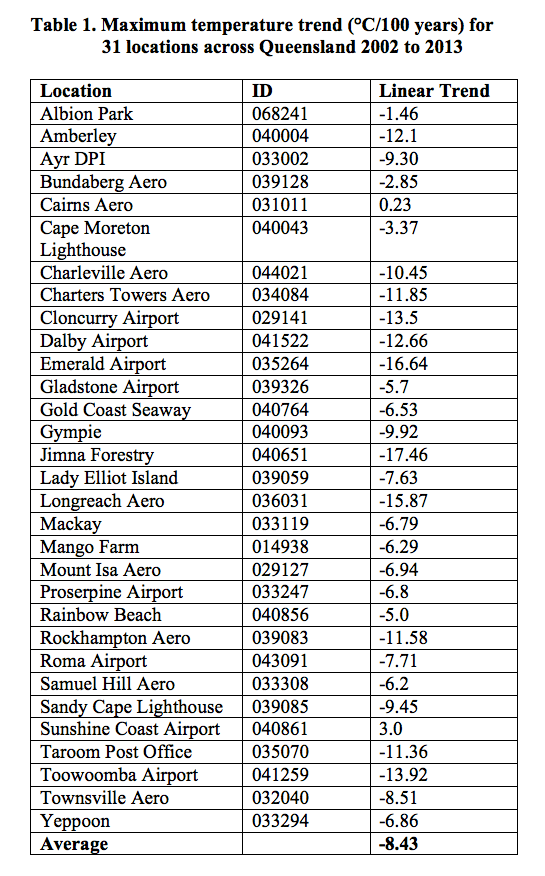
As part of ongoing research into natural rainfall patterns in Queensland, Professor John Abbot and I have been studying the temperature record for northeastern Australia, as temperature is a key input variable in our neural network models (e.g. Abbot and Marohasy 2014). Considering the data from the late 1800s until 1960, a cooling trend is evident, followed by warming between 1960 and 2001. In contrast, the last 12 years show quite dramatic cooling, Table 1. All three periods have occurred while greenhouse gases, particularly carbon dioxide, have been increasing in concentration in the atmosphere.
temps
Our analysis of the maximum temperature trend for the years 2002 to 2013 is based, not on the modeled temperature values used to generate official temperature statistics, but on the unadjusted observed temperatures also available from the Bureau of Meteorology website. The thirty-one sites across Queensland were chosen on the basis that there is a continual temperature record for the period 2002 to 2013 at each of the locations. We choose 2002 as the start date, as the data suggests a change in trend at about this year from warming to cooling. This is consistent with published studies by astrophysicists and physicists (e.g. Nicola Scafetta 2010, Abdussamatov 2012, and Lu 2013) and closely follows the timing of the last solar maximum (eg. NASA update 02/05/2014,http://solarscience.msfc.nasa.gov/predict.shtml). While Table 1 is limited to Queensland, preliminary assessment of data from NSW, Victoria and the Northern Territory also suggests the onset of a cooling trend.
This information is in stark contrast to the information in the State of the Climate Report 2014 recently published by the Bureau and also CSIRO. The report states that “warming over Australia has been consistent” and temperatures are “projected to continue to increase, with more hot days and fewer extremely cool days.”
In order to reconcile the information in Table 1, with the claims in the State of the Climate Report 2014, it is important to realize that, like the calculation of the annual mean temperature for Australia, data present in the report is based wholly on modeled output. That is observed temperature values have been first passed through a two-step homogenization process involving the application of complex mathematical algorithms.
It is important to make a distinction between output from a computer model and real data. In his bookScience and Public Policy: The virtuous corruption of virtual environmental science Aynsley Kellow, Professor and Head of the School of Government at the University of Tasmania, shows through many examples, including from climate science, how a reliance on computer models over the last 30 years as well as the infusion of values, has produced a preference for virtual over observational data. But the Australian public and Australian industry deserve much better from the Bureau.
As an Australian scientist with a keen interest in public policy and temperature records, I ask you as the Minister ultimately responsible for the activities of the Australian Bureau of Meteorology, to consider how you might reconcile increasing atmospheric concentrations of carbon dioxide with a falling temperature trend, and what needs to be done if we are to adequately prepare as a nation for the possible onset of a period of sustained cooling.
Yours sincerely
Dr Jennifer Marohasy
Adjunct Research Fellow
Central Queensland University
Links/References
Letter from Jennifer Marohasy to Minister Greg Hunt, 4th March 2014
http://jennifermarohasy.com/questions-for-the-australian-bureau-of-meteorology/
John Abbot and Jennifer Marohasy, 2014. Input Selection and optimization for monthly rainfall forecasting in Queensland, Australia, using artificial neural networks, Atmospheric Research, Volume 138, Pages 166-178.
Nicola Scafetta, 2010. Empirical evidence for a celestial origin of the climate oscillations and its implications, Journal of Atmospheric and Solar-Terrestrial Physics, Volume 72, Pages 951-970.
Habibullo I. Abdussamatov, 2012. Bicentennial decrease of the total solar irradiance leads to unbalanced thermal budget of the Earth and the Little Ice Age, Applied Physics Research, Volume 4. DOI: 10.5539/apr.v4n1p178
Qing-Bu Lu, 2013. Cosmic-ray driven reaction and greenhouse effect of halogenated molecules: culprits for atmospheric ozone depletion and global climate change, International Journal of Modern Physics B, Volume 27, DOI: 10.1142/S0217979213500732