Showing posts with label development. Show all posts

Monday, 14 April 2014

NEW PIONEERS & A NEW WILD FRONTIER – THE BRIGALOW SCHEME

In 1976 I moved to Central Queensland to work with local Stock & Station Agent.
Not many years before in the 1960’s a whole new frontier was opened up to new settlers with the Brigalow Development Scheme. If you were lucky you might be able to go into a ballot with the Queensland Government to draw a block. The block you drew was virgin Brigalow scrub and once you had pulled, burnt, grassed and watered your block, and satisfied the government’s development conditions, you would get title to it.
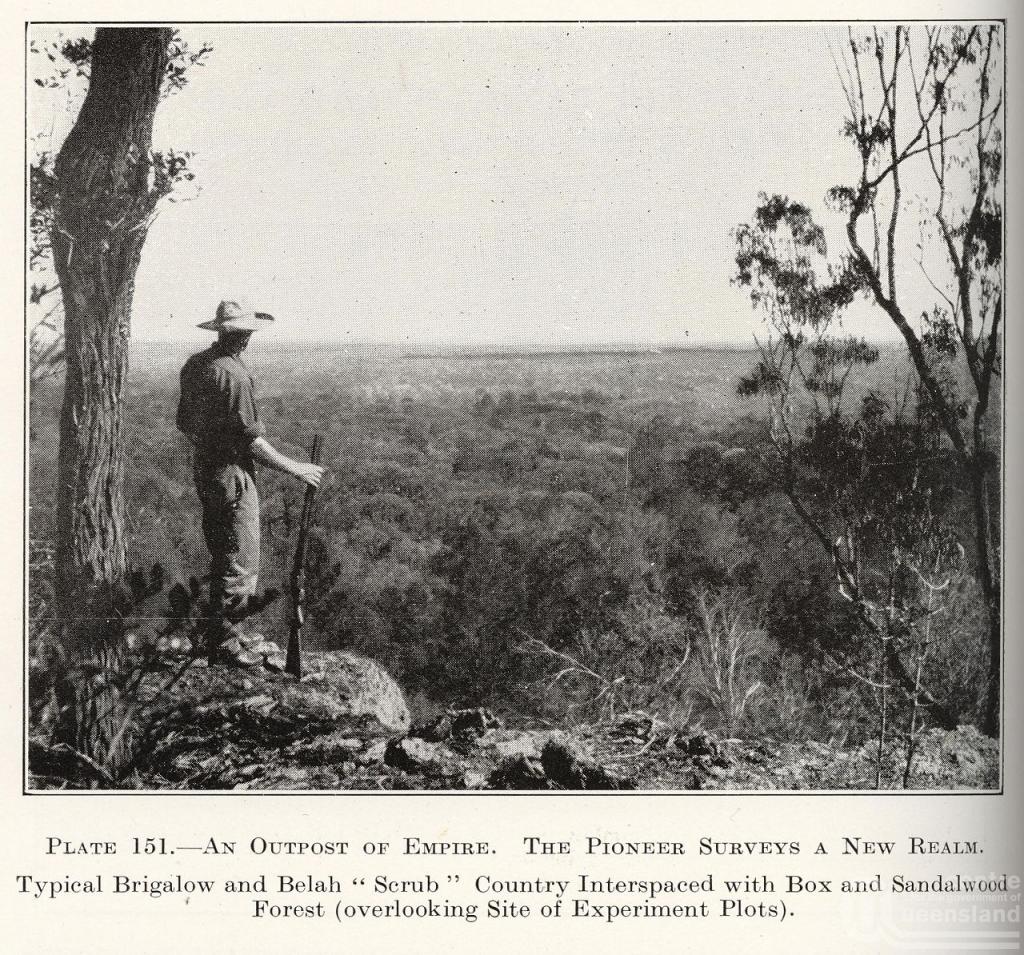
<span class="caption-caption">Typical Brigalow and Belah 'scrub' country interspaced with Box and Sandalwood Forest (overlooking site of experimental plots)</span>. <br />From <span class="caption-book">Queensland Agricultural Journal</span>, 1930, collection of <span class="caption-contributor">Fryer Library, UQ</span>.
Photo sourced Queensland Places - Brigalow belt
As most new settlers had little money to back them they had to spend most of their earnings developing their blocks so many lived in basic camps and sheds in what was a new frontier. Many stories abounded about life on the Brigalow blocks.

One such story was about a settler (who we shall call Settler) who had drawn a block that had two bores for water beside a creek that was also just near the neighbour’s boundary.
As mentioned, almost without exception, Brigalow settlers were always strapped for cash and so when the neighbour approached Settler with a suggestion that he knew someone, who had a property some distance away, who was looking for agistment and that he was offering an extremely generous price, Settler readily accepted.
As Settler had no yards, the cattle were unloaded at the neighbour's and put through the fence between the two bores.
On Settlers first inspection of the agisted cattle, after their arrival, he felt that there were far more cattle in his property than had been agreed.
In those days they had no phones at all, let alone mobiles and no electricity, so communicating something like a complaint about excessive cattle numbers could take some days.
So Settler approached the neighbour about it and was informed that he was also agisting cattle for the same person and that they were from the same mob. The neighbour suggested that some cattle may have got through the fence, which was in poor condition, to get back with their mates, but he would contact the stock owner about it. Settler asked for a paddock count.
Apparently it took some time before the stock owner and the neighbour arrived with horses to muster and do a paddock count, certainly far longer than any reasonable person would expect, so consequently, Settler was already well and truly “off side” when they arrived.
The cattle were mustered into a corner at one of the bores where the stock owner suggested that Settler count them along the fence whilst the stock owner and the neighbour held them back.
Each time the count started, Settler could hear the stock owner ” boring it into them” so that they raced along the fence 10 or twelve abreast, impossible to count and it was obvious that they didn’t want an accurate count.
The count was subsequently abandoned with Settler insisting that three quarters of the mob be removed. This was done with reluctant help from the stock owner.
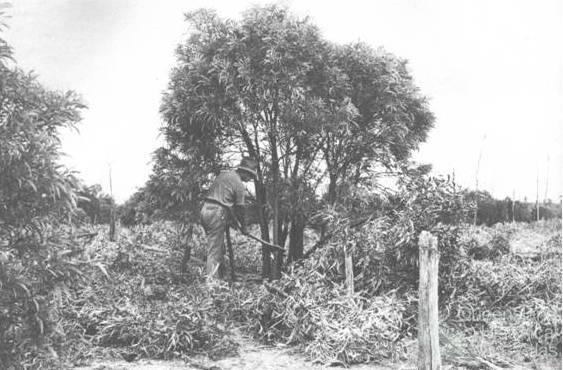
Brigalow suckers axed at Hannasford, 1939
Photo sourced Qld historical Atlas

Back at camp, Settler declared that the stock owner was not to be trusted and sent someone to patrol the boundary each morning on horseback to look for tracks. There often were.
Settler would also drive his old truck down to the bore in the evenings and check to see if anything was going on. He usually took a .303 rifle with him.
One evening, it was just coming on dark, when Settler encountered the stock owner and the neighbour with a mob of cattle near the bore. Settler was enraged.
Settler was not sure what they were doing, but it appeared they had just bought a mob into Settlers property and were holding them at the bore. They certainly had no right to be there and tried to beat a hasty retreat.
It was dark enough not to be able to see clearly but there is no doubting who they were and Settler pulled out the .303 and fired a shot in their direction. At this, there were cattle running in all directions, men yelling and general pandemonium. Settler quickly jumped into the truck and returned to his camp. Settler had an awful feeling that he may have shot someone.
A few days later the Police Sergeant from a nearby town paid Settler a visit. After the Police sergeant left Settler said that a complaint had been made by the stock owner and that one of his men had been shot through the leg and his horse had been killed. There was, however, no dead horse at the location of the shooting.
Whether someone had been shot or grazed by the bullet or not, we still don’t know. Settler felt that the whole complaint to the Police may have been an exaggeration in the hopes that the Police visit to Settler would deter him from any further action.
In any case, apparently the Sergeant had given him a lecture on the consequences of shooting someone.
The whole agistment deal was a disaster, the stock owner hadn’t paid and owing to the overstocking Settler had no grass, so you can only imagine Settler’s utter amazement when he looked up one morning, at the sound of a vehicle, to see the stock owner coming down the track.
At the sight of the stock owner, Settler was heading inside for the gun. The stock owner stopped about 100 metres from the camp and got out of his vehicle with his hands in the air (like you would if you were being arrested at gunpoint).
The stock owner then shouted:-
”Settler, I hear you want to sell the place”.
On hearing these words Settler’s demeanour changed in an instant and he said:-
“Come in and have a drink”

Tuesday, 6 August 2013

Northern Australia should have a say in its own future

By Allan Dale, James Cook University
Cross post under The Conversation republishing guidelines  The Conversation

Jd3gvmfr-1375145698


Northern futures, northern voices: It seems everyone has ideas about how Australia’s north could be better, but most of those ideas come from the south. In this six-part weekly series, developed by the Northern Research Futures Collaborative Research Network and The Conversation, northern researchers lay out their own plans for a feasible, sustainable future.


Recently, Australia’s north has featured front-and-centre in national debates about the country’s future; the election campaign will likely see more claims about what the north can do for the country.
 
Some cast it as the frontier saviour, a source of bold new resource and agricultural developments both real and imagined. Others dream of securing the north’s expansive landscapes as iconic wilderness.
 
Northern policy has long been a source of conflict. Debates have raged about the success or otherwise of government interventions in indigenous communities. Quick-draw policy responses on complex issues like the live cattle trade have devastated many communities. Additionally, media images of coast-bound refugees keep the north’s strategic importance centre-stage, raising unresolved tensions about our Asian-Pacific relationships.
 
Those debates are often crafted by, and for, a southern audience. In my view, we will continue to repeat the mistakes of the past until we rethink governance of northern Australia. Governance is not sexy, but it’s fundamental to making things happen. As a regional water official at a Mekong Basin workshop in northern Thailand recently stated, governance is “how society shares power, benefit and risk”.

The north needs a say too

In the 1930s, Australian treasurer Ted Theodore was calling for northern separatism; few suggest that now. But many in the north would argue there are major flaws in the south’s contribution to our governance and that major policy decisions are often made in the interest of a southern electorate.
 
The north is different to the south in many ways. It has a low population and institutional capacity. Land tenure is largely public rather than private. It is primarily an indigenous domain. It has enormous mineral and soil wealth, but resource limitations and a vastly different climate. Much of it is closer to populous Asia-Pacific capitals than to Perth, Brisbane or Canberra.
 
Northerners don’t want separatism, but they do want a genuine dialogue between northern and southern Australia; one focused on how the nation as a whole might secure better northern governance. Australian and state and territory governments should negotiate big policy decisions in the north and  manage government policy and programs in radically different ways.
This could emerge through a stronger northern Australian policy and delivery architecture integrated into COAG.
 
But to work, this kind of architecture must be powerfully engaged with a cohesive and strong pan-tropical alliance of northern Australia’s sectoral interests. It would have to include traditional owners, local government, industry, human service and conservation. Such an approach must also be independently informed by the north’s research institutions.

Problems that need attention

There are land use and tenure conflicts across the north (the dispute over what to do with Cape York is just one example), and we need innovation to solve them. This requires a long-term, cohesive and regionally driven approach to land use and infrastructure planning.
 
We also need a more consistent approach to negotiating major project development, to build the long-term foundations for regional community development.
 
Alongside this, we have an opportunity to create a northern-specific ecosystems services economy
– an economy that benefits from conservation. We could deliver land owners real economic benefit for managing extensive landscapes better.
 
Despite the Intervention, the fundamental (top down) model of both local government and indigenous community development has not changed much in 30 years. These approaches disempower and deliver stop-start progress. Fragmented, welfare-oriented, inflexible and annualised government programs simply do not build lasting human capacity.
 
Finally, to shift the whole economy from an historically boom-bust cycle, the nation must build a tropical knowledge economy. This could underpin productivity in existing industries (minerals, energy, agriculture, fishing, tourism) and help us think about export opportunities right across the globe’s tropical latitudes. This will rely on Australia investing in tropical knowledge development (such as tropical health, agriculture, environmental and disaster management, design and energy) within the north, brokered into the wider tropical region through long term partnerships, trade and innovation clusters and foreign investment.

A smart north is good for all Australians

A progressive and productive northern Australia, with a strong identity and great lifestyle, tightly integrated with its Asia-Pacific neighbours, should attract a diversity of people (with a wide skills base) interested in playing a strategic role in the Asian Century.
 
We can transform our reputation from the wild frontier on the northern margin of a vast empty continent, to a naturally blessed region providing high-value knowledge-based services in the south of a dynamic, rapidly growing region of 500 million people.
 
This is indeed about how society shares power, benefit and risk.
 
If we don’t get the governance right, we run big risks: we’ll entrench a boom/bust economy, whole regions of multi-generational disadvantage and degradation of the nation’s cultural and environmental jewels.
 
If we can more equitably share power and benefit across the north, we can capture opportunities that may hold the keys to the whole nation’s future.
***********


Allan Dale receives funding for a day a week under the Northern Futures Collaborative Research Network. He is Chair of Regional Development Australia Far North Queensland and Torres Strait.
The Conversation

This article was originally published at The Conversation
.

Sunday, 24 February 2013

Barnaby Joyce doorstop - Coalition Dams Report


Ten days ago Senator Barnaby Joyce made this opening statement to the assembled media at the doors to the Senate in what is known as a 'doorstop'. I thought it worthwhile to revisit this issue, one that leads to wider questions of balanced development, nation building, food security and oppotunities for regional areas.

Barnaby found it neccessary to make a doorstop appearance because that morning slashed across all major newspapers were articles based on the leaking of the Coalition's draft policy discussion paper for water management of Australia. This is but one example,Tony Abbott's bold water plan leaked 

I will copy the questions and answers that followed in the first comment below. I don't believe that any copyright applies as this doorstop transcript has been made freely available from Senator Joyce's office.


Photo sourced The Age


You have probably read the front page of the paper and the discussion in regards to the Coalition Dams Taskforce. I think it is really important that we deal with this issue in a positive way. The Australian people want to take the next step. The Australian people want the vision that takes them ahead, that has the capacity to grow the size of our economy to grow areas of opportunity and to create a mechanism to assist us in paying the debt the Labor Party has left behind.

Now water is wealth. Efficient storage and usage of water that is environmentally responsible gives our nation a great capacity to take that next step. There is no one here today who is not the benefactor of public works, of dams the capacity to store water. Let’s face it out in the country you can build it all yourself.  We should not be scared of taking the next step. One of the greatest engineering feat of this nation is not that far from here, which is the Snowy Mountain Scheme which is something even to this day people use as a legacy that makes them feel proud of who they are as Australians. They bought in so many people who were immigrants who helped to construct this nation and so I believe the Australian people will be ready to go on a, progress a stage in their life with a new government that is going to take us the next step forward. 

Now I know there will be cynics out there that say that every dam is evil and to anything to do with dams is environmental vandalism. Some of these people you can never make happy. In fact there are probably many in the Greens who want to pull the dams we’ve got down.

What I can say anecdotally is the investment made some time ago in the town I live in St George, for public infrastructure for a dam is now responsible for a community that was built around it. It produces between three-quarters and a billion dollars worth of renewable    income every year predominantly through irrigation. Who are the benefactors of that? It is every person who collects tax revenue from that area and all the people who have the jobs in that area. When you look at it, there are 5,000 people who live in that area so it’s a pretty good return for us all.


Photo source The Punch