Showing posts with label environment. Show all posts

Saturday, 7 April 2018

The Wanton Worship of Woody Weeds

By Viv Forbes,

Greens worship woody weeds. Their proposed tree-clearing bans in Queensland are the latest salvo in a long war favouring trees and damaging grasslands and pastoralists.

For millennia Australia’s open forests and treeless plains have supported our national emblems – the kangaroo and the emu, which in turn sustained aborigines, eagles and dingos. Australian grasslands also nurtured now-endangered species such as bustards, quail, pigeons, finches and grass parrots.

Nothing stands still in nature. Savannas are forever a battleground between grassland, scrub and desert. Greens gaze in rapture at the trees but ignore the valuable grasses beneath their feet – native plants like Mitchell Grass and Kangaroo Grass and cultivated grasses like wheat, barley, oats, sorghum and sugar cane.

Greens hate grazing animals like cattle and sheep (but not wildebeest!) and, like trained parrots, repeat the hard-hoof fairy-tale about soil compaction and erosion. In reality, hoof action breaks crusty soil. A short burst of concentrated animal impact with hoof cultivation, seed burial, and application of dung and urine fertilisers does wonders for the long-term health of the pasture. It is not a question of hard hooves or soft paws - it is a grazing management question. A healthy pasture needs grasses, herbs, legumes and periodic grazing animals – shut out the ruminants, or stock heavily and continuously, and you will get weeds and desert.

Greens favour “Do Nothing Pasture Management”. Along with their bans on mechanical or chemical control of tree invasions, they try to prevent bushfires which have for millennia maintained the vigour of the grasslands. To have healthy pasture requires recycling of nutrients from old dead grass before the summer rains. This is best achieved by concentrated short-term hoof impact or by controlled burning (both of which may also kill tree seedlings that are forever trying to invade the grasslands).

Greens are always nibbling away at grasslands and open forests by demanding ever more nationalised parks, conservation zones and other green blockades. Instead of supporting graziers with their productive pastures and grazing animals they create ever-expanding sterilised un-managed areas which become havens for weeds like lantana, prickly pear, cactus and wait-a-while and pests like feral dogs, wild pigs and wild cats.


Proposed new Queensland laws will hinder landowners in harvesting mulga scrub during drought and controlling invasion of grasslands by woody weeds. These destructive green bans plus the unjust Kyoto tree-clearing land seizures are part of the global Green plan to drive farmers and graziers from much of the land.

The great value of ruminants is their efficiency in converting the vegetation of poorer grasslands and open forest into edible proteins and fats. ALP/Green policies will reduce the supply of this truly free-range food and increase our dependence on feedlot food, which is worse for the environment and our health.

And for those who believe the greenhouse warming fable, grassland plants remove the bogey-man (carbon dioxide) from the atmosphere. This carbon collected by grazing animals ends up in long-term storage in human bodies via meat and other animal food products. At the end of their life, most human bodies get sequestered in carbon-based coffins and buried in carbon cemeteries. Greens should be happy with that, but the plant world will gradually suffer from this relentless loss of the gas of life from the biosphere.

The bureaucracy of our “Brave New Green World” will use drones, spy cameras and computer programs to trap and punish any grazier who dares to defend his grassland from invading trees.
 

Instead of tree clearing bans we need to free our land managers for a war on woody weeds using controlled burning, better grazing management and reversal of the unjust Kyoto land sterilisation program.

***

Viv Forbes has a degree in Applied Science, and long experience in soil science, pasture management and breeding and managing cattle and sheep.


Further Reading:

Saving the Grasslands with grazing animals by Alan Savory (well worth watching):

https://www.youtube.com/watch?v=vpTHi7O66pI

What landowners think of the proposed vegetation management bans:

Saturday, 22 March 2014

The battle over Abbot Point

 by Alison Jones and Dr Brett Kettle

Reef park approves dumping plan
Abbot Point near Bowen in Queensland. Source: The Australian

“Save the reef” has become a popular catch-cry among many environment groups, with Greenpeace’s Great Barrier Reef website shared more than 125,000 times on social media to date. It and many similar campaigns have focused heavily on “massive dredging, dumping and shipping” for coal and gas ports, particularly the recent Abbot Point dredging decision.
There is no doubt that there are reasons to be gravely concerned about the Great Barrier Reef, with less coral in some parts of the 2300 km ecosystem than three decades ago (the finer points of the issue are detailed here, here, here and here).
Yet groups such such as Greenpeace, the Australian Marine Conservation Society (AMCS), WWF, as well as The Greens, some scientists and, increasingly, the media and community, are wrong to portray dredging and dredge spoil disposal as a major threat to the reef’s survival.
This deliberate misrepresentation of the facts is evidenced in a recent comment by Felicity Wishart from the AMCS that: “If we are scaremongering it’s because the evidence is clear that there are real concerns to be worried about.”
Rather than saving the reef from decline, “scaremongering” over the Abbot Point dredging plan and the subsequent diversion of management, research and conservation efforts, are now threatening to undermine efforts at tackling the more serious issues facing the reef.
We risk seeing hundreds of millions of dollars poured into studies, offsets, monitoring, campaigning, legal costs and holding costs unrelated to the major factors that really affect the reef – just at a time when every available dollar is needed to focus on measures aimed at improving the reef’s resilience.

.

Wanted: reef science free from politics

Image sourced: Reef hysteria
According to the Australian Institute of Marine Science, nearly half of the reef’s decline to date (mostly in the southern part of the reef) can be attributed to impacts from cyclones, 42% to the crown-of-thorns starfish, and 10% to coral bleaching.
It is clear that the Abbot Point disposal site has no coral or seagrass and that risks from dredge spoil are low. Even ardent opponents of dredging have acknowledged that it is possible to manage port developments properly, pointing to the 1993 dredging at Townsville as an example.
Of the many dredging programs in Australia, there are few cases in which trigger levels have even been breached, and none where impacts have exceeded those that were predicted.
If coral really has declined by half since 1985, as reported by the Australian Institute of Marine Science study, Australia appears to have as little as a decade to identify solutions, and then another decade to trial, implement, and scale them up.
If that time frame is correct, then it is even more urgent that we avoid devaluing the role of science in helping us “manage, mitigate, adapt or even discover solutions”, as Australia’s Chief Scientist Ian Chubb recently wrote on The Conversation.


A more urgent set of priorities

Granted, scientists need to get better at predicting and measuring the low-level, long-term, far-field and cumulative effects of dredging.
However, most of the technical ambiguity around dredging impacts is about fine-tuning tactical operational issues of dredge operation, or the optimum location of material placement to achieve a balance of community priorities.
The more important science challenges for the future health of the Great Barrier Reef are aimed at sustaining its various uses. These include improving our knowledge of how the reef changes and adapts to disturbance, and learning how to manage the reef to minimise harm and to boost its ability to recover. These will involve refocussing a bewildering array of scientific resources into a unified strategy.
So what should we be putting more effort into if we’re to look after the health of the Great Barrier Reef in a future that includes accelerating change?
Significant funds that might otherwise go to research are currently spent on trying to remove Crown-of-Thorns Starfish, even though scientists acknowledge that “manual killing can only work on the scale of a few hundred square metres”. This is despite the fact that the causes of outbreaks are still inferred, rather than known with any confidence.
Nutrients in municipal sewage are discharged all year round, but the relative risk this poses to the reef compared to that in agricultural runoff and flood waters, is still unclear.
Maintenance dredging, which involves the removal of fine sediments from near the coast, has the potential to reduce catchment-generated fine sediments that impact coastal reefs. The extent of this possible benefit has not been studied.
The ultimate problem is that the body of science available is often incomplete and there is no overarching, risk-based synthesis.

.

Intervention

If the Reef indeed faces accelerating change at a time when human uses also continue to accelerate, then it is inevitable that intervention programs for high value reefs – currently confined mainly to small-scale starfish control and coral reseeding – may become more urgent.
Mangroves, corals, seagrasses, fisheries and even the seabed itself are all capable of deliberate manipulation if it were deemed necessary to do so to protect, preserve or enhance a use or value of the reef. Options like building artificial coastal wetlands or even “barrier islands” to protect the coast might seem outlandish, but are technically feasible.
Yet little of the underlying science for this has been done, leaving a significant policy gap to guide potential future works. We should start studying these problems now.

.

Barriers to decision-making

As scientists, we like to imagine that regulators devour our work and convert it into useful policy. The unfortunate reality is that our work is unintelligible to all but a handful of people, and in the real world, reef users struggle to adapt their everyday practices to such complex advice.
For instance, reef managers now insist that industries that use the reef should incorporate the concept of resilience into their impact assessments. But many are understandably frustrated at being asked to adopt something so poorly defined.
Scientists need to rise to the challenge of translating their work into practical guidelines that can be implemented today. In the words of another contributor to The Conversation, “scientists should be provoked into thinking about the way science advice is given and how they communicate".
This also means shying away from “scaremongering” that masks the real issues, creates widespread confusion and destroys the public’s confidence in their ability to rely on scientists. Its time for scientists to reject scaremongering or distortion of their results; to produce more cogent and practical guidance for policy makers; and to restore the faith of the community in science as a tool to help solve environmental problems. For the Great Barrier Reef, the clock is ticking.

Originally published as: The battle over Abbot Point risks losing the Great Barrier Reef war

Cross post under The Conversation republishing guidelines.

Conversation logo

Tuesday, 4 March 2014

EPA wants environmental impact statements on water for droughted cattle

by Jim Fryar


With drought biting hard in much of Queensland and NSW, many farmers are attempting to improve water distribution on their properties in order to give starving stock access to larger areas of grazing.  While this is happening, bureaucrats in the capital cities are fretting over whether this will threaten the environment: 


"As the government steps up its drought relief, there's concern a move by the federal environment department might actually make it harder for graziers to roll out emergency water infrastructure. 
Millions of dollars have already been spent installing bores, pipes and troughs to keep starving stock alive and yesterday's federal package increased the government's contribution from half to 75 per cent. 
Yet, the federal environment department is currently investigating whether the 'proliferation, placement and management of artificial watering points' represents a threat to the environment. 
It's a move that's incensed graziers and land managers who are questioning the department's decision to consider a nomination under the Environmental Protection Biodiversity and Conservation (EPBC) Act. 
Northern Gulf NRM chief executive officer Grant Fawcett- based in Georgetown, about 400 kilometres west of Cairns - says getting the balance between economic and environmental benefits should be left to land managers. … 
… But graziers such as former Cattle Council president Greg Brown, who've spent hundreds of thousands of dollars improving waters on his property, 'Meadowbank', says it shows federal bureaucrats are out of touch and he hopes the review is ignored. 
"I think it's a rather strange sort of assertion myself. I would have thought that additional water in country would actually enhance the survival of wildlife and biodiversity." 
"Obviously people are entitled to establish watering points on their own property... it's entirely up to you with regard to putting watering points around the place and I have some doubts as to whether they're going to be consulting the federal department of environment.” …
The greatest single asset of most farmers and graziers is their land, which is what they rely on to provide the majority, if not all of their income.  They would be cutting their own throats economically were they to damage its productivity by carrying out actions with poor environmental outcomes.
They also understand the land and its workings far better than the average big city bureaucrat even though they don’t work for a government department and are not trained to apply theoretical ideas to hypothetical situations using self-righteousness as a guide.
 
First published at Real World Libertarian

Friday, 27 December 2013

Gladstone harbour - the truth and the pain to bring it to light

Truth never lost ground by enquiry. - WILLIAM PENN, Some Fruits of Solitude

 
Truth will ultimately prevail where there is pains taken to bring it to light. - GEORGE WASHINGTON
Pic supplied by author
Photo by John Mikkelsen

Finally the truth has come out in the major metropolitan newspapers about what has been killing marine life in Gladstone harbour. To be fair the situation wasn’t helped by the Gladstone Port Corporation (GPC) withholding reports from public examination for over two years. The local newspaper, the Gladstone Observer, has finally reported the news instead of printing the version presented by the GPC without too much outside inquiry. The full page advertising by GPC at the time may have been co-incidental.  
The enquiry for truth has largely been pursued in the alternative media on blog sites. The most prolific writer about the disaster besetting Gladstone harbour is John Mikkelsen or Mikko to his online friends, a semi-retired journalist living at the time at Tannum Sands who could see first-hand the fish deaths, could talk to the local fishermen and the scientists who came to investigate.
John Mikkelsen in his latest blog post, Gladstone Harbour- dredging up what went wrong, writes of the “latest of the belated reports emerging showing how environmental breaches went unreported in Gladstone Harbour;” referring to Tony Moore’s December 20th Brisbane Times newspaper article, Gladstone Harbour bund wall failures explained.
The Australian in the November 18th issue carried the article, Fish fears rise over LNG port dredging, revealing how GPC withheld reports for more than two years containing evidence contrary to the GPC claim that the problems were all caused by a flood in 2011, a scenario that as time went on became increasingly apparent to be unlikely.  The author of this article in the Australian is the Environment editor, Graham Lloyd who has since followed up with two more articles, Bad build blamed for fish deaths and Gladstone port plea to stem toxic leak.

 
Vision demonstrating failings in the bund wall at Gladstone Harbour.
Photo Brisbane Times


The evidence now available supports what John Mikkelsen has been writing since September 2011. His articles were published in two of Australia’s largest blog sites, Something’s really fishy in the Gladstone waters at The Punch on October 2011 and then on the 26th at ABC’s Unleashed, Gladstone fish can't read.

John Mikkelsen
But the enquiry into truth was not without cost, on October 17th 2011 Mikko who several years previously had held the position of editor of the Gladstone Observer wrote:

“”Yesterday I watched a convoy of tugs towing barges loaded with dredging spoil past Tannum Sands to the dumping grounds in open waters just outside the entrance to Gladstone Harbour, the scene of widespread controversy surrounding continuing catches of sick fish and dead marine animals.

On Wild Cattle Island, a national park just south of Tannum beach, I saw the carcass of another dead adult turtle washed up at low tide, the latest in more than 200 strandings.

In the past week, local media outlets have all run full-page advertisements from the Gladstone Ports Corporation stating “Water quality in Gladstone Harbour is OK”. Tell that to the fish.

Meanwhile, for almost five years I have been writing a weekly column, ‘What Goes Around’ in The Gladstone Observer. For the past month, I have focussed on the harbour controversy but it has now been axed because of “budget restrictions”. All online comments to articles relating to the harbour and diseased fish were removed just over a week ago and since then new articles have not allowed online comment.

All that could be coincidental and I am not suggesting otherwise, just presenting the circumstances. My last article, published in today’s Observer (October 17)”

The above quote was published at a community blog site that no longer deserves to be named. This article attracted several thousand views to the ongoing comments that kept people up to date to the unfolding situation at Gladstone harbour. Most of these views would have been from people keeping themselves informed rather than those actually commenting.  Unfortunally the article also attracted a couple of people with the zealous desire to discredit the evidence being presented and although living far away from Gladstone were very persistent in harassment often using cherry picked Google searches. The article was deleted in November 2012 because of the abuse of trust that the community placed in one person to hold the site’s password; it was deleted for no other reason than this person choose at the time to disagree with it.

The original post was copied and is available at the pindanpost blog site. Many pages of updated comments, including informed scientific commentary, are lost.   

It appeared that the motivation to persistently harass the events at Gladstone harbour to be reported and commented upon was that environmental groups had subsequently become active about the issue and that if the ‘greenies’ were making statements they had to be automatically wrong. While it is certainly easy to find many examples of the extreme end of the environmental movement in their ‘the end justifies the means’ approach using alarmism, misinformation and even sabotage, it is simplistic to assume that everyone interested in environmental issues are of bad character with incorrect information. Whenever in this harassment it was pointed out the greenies were involved with Gladstone harbour, Mikko would patiently reply that “even a broken clock is right twice a day.”    

Social media can be and is being used for good; the enquiry into the truth about Gladstone harbour would not have proceeded without the use of blog sites. However it also provides a soap box for those that society would not have otherwise have provided for some people. It brings out the ‘haters’ from both the politically left and the right. It provides the opportunity for you to hear the viewpoint that you want to hear and to attack every view expressed by other sources that have been pigeon holed as wrong. Social media provides the opportunity for those that wish to rant, engage in absolutes and abuse just as it can provide the opportunity for enquiry, positive engagement and thoughtfulness. 


Photo sourced -
 Those of us who are politically conservative and are interested in a balance of conservation with economic development and community values should stand strong against the attacks of some on the left who believe that the only legitimate comment on environmental issues is owned by them. Also those of us you are politically conservative and are interested into the enquiry into the truth of a situation should resist the weakness that requires one to retreat to known absolutes and not allow new events to challenge one’s thinking. Sometime there are circumstances where you end up on a parallel course to others that are normally in opposition; it appears that some are so insecure in their own convictions that they create an artificial world of “East is East, and West is West, and never the twain shall meet”.


Congratulations Mikko for the truth belatedly being reported in the major metropolitan main stream media. You have stuck to your guns; the truth has ultimately prevailed thanks to the pains you took to bring it to light. The pursuit may have not been without pain; there are a few people that owe you an apology.


The event of November 2012 was the catalyst for the beginning of this blog site and below is the list of the posts published by John Mikkelsen about the Gladstone Harbour


Photo sourced from,


Gladstone Harbour- dredging up what went wrong


UPDATE #1
May 9 2014
The independent report to federal Environment Minister Greg Hunt was released on and it reveals that there was an obvious determined attempt to cover up the whole devastating effects of the dredging and leaking bund wall, coinciding with the fish disease and toxic algae outbreaks.

Bad build and oversight failure at Gladstone gas hub.
.


Tuesday, 6 August 2013

Northern Australia should have a say in its own future

By Allan Dale, James Cook University
Cross post under The Conversation republishing guidelines  The Conversation

Jd3gvmfr-1375145698


Northern futures, northern voices: It seems everyone has ideas about how Australia’s north could be better, but most of those ideas come from the south. In this six-part weekly series, developed by the Northern Research Futures Collaborative Research Network and The Conversation, northern researchers lay out their own plans for a feasible, sustainable future.


Recently, Australia’s north has featured front-and-centre in national debates about the country’s future; the election campaign will likely see more claims about what the north can do for the country.
 
Some cast it as the frontier saviour, a source of bold new resource and agricultural developments both real and imagined. Others dream of securing the north’s expansive landscapes as iconic wilderness.
 
Northern policy has long been a source of conflict. Debates have raged about the success or otherwise of government interventions in indigenous communities. Quick-draw policy responses on complex issues like the live cattle trade have devastated many communities. Additionally, media images of coast-bound refugees keep the north’s strategic importance centre-stage, raising unresolved tensions about our Asian-Pacific relationships.
 
Those debates are often crafted by, and for, a southern audience. In my view, we will continue to repeat the mistakes of the past until we rethink governance of northern Australia. Governance is not sexy, but it’s fundamental to making things happen. As a regional water official at a Mekong Basin workshop in northern Thailand recently stated, governance is “how society shares power, benefit and risk”.

The north needs a say too

In the 1930s, Australian treasurer Ted Theodore was calling for northern separatism; few suggest that now. But many in the north would argue there are major flaws in the south’s contribution to our governance and that major policy decisions are often made in the interest of a southern electorate.
 
The north is different to the south in many ways. It has a low population and institutional capacity. Land tenure is largely public rather than private. It is primarily an indigenous domain. It has enormous mineral and soil wealth, but resource limitations and a vastly different climate. Much of it is closer to populous Asia-Pacific capitals than to Perth, Brisbane or Canberra.
 
Northerners don’t want separatism, but they do want a genuine dialogue between northern and southern Australia; one focused on how the nation as a whole might secure better northern governance. Australian and state and territory governments should negotiate big policy decisions in the north and  manage government policy and programs in radically different ways.
This could emerge through a stronger northern Australian policy and delivery architecture integrated into COAG.
 
But to work, this kind of architecture must be powerfully engaged with a cohesive and strong pan-tropical alliance of northern Australia’s sectoral interests. It would have to include traditional owners, local government, industry, human service and conservation. Such an approach must also be independently informed by the north’s research institutions.

Problems that need attention

There are land use and tenure conflicts across the north (the dispute over what to do with Cape York is just one example), and we need innovation to solve them. This requires a long-term, cohesive and regionally driven approach to land use and infrastructure planning.
 
We also need a more consistent approach to negotiating major project development, to build the long-term foundations for regional community development.
 
Alongside this, we have an opportunity to create a northern-specific ecosystems services economy
– an economy that benefits from conservation. We could deliver land owners real economic benefit for managing extensive landscapes better.
 
Despite the Intervention, the fundamental (top down) model of both local government and indigenous community development has not changed much in 30 years. These approaches disempower and deliver stop-start progress. Fragmented, welfare-oriented, inflexible and annualised government programs simply do not build lasting human capacity.
 
Finally, to shift the whole economy from an historically boom-bust cycle, the nation must build a tropical knowledge economy. This could underpin productivity in existing industries (minerals, energy, agriculture, fishing, tourism) and help us think about export opportunities right across the globe’s tropical latitudes. This will rely on Australia investing in tropical knowledge development (such as tropical health, agriculture, environmental and disaster management, design and energy) within the north, brokered into the wider tropical region through long term partnerships, trade and innovation clusters and foreign investment.

A smart north is good for all Australians

A progressive and productive northern Australia, with a strong identity and great lifestyle, tightly integrated with its Asia-Pacific neighbours, should attract a diversity of people (with a wide skills base) interested in playing a strategic role in the Asian Century.
 
We can transform our reputation from the wild frontier on the northern margin of a vast empty continent, to a naturally blessed region providing high-value knowledge-based services in the south of a dynamic, rapidly growing region of 500 million people.
 
This is indeed about how society shares power, benefit and risk.
 
If we don’t get the governance right, we run big risks: we’ll entrench a boom/bust economy, whole regions of multi-generational disadvantage and degradation of the nation’s cultural and environmental jewels.
 
If we can more equitably share power and benefit across the north, we can capture opportunities that may hold the keys to the whole nation’s future.
***********


Allan Dale receives funding for a day a week under the Northern Futures Collaborative Research Network. He is Chair of Regional Development Australia Far North Queensland and Torres Strait.
The Conversation

This article was originally published at The Conversation
.

Tuesday, 28 May 2013

Haven’t Lost Half of the Great Barrier Reef: Part 2, Junk Methodology


by Jennifer Marohasy
 
HOW could scientists conclude that half of the Great Barrier Reef has been lost in the last 27 years: target coral reefs most affected by cyclones, coral bleaching and crown-of-thorn starfish outbreaks, while ignoring more representative reefs with healthy corals. And I didn’t make that up! It’s documented in a peer-reviewed study by H. Sweatman, S. Delean and C. Syms entitled: ‘Assessing loss of coral cover on Australia’s Great Barrier Reef over two decades, with implications for longer-term trends’ [1].

Indeed the claim that there has been a 50 per cent decline in coral cover at the Great Barrier Reef appears to be largely an artifice of the survey method. In particular, coral reefs most severely affected by bleaching in 1998, and reefs disproportionally affected by crown-of-thorn starfish outbreaks, and also reefs with insufficient time to recover from cyclones in 2009 and 2011 were targeted for repeated sampling, while more representative reefs with healthy corals were ignored.

In part 1 of this series, I reported that the World Heritage Centre will demand action by the Australian Government to spend vast sums of taxpayers’ funds to address this manufactured issue, or have the Great Barrier Reef placed on its World Heritage in Danger List. This demand is a recommendation of the United Nation’s International Union for the Conservation of Nature, UNESCO, in its State of Conservation report prepared for the June meeting of the UNESCO committee [2], which in turn is based upon a report of the environmental lobby groups WWF and the Australian Marine Conservation Society, whose report [3] in turn relies on the claims of a peer reviewed study by Glenn De’ath and co-workers [4].

The paper by De’ath and co-workers published in the US Proceedings of the National Academy of Sciences in 2012 [5] does indeed claim a 50 per cent decline in coral cover based on 27 years of data from the Australian Institute of Marine Sciences (AIMS) Long-Term Monitoring Program.

The scientists suggests 48 per cent of the decline can be attributable to cyclones, 42 per cent to crown-of-thorn predation and 10 per cent to coral bleaching. But remarkably, and at odds with the broad claims in De’ath et al. 2012, there has arguably been no increase in the incidence of cyclones over the same period [5], no evidence for deterioration in water quality at the Great Barrier Reef [6], and no general increase in the incidence of coral bleaching . So, it would seem remarkable that coral cover has declined so dramatically and purportedly from these sources.

De’ath draw their conclusions from modelling based on a study of just 214 reefs chosen from a total of approximately 3,000 reefs. So they sampled approximately 7 per cent of reefs. They do not explain in the paper how the 7 per cent of reefs were chosen, for example, they do not explain whether they randomly choose the reefs that would be studies as one draws numbers in a lottery, or whether particular reefs were selected. They also don’t explain if they continued to sample the same number of reefs over the 27-year period of the survey, or, for example, whether they reduced the number of reefs sampled over this 27-year period, and, for example, only went back to reefs that showed dramatic decline in coral cover.

Of course while scientists claim to be trustworthy, there is reason to be sceptical. As Aynsley Kellow, Professor and Head of the School of Government at the University of Tasmania, explains in his book ‘Science and Public Policy: The Virtuous Corruption of Virtual Environmental Science’ much of modern environmental science has been corrupted by noble causes. These same causes have brought tremendous prestige and wealth to many scientists.

Remarkably many problems with the AIMS long-term monitoring program, the exact same program relied upon by De’ath and co-workers to conclude half of the Great Barrier Reef has been lost, are detailed in a paper published just one year before by Hugh Sweatman and co-workers [1]. Sweatman and De’ath are colleagues at AIMS and incredibaly Sweatman is one of the authors of the 2012 De’ath paper.

In the 2011 paper Dr Sweatman writes with respect to sampling in the central section of the Great Barrier Reef:
“In the early years of the programme, up to 32 reefs spread across the Swains sector were surveyed annually, but only seven reefs in the south of the Swains sector were surveyed regularly 1993–2004. Five of these seven reefs had large and persistent outbreaks of A. planci for most of the survey period, a high incidence of outbreaks that was not representative of reefs across the sector”.

Sweatman et al. 2011 go on to explain that the overall decline, often reported in coral cover for the Great Barrier Reef, is mainly used to due to large losses of coral in six of 29 subregions. This loss is attributed to coral bleaching in 1998 and outbreaks of crown-of-thorns starfish. Otherwise, Sweatman explains that living coral cover increased in one subregion (3%) and 22 subregions (76%) showed no substantial change.

Furthermore, coral reefs in the great majority of subregions showed cycles of decline and recovery over the survey period, but with little synchrony among subregions and no long term decline.
Sweatman and co-workers conclude that much of the apparent long-term decrease in coral cover reported in the scientific literature results from combining data from selective, sparse, small-scale studies before 1986 with data from both small-scale studies and large-scale monitoring surveys after that date.

In other words Sweatman et al. (2011) detail problems with the methodology used by all studies that rely on the AIMS monitoring data. Yet these issues, central to the credibility of the claim that there has been a 50 per cent decline in coral cover, are ignored in De’ath et al. 2012.

******

This is part two of a new series on the Great Barrier Reef and claims that 50 per cent of it have been lost. Read part 1 here:  http://evacuationgrounds.blogspot.com.au/2013/05/the-great-barrier-reef-have-we-really.html

Links/References
1. Sweatman, H., S. Delean, C. Syms. 2011. Assessing loss of coral cover on Australia’s Great Barrier Reef over two decades, with implications for longer-term trends. Coral Reefs. 30: 521-531

2. IUCN, 2013, State of State of conservation of World Heritage properties WHC-13/37.COM/7B, accessed at http://whc.unesco.org/archive/2013/whc13-37com-7B-en.pdf

3. WWF AMCS, 2013, Report to the UNESCO WHC accessed at http://awsassets.wwf.org.au/downloads/mo030_fight_for_the_reef_report_to_the_unesco_world_heritage_committee_1feb13.pdf

4. De’ath, G., K. E. Fabricius, H. Sweatman, and M. Puotinen. 2012. The 27–year decline of coral cover on the Great Barrier Reef and its causes. Proceedings of the National Academy of Sciences. 109(44): 17995-17999.
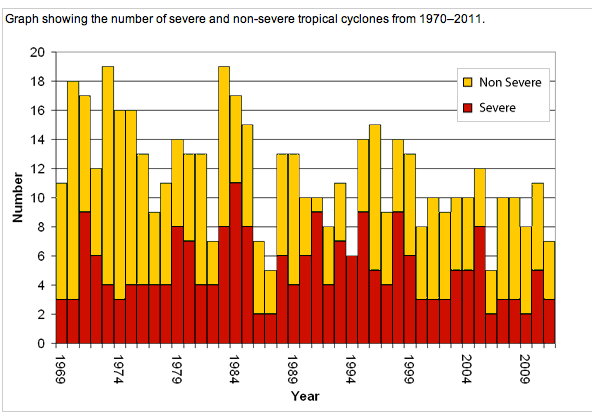
cyclone number
5. Data from the Bureau of Meteorology shows no increase in the number or severity of cyclones impacting Australia or the Great Barrier Reef. Click on the image for a better view…
This is contrary to a claim in the De’ath et al. 2012 paper that “cyclone intensities are increasing with warming ocean temperatures”.


6. While it is generally assumed, and inferred, that water quality at the Great Barrier Reef is deteriorating, these claims are not supported by the hard data as detailed in part 1 of this series… http://evacuationgrounds.blogspot.com.au/2013/05/the-great-barrier-reef-have-we-really.html
For example, chlorophyll monitoring on the Great Barrier Reef shows:
“Results to date show that compared with coastal regions in other parts of the world, chlorophyll a concentrations in the GBR lagoon are generally low. Chlorophyll a concentrations vary across the shelf seasonally and also with latitude. There are also persistent local gradients in chlorophyll a concentration, usually away from the coast. Consistent long-term trends in chlorophyll a concentrations haven’t yet been discerned.”. Download this text from AIMs website on April 4, 2013
http://www.aims.gov.au/docs/data-centre/chlorophyllmonitoring.html

Furthermore the De’ath et al. 2012 study states: “The disturbance data for COTS and cyclones show periodic and random fluctuations but no systematic long-term variation over the 27 year observation period.”
 
This article was first published at jennifiermarohasy blog
Permission for this cross post was given by Jennifer Marohasy 
. 

Saturday, 11 May 2013

Old hands tell good reef story

For those who only get to read the scaremongering of the "experts" who sit in their ivory towers in front of a computer in some far off office, a story published today in the Cairns Post gives a different perspective.
This perspective is one which locals and those who actually know the reef have agreed upon consistently.
Ben Cropp has been diving reefs worldwide and particularly the Great Barrier Reef for sixty years. He is a marine life filmmaker. 

One would expect that he would be more qualified to comment on the health of the reef than those who sit in offices theorising about what "might" happen and trying to damage the integrity of the reef in our areas.
Why would someone in America or Brisbane/Sydney/Melbourne etc. in the comfort of their air-conditioning be more qualified to have their theories believed than those who actually love, live and work in the area consistently for decades?
Anna Bligh came to Cairns for one day a few years ago and was able to go away claiming that the damage from run-off was so terrible. Her expertise was that she put her hand over the side of a boat for a picture shoot!!!!!!! How would she know and where is she now?? 


I am including a link to a story published in the Port Douglas Newsport last year. Peter Wright and Ben Cropp both marine experts with decades spent on the Great Barrier Reef.

http://www.tourismportdouglas.com.au/Reef-report-misleading-says-local-expe.8417.0.html

Here is another story which was in the paper earlier this week:
More scaremongering from those who want to stop any industry or enjoyment. The Reef is shown to be in good condition by those who actually know the area.
http://www.cairns.com.au/article/2013/05/09/242077_local-news.html


The Great Barrier Reef: Have we Really Lost Half of It? [Part 1: Water Quality]

by Jennifer Marohasy
 
IT was all over the news again this morning, that unless action is taken to improve water quality the Great Barrier Reef could be placed on the World Heritage list of sites in danger and by the way, there has already been a 50 percent decline in coral cover at the Great Barrier Reef.
No wonder the average person is concerned about the environment! Such casual reporting that we have already lost a full half of the Great Barrier Reef!


Photograph by Walter StarckThis publicity is all part of a campaign to stop the development of new port facilities along the Queensland coastline. But rather than just come out and say they don’t want more development– that in fact they despise industry– the activist scientists dress it up as the end of the Great Barrier Reef as we know it.
I have written extensively about the water quality scare campaigns of the late 1990s and early 2000s [1,2,3]. They weren’t about new port developments, but they did prostitute science just like this new campaign.

Photograph by Walter Starck

It is still my contention that while agriculture is having a measurable impact in Great Barrier Reef catchments i.e. in river and streams that flow into the GBR, there is no measurable negative water quality impacts on the Great Barrier Reef proper [1,2,3].
This is a highly contentious claim. But it’s supported by the data [4]. Indeed the Australian Institute of Marine Science has been measuring water quality across the GBR for decades –- cross shelf and seasonal patterns of water column nitrogen (nitrite, nitrate, dissolved organic nitrogen, particulate nitrogen) and chlorophyll a concentrations –- and the data shows no trend of eutrophication. Indeed both nearshore and offshore reefs appear to be developing, for the most part, in a generally low-nutrient environment.
Nevertheless, hundreds of millions of dollars have been spent over the last 10 or more years ostensibly to improve reef water quality. Just a week ago I was told by a Central Queensland landholder that she has received a little over A$100,000 in government grants over the last few years to undertake improvements on her farm as part of the Reef Rescue program [5]. She said she doubted that any of the several projects could conceivably have an impact on reef water quality, but they have significantly improved the value of her property. Indeed, there is money to construct water troughs and increase ground cover and the list goes on [6]. That is the power of the agricultural lobby, they couldn’t beat the WWF campaign that painted them as destroying the reef [2], but they were encouraged to put their handout for government money and got A$400 million to be distributed to landholders and hangers-on.
All this money, and still the perception that reef water quality is deteriorating! Then again, I guess there wouldn’t have been the extra $200 million announced recently for rural industry, and extension of the same tax-payer-funded program to 2018, if there were a perception that the perceived water quality problem had been solved.
But what about this claim of a 50 percent decline in coral cover? The claim was recently made in the preamble to a petition by a group of “respected coral reef scientists” and promoted by Scientific America [7]. They reference a peer-reviewed paper entitled ‘The 27-year decline of coral cover on the Great Barrier reef and its causes’ published in the Proceedings of the National Academy of Science by Dr Glenn De’ath et al 2012. [8]
I’ll start to dissect this claim in Part 2 of a planned series on the Great Barrier Reef.
***
References/Further Reading
1. Great Barrier Reef ‘research’ – A litany of false claims By Jennifer Marohasy, October 2011 http://www.onlineopinion.com.au/view.asp?article=12719
2. WWF Says ‘Jump’, Governments Ask ‘How High’? By Jennifer Marohasy, March 2002 http://pandora.nla.gov.au/pan/33869/200304300000/www.ipa.org.au/pubs/ngounit/wwffs.html
3. Deceit in the name of conservation By Jennifer Marohasy, March 2003 http://jennifermarohasy.com/wp-content/uploads/2011/08/Review55-1DeceitinNameConservation.pdf
4. For example… Chlorophyll monitoring on the Great Barrier Reef “Results to date show that compared with coastal regions in other parts of the world, chlorophyll a concentrations in the GBR lagoon are generally low. Chlorophyll a concentrations vary across the shelf seasonally and also with latitude. There are also persistent local gradients in chlorophyll a concentration, usually away from the coast. Consistent long-term trends in chlorophyll a concentrations haven’t yet been discerned.” Download this text from AIMs website on April 4, 2013 http://www.aims.gov.au/docs/data-centre/chlorophyllmonitoring.html
5. Reef Rescue  “In the first phase of the Caring for our Country Reef Rescue program, the Australian Government committed $200 million over five years (2008-09 to 2012-13) to improve the quality of water entering the Great Barrier Reef lagoon. Over the course of the program more than 3200 individual land managers received water quality grants for on-farm projects. Through the second phase of Caring for our Country, the Australian Government has committed a further $200 million to continue efforts to protect the Great Barrier Reef through improvements to the quality of water flowing into the Great Barrier Reef lagoon. Over a further five year period the Reef Rescue program will enhance the reef’s resilience to the threats posed by climate change and nutrients, pesticides and sediment runoff through a number of complimentary approaches. The next phase of Reef Rescue will support activities that will contribute to both the Sustainable Environment and Sustainable Agriculture streams of Caring for our Country.” Downloaded from government website on April 4, 2013 http://www.nrm.gov.au/funding/reef-rescue/
6. $200m to extend Reef Rescue program Beef Central, April 29, 2013 http://www.beefcentral.com/p/news/article/3062
7. Coal Development Threatens Great Barrier Reef by Stephanie Paige Ogburn, April 30, 2013 http://www.scientificamerican.com/article.cfm?id=coal-development-threatens-great-barrier-reef
8. De’ath, G., K. E. Fabricius, H. Sweatman, and M. Puotinen. 2012. The 27–year decline of coral cover on the Great Barrier Reef and its causes. Proceedings of the National Academy of Sciences. 109(44): 17995-17999.
***

This article was first published at jennifiermarohasy blog
Permission for this cross post was given by Jennifer Marohasy 

Friday, 8 February 2013

Green tape on farming has disastrous wider impacts


Cross posted under IPA’s copyright policy from an article by Peter Gregory

Agricultural blocks squander our chance to play vital food role

Bad policies underpinned by warped environmental priorities don't just hold back agriculture in Queensland and hurt farmers in the state.
They have a disastrous impact on poor people living in the region.
Australia has long been a net exporter of food, currently producing enough to feed 60 million people. Queensland has the largest area of agricultural land of any Australian state and produces almost a quarter of the nation's gross value of agricultural commodities. Australia and Queensland could double their agricultural output if it weren't for policies that block agricultural development.
Dam building, for example, has been blacklisted from state and federal policy agendas for two decades because of pressure from green activists. Queensland has only built three dams in the past decade, compared to 15 in the 1990s and 20 in the 1980s. Yet the CSIRO cites lack of water availability for why 5 to 17 million hectares of arable land in Australia's north isn't used for agriculture.
Food prices in the Asia-Pacific have doubled in the past decade. If Queensland was to operate at anywhere near its agricultural potential, the resultant increase in supply would ease this pressure for millions of the world's poorest.
In light of the 578 million people in the Asia-Pacific who are malnourished and the 3.3 million children under the age of five who die each year from hunger and malnutrition globally, this state of affairs should be viewed as the disgrace that it is.
As assistant director-general of the UN Food and Agricultural Organisation Hiroyuki Konuma rightly said last year, "huge investments in the agricultural sector" are needed to address malnutrition in the region.
Undoubtedly, Queensland is blessed with incredible natural treasures that warrant protection from the effects of building dams.
But not all of the state is the Great Barrier Reef or the Daintree Rainforest.
Likewise, live cattle exports were halted to Indonesia last year in the wake of a Four Corners report depicting horrific treatment of the animals. There were further calls to ban live exports after similarly barbaric treatment of sheep was filmed in Pakistan.
Beef is Queensland's largest rural-based industry and its second biggest export industry (behind coal). The state easily has the largest beef industry in Australia, providing almost two-thirds of Australia's beef exports to high-value, premium overseas markets.
But it could be even bigger and more beneficial to Queenslanders and those beyond our shores.
Maltreatment of animals is reprehensible and efforts must be made to prevent it from happening again. But Indonesia sources 25 per cent of its beef from Australia. And there are 65 million people living in extreme poverty in Indonesia and Pakistan combined.
Incredibly, in combination with policy decisions made by the Indonesian Government as a result, the ban caused beef prices to double in Indonesia, denying poor people access to an important source of nutrition.
Putting aside the fact that there are ways to solve this problem without completely halting live exports, do supporters of the measure really think that animal welfare is more important than the lives of some of the world's poorest people?
A further barrier to Queensland fulfilling its agricultural potential are farm labour costs, which rose 151 per cent between 1996 and 2008 in Australia.
This rise was substantially contributed to by the scrapping of individual workplace agreements.
This, in combination with other burdens such as the carbon tax and the duplication of state and federal environmental regulation, has made it less profitable to run a farm and discourages investment in increasing production.
For example, after being subjected to a three-year-long approval process that cost more than $30,000 to meet state and federal obligations just to grow a cassava crop, one Burdekin farmer commented, "once you realise all this (regulation), you would never start".
It has been argued long and hard by those who support agricultural development - and oppose the blacklisting of dam building, a ban on live exports and the over-regulation of Queensland's agricultural sector - that such policy positions put Queensland industry and jobs in peril.
They are right. But these are not the only considerations in play.
Queensland's agricultural sector can feed millions of people in the region - many of whom are extremely poor. But the state is passing up the opportunity to be Asia's food bowl on the basis of environmental claims that are questionable at best