Showing posts with label coral reefs. Show all posts

Saturday, 20 December 2014

Rising Seas are Nothing New


by Viv Forbes
 
The most careful analysis of world sea levels suggests they are rising at between zero and 2mm per year. Measurements to this accuracy are questionable as they are complicated by changes in ocean currents and wind direction, and shorelines that may rise and sink.

Sea levels are never still, but with global temperatures flat and snow cover and polar ice steady, sea levels are probably as stable today as they ever get.


Image sourced [here]

However, we still have creative climatists concocting complex computer models that predict dangerously rising seas to justify their goal to ban coastal development and to revive their failing war on carbon.

Alarmists should study earth history.

At the depth of our recent ice age, just 16,000 years ago, a thick sheet of ice covered much of North America and Northern Europe.


So much water was locked up in ice that humans could walk on dry land from London to Paris, from Siberia to Alaska and from New Guinea to Australia. The River Rhine flowed across a broad coastal plain (which is now the North Sea) and met the Atlantic Ocean up between Scotland and Norway.
image sourced [here]


There was no Great Barrier Reef as Queensland’s continental shelf was part of the coastal plain, and rivers like the Burdekin met the ocean about 160 km east of its current mouth. Most of its ancestral river channel can still be recognised beneath the Coral Sea.

Then, about 13,000 years ago, with no help from man-made engines burning hydrocarbons, the Earth began warming. This was probably caused by natural cycles affecting our sun and the solar system, aided by volcanic heat along Earth’s Rings of Fire under the oceans.

The great ice sheets melted, sea levels rapidly rose some 130m and coastal settlements and ancient port cities were drowned and are being rediscovered, even today
 
As the oceans warmed, they expelled much of their dissolved load of carbon dioxide. The warm temperatures and extra carbon dioxide plant food caused vigorous plant growth. Permafrost melted, forests colonised the treeless tundra and grasses and herbs covered the great plains. Iceball Earth became the Blue/green planet, supporting a huge increase in plant and animal life.

Without any zoning laws to guide them, our smart ancestors moved ahead of the rising waters and adapted happily to the warmer climate with less snow, more rain, more carbon dioxide plant food and more ice-free land.

This warming phase peaked in the Medieval Warm Era about 1,000 years ago, when sea levels also peaked. They fell during the Little Ice Age, rose slightly during the Modern Warm Era, and are relatively stable now.

Rising seas are never a lethal threat to life on Earth. The danger sign is falling sea levels caused by a return of the great ice sheets. This would quickly put high-latitude farming into the deep freezer, thus creating widespread starvation. Trying to grow crops on emerging salty mudflats in an icy climate will give some future farmers a real climate concern.

And despite World Heritage listing, when the next ice age comes the skeletons of the stranded Great Barrier Reef will become bleached limestone deposits on the coastal plain. The indestructible coral populations will abandon their marooned homes and build new reefs further out under the retreating seas.
Image sourced [here]
For those who would like to read more:

Ice Age Europe
http://donsmaps.com/icemaps.html

Nothing New about Rising sea levels:
http://carbon-sense.com/2013/11/30/nothing-new-about-climate-change/

Sea levels were probably been higher than this during the Medieval Warming, and fell in the Little Ice Age:
http://carbon-sense.com/2013/12/02/endlich-sea-level-claims/

The Buried Burdekin River Channel
http://digitalcommons.unl.edu/geosciencefacpub/386/

Sea level in the southwest pacific is stable:
http://carbon-sense.com/2010/01/01/south-pacific-sea-level-changes/

Saturday, 22 March 2014

The battle over Abbot Point

 by Alison Jones and Dr Brett Kettle

Reef park approves dumping plan
Abbot Point near Bowen in Queensland. Source: The Australian

“Save the reef” has become a popular catch-cry among many environment groups, with Greenpeace’s Great Barrier Reef website shared more than 125,000 times on social media to date. It and many similar campaigns have focused heavily on “massive dredging, dumping and shipping” for coal and gas ports, particularly the recent Abbot Point dredging decision.
There is no doubt that there are reasons to be gravely concerned about the Great Barrier Reef, with less coral in some parts of the 2300 km ecosystem than three decades ago (the finer points of the issue are detailed here, here, here and here).
Yet groups such such as Greenpeace, the Australian Marine Conservation Society (AMCS), WWF, as well as The Greens, some scientists and, increasingly, the media and community, are wrong to portray dredging and dredge spoil disposal as a major threat to the reef’s survival.
This deliberate misrepresentation of the facts is evidenced in a recent comment by Felicity Wishart from the AMCS that: “If we are scaremongering it’s because the evidence is clear that there are real concerns to be worried about.”
Rather than saving the reef from decline, “scaremongering” over the Abbot Point dredging plan and the subsequent diversion of management, research and conservation efforts, are now threatening to undermine efforts at tackling the more serious issues facing the reef.
We risk seeing hundreds of millions of dollars poured into studies, offsets, monitoring, campaigning, legal costs and holding costs unrelated to the major factors that really affect the reef – just at a time when every available dollar is needed to focus on measures aimed at improving the reef’s resilience.

.

Wanted: reef science free from politics

Image sourced: Reef hysteria
According to the Australian Institute of Marine Science, nearly half of the reef’s decline to date (mostly in the southern part of the reef) can be attributed to impacts from cyclones, 42% to the crown-of-thorns starfish, and 10% to coral bleaching.
It is clear that the Abbot Point disposal site has no coral or seagrass and that risks from dredge spoil are low. Even ardent opponents of dredging have acknowledged that it is possible to manage port developments properly, pointing to the 1993 dredging at Townsville as an example.
Of the many dredging programs in Australia, there are few cases in which trigger levels have even been breached, and none where impacts have exceeded those that were predicted.
If coral really has declined by half since 1985, as reported by the Australian Institute of Marine Science study, Australia appears to have as little as a decade to identify solutions, and then another decade to trial, implement, and scale them up.
If that time frame is correct, then it is even more urgent that we avoid devaluing the role of science in helping us “manage, mitigate, adapt or even discover solutions”, as Australia’s Chief Scientist Ian Chubb recently wrote on The Conversation.


A more urgent set of priorities

Granted, scientists need to get better at predicting and measuring the low-level, long-term, far-field and cumulative effects of dredging.
However, most of the technical ambiguity around dredging impacts is about fine-tuning tactical operational issues of dredge operation, or the optimum location of material placement to achieve a balance of community priorities.
The more important science challenges for the future health of the Great Barrier Reef are aimed at sustaining its various uses. These include improving our knowledge of how the reef changes and adapts to disturbance, and learning how to manage the reef to minimise harm and to boost its ability to recover. These will involve refocussing a bewildering array of scientific resources into a unified strategy.
So what should we be putting more effort into if we’re to look after the health of the Great Barrier Reef in a future that includes accelerating change?
Significant funds that might otherwise go to research are currently spent on trying to remove Crown-of-Thorns Starfish, even though scientists acknowledge that “manual killing can only work on the scale of a few hundred square metres”. This is despite the fact that the causes of outbreaks are still inferred, rather than known with any confidence.
Nutrients in municipal sewage are discharged all year round, but the relative risk this poses to the reef compared to that in agricultural runoff and flood waters, is still unclear.
Maintenance dredging, which involves the removal of fine sediments from near the coast, has the potential to reduce catchment-generated fine sediments that impact coastal reefs. The extent of this possible benefit has not been studied.
The ultimate problem is that the body of science available is often incomplete and there is no overarching, risk-based synthesis.

.

Intervention

If the Reef indeed faces accelerating change at a time when human uses also continue to accelerate, then it is inevitable that intervention programs for high value reefs – currently confined mainly to small-scale starfish control and coral reseeding – may become more urgent.
Mangroves, corals, seagrasses, fisheries and even the seabed itself are all capable of deliberate manipulation if it were deemed necessary to do so to protect, preserve or enhance a use or value of the reef. Options like building artificial coastal wetlands or even “barrier islands” to protect the coast might seem outlandish, but are technically feasible.
Yet little of the underlying science for this has been done, leaving a significant policy gap to guide potential future works. We should start studying these problems now.

.

Barriers to decision-making

As scientists, we like to imagine that regulators devour our work and convert it into useful policy. The unfortunate reality is that our work is unintelligible to all but a handful of people, and in the real world, reef users struggle to adapt their everyday practices to such complex advice.
For instance, reef managers now insist that industries that use the reef should incorporate the concept of resilience into their impact assessments. But many are understandably frustrated at being asked to adopt something so poorly defined.
Scientists need to rise to the challenge of translating their work into practical guidelines that can be implemented today. In the words of another contributor to The Conversation, “scientists should be provoked into thinking about the way science advice is given and how they communicate".
This also means shying away from “scaremongering” that masks the real issues, creates widespread confusion and destroys the public’s confidence in their ability to rely on scientists. Its time for scientists to reject scaremongering or distortion of their results; to produce more cogent and practical guidance for policy makers; and to restore the faith of the community in science as a tool to help solve environmental problems. For the Great Barrier Reef, the clock is ticking.

Originally published as: The battle over Abbot Point risks losing the Great Barrier Reef war

Cross post under The Conversation republishing guidelines.

Conversation logo

Sunday, 22 December 2013

Corals – the Great Survivors

Photo sourced [here]
by Viv Forbes

For at least fifty years, agitated academics have been predicting the end of the Great Barrier Reef. Now international “experts” are also sprouting coral calamity. But despite the alarms, the reef is still there.

An early scare focussed on the Crown of Thorns Starfish which was going through one of its sporadic population booms. Such plagues come and go with the natural cycles of growth and decay. But the reef survived.


Then experts got scared in case someone drilled for oil on the Reef – so we had a Royal Commission and banned all that. However marine life seems to flourish around all artificial reefs such as jetties, shipwrecks and drilling platforms. Rigs have to be regularly cleaned of marine growth.

Natural hydrocarbons have been part of the wild environment for longer than corals, which may explain why corals are remarkably tolerant of hydrocarbons. Despite natural oil and gas seeps, man-made spills, and hundreds of offshore drilling rigs, corals still thrive.

After the worst oil spill ever during the First Gulf War there was no clean-up attempt apart from oil skimming because the 700 oil-well fires had priority. Fresh crude oil floats and is a danger to sea birds, but it soon reacts with air and salt water to become solid tar balls which sink to the sea floor. An inspection of the sea bed later to catalogue “the disaster” found teeming wildlife, with sea-grass, snails and fish thriving after the fertilising effect of the oxidising oil.

Corals are even thriving at the exact spot in the Montebello Islands where two atomic devices were tested by the British in 1952


Photo sourced from [here]

Another scare concerned coastal development and agricultural run-off. Again destruction of the Great Barrier Reef was forecast. Academics were summoned and a huge national park was established for their playground. Run-off still occurs, rivers still flood, but the reef is still there.

Lately global warming scares such as coral bleaching and ocean acidity have mesmerised the media. These are supposedly caused by wicked humans burning hydrocarbons and using energy by doing things. So we introduced a carbon tax, despite the fact that no unusual warming or acidity can be measured. And the reef is still there.

Now we are told that port dredging near Bowen is going to destroy the Reef. The Great Barrier Reef is 2,400 km long – stirring some mud at one small spot 40 km from the reef is unlikely to be noticed by the coral. Moreover, the stuff being dredged is comprised of natural material eroded from the land and put there over millennia by coastal rivers. Compared with the silt load discharged by rivers like the mighty Burdekin in a normal wet season, or stirred up by cyclonic surges, dredging is a non-event. The Reef has been coping with sediments like that for thousands of years


Photo sourced from [here]
All plants and animals need minerals for optimum health. Marine life gets its minerals from erosion of rocks on the land. Coastal rivers (and dredging of river silt) stir up the minerals which supply the off-shore environment. Like all nutrients, some is necessary, too much brings harm.

Corals are among the greatest survivors on Earth and have been here for about 500 million years. Many of the types of corals found on reefs today were present in similar forms on reefs 50 million years ago.

Since corals first appeared there have been five mass extinctions when over 50% of all life forms on land and in the seas died. These episodes usually included massive volcanic events that filled air and sea with debris, lava, heat and acid fumes. And still corals survived.

Then there were asteroid impacts that created huge craters that dwarf man’s puny ports. Debris, rock, mud and slush were flung in all directions – far more and further than man’s dredging will ever do. Corals even survived this.


Corals also survived several deadly ice ages when sea levels fell so low that many coral reefs left their skeletons stranded as limestone hills on dry land. But always some colonisers followed the retreating seas and survived.

Then came the hot climate eras when the great ice sheets melted and sea levels rose dramatically. Some coral reefs drowned, but others just built on top of the old drowned corals forming the beautiful coral atolls we see today. Corals flourish in gently rising seas such as we have today – it gives them room to refresh and grow vertically.

And if the water gets too warm, coral larvae just drift into cooler waters closer to the poles. The Great Barrier Reef would move slowly south.

Corals have outlasted the dinosaurs, the mammoths and the sabre-toothed tiger. Captain Cook’s ship was almost disembowelled by the sturdy corals of the Great Barrier Reef in 1770. If Cook came back today, he would be unable to detect any changes in the Reef.

We should of course minimise soil erosion, human pollution of offshore waters and direct damage or interference with the Reef. However, green extremists would like to sacrifice all of Queensland’s coastal industry on the coral altar - exploration, mining, farming, land development, tourism, forestry, fishing, and shipping. They need reminding it is only rich societies who can afford to care for their environment.

Photo sourced Drive Great Barrier Reef

No matter what the future holds, corals are more likely than humans to survive the next major extinction.

In the event of yet another Ice Age we must hope that reef alarmists have not denied us the things we will need to survive - food, energy, chemicals, shelter, concrete and steel generated by carbon fuels.


Viv Forbes, BScAppGeol, FAusIMM, FSIA
Rosewood    Qld   Australia
forbes@carbon-sense.com


Viv Forbes is has a degree in applied science, and has spent a lifetime working in, studying and writing about the geological history and primary industries of Queensland. He is a sheep breeder and a semi-retired coal industry manager. He is certain that the Great Barrier Reef will outlast him.
He is Chairman of the Carbon Sense Coalition.


Tuesday, 28 May 2013

Haven’t Lost Half of the Great Barrier Reef: Part 2, Junk Methodology


by Jennifer Marohasy
 
HOW could scientists conclude that half of the Great Barrier Reef has been lost in the last 27 years: target coral reefs most affected by cyclones, coral bleaching and crown-of-thorn starfish outbreaks, while ignoring more representative reefs with healthy corals. And I didn’t make that up! It’s documented in a peer-reviewed study by H. Sweatman, S. Delean and C. Syms entitled: ‘Assessing loss of coral cover on Australia’s Great Barrier Reef over two decades, with implications for longer-term trends’ [1].

Indeed the claim that there has been a 50 per cent decline in coral cover at the Great Barrier Reef appears to be largely an artifice of the survey method. In particular, coral reefs most severely affected by bleaching in 1998, and reefs disproportionally affected by crown-of-thorn starfish outbreaks, and also reefs with insufficient time to recover from cyclones in 2009 and 2011 were targeted for repeated sampling, while more representative reefs with healthy corals were ignored.

In part 1 of this series, I reported that the World Heritage Centre will demand action by the Australian Government to spend vast sums of taxpayers’ funds to address this manufactured issue, or have the Great Barrier Reef placed on its World Heritage in Danger List. This demand is a recommendation of the United Nation’s International Union for the Conservation of Nature, UNESCO, in its State of Conservation report prepared for the June meeting of the UNESCO committee [2], which in turn is based upon a report of the environmental lobby groups WWF and the Australian Marine Conservation Society, whose report [3] in turn relies on the claims of a peer reviewed study by Glenn De’ath and co-workers [4].

The paper by De’ath and co-workers published in the US Proceedings of the National Academy of Sciences in 2012 [5] does indeed claim a 50 per cent decline in coral cover based on 27 years of data from the Australian Institute of Marine Sciences (AIMS) Long-Term Monitoring Program.

The scientists suggests 48 per cent of the decline can be attributable to cyclones, 42 per cent to crown-of-thorn predation and 10 per cent to coral bleaching. But remarkably, and at odds with the broad claims in De’ath et al. 2012, there has arguably been no increase in the incidence of cyclones over the same period [5], no evidence for deterioration in water quality at the Great Barrier Reef [6], and no general increase in the incidence of coral bleaching . So, it would seem remarkable that coral cover has declined so dramatically and purportedly from these sources.

De’ath draw their conclusions from modelling based on a study of just 214 reefs chosen from a total of approximately 3,000 reefs. So they sampled approximately 7 per cent of reefs. They do not explain in the paper how the 7 per cent of reefs were chosen, for example, they do not explain whether they randomly choose the reefs that would be studies as one draws numbers in a lottery, or whether particular reefs were selected. They also don’t explain if they continued to sample the same number of reefs over the 27-year period of the survey, or, for example, whether they reduced the number of reefs sampled over this 27-year period, and, for example, only went back to reefs that showed dramatic decline in coral cover.

Of course while scientists claim to be trustworthy, there is reason to be sceptical. As Aynsley Kellow, Professor and Head of the School of Government at the University of Tasmania, explains in his book ‘Science and Public Policy: The Virtuous Corruption of Virtual Environmental Science’ much of modern environmental science has been corrupted by noble causes. These same causes have brought tremendous prestige and wealth to many scientists.

Remarkably many problems with the AIMS long-term monitoring program, the exact same program relied upon by De’ath and co-workers to conclude half of the Great Barrier Reef has been lost, are detailed in a paper published just one year before by Hugh Sweatman and co-workers [1]. Sweatman and De’ath are colleagues at AIMS and incredibaly Sweatman is one of the authors of the 2012 De’ath paper.

In the 2011 paper Dr Sweatman writes with respect to sampling in the central section of the Great Barrier Reef:
“In the early years of the programme, up to 32 reefs spread across the Swains sector were surveyed annually, but only seven reefs in the south of the Swains sector were surveyed regularly 1993–2004. Five of these seven reefs had large and persistent outbreaks of A. planci for most of the survey period, a high incidence of outbreaks that was not representative of reefs across the sector”.

Sweatman et al. 2011 go on to explain that the overall decline, often reported in coral cover for the Great Barrier Reef, is mainly used to due to large losses of coral in six of 29 subregions. This loss is attributed to coral bleaching in 1998 and outbreaks of crown-of-thorns starfish. Otherwise, Sweatman explains that living coral cover increased in one subregion (3%) and 22 subregions (76%) showed no substantial change.

Furthermore, coral reefs in the great majority of subregions showed cycles of decline and recovery over the survey period, but with little synchrony among subregions and no long term decline.
Sweatman and co-workers conclude that much of the apparent long-term decrease in coral cover reported in the scientific literature results from combining data from selective, sparse, small-scale studies before 1986 with data from both small-scale studies and large-scale monitoring surveys after that date.

In other words Sweatman et al. (2011) detail problems with the methodology used by all studies that rely on the AIMS monitoring data. Yet these issues, central to the credibility of the claim that there has been a 50 per cent decline in coral cover, are ignored in De’ath et al. 2012.

******

This is part two of a new series on the Great Barrier Reef and claims that 50 per cent of it have been lost. Read part 1 here:  http://evacuationgrounds.blogspot.com.au/2013/05/the-great-barrier-reef-have-we-really.html

Links/References
1. Sweatman, H., S. Delean, C. Syms. 2011. Assessing loss of coral cover on Australia’s Great Barrier Reef over two decades, with implications for longer-term trends. Coral Reefs. 30: 521-531

2. IUCN, 2013, State of State of conservation of World Heritage properties WHC-13/37.COM/7B, accessed at http://whc.unesco.org/archive/2013/whc13-37com-7B-en.pdf

3. WWF AMCS, 2013, Report to the UNESCO WHC accessed at http://awsassets.wwf.org.au/downloads/mo030_fight_for_the_reef_report_to_the_unesco_world_heritage_committee_1feb13.pdf

4. De’ath, G., K. E. Fabricius, H. Sweatman, and M. Puotinen. 2012. The 27–year decline of coral cover on the Great Barrier Reef and its causes. Proceedings of the National Academy of Sciences. 109(44): 17995-17999.
cyclone number
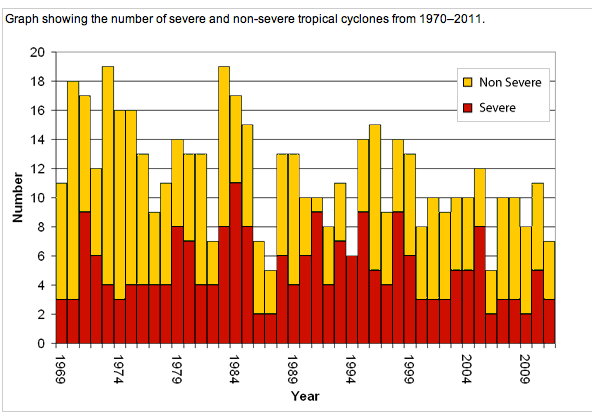
5. Data from the Bureau of Meteorology shows no increase in the number or severity of cyclones impacting Australia or the Great Barrier Reef. Click on the image for a better view…
This is contrary to a claim in the De’ath et al. 2012 paper that “cyclone intensities are increasing with warming ocean temperatures”.


6. While it is generally assumed, and inferred, that water quality at the Great Barrier Reef is deteriorating, these claims are not supported by the hard data as detailed in part 1 of this series… http://evacuationgrounds.blogspot.com.au/2013/05/the-great-barrier-reef-have-we-really.html
For example, chlorophyll monitoring on the Great Barrier Reef shows:
“Results to date show that compared with coastal regions in other parts of the world, chlorophyll a concentrations in the GBR lagoon are generally low. Chlorophyll a concentrations vary across the shelf seasonally and also with latitude. There are also persistent local gradients in chlorophyll a concentration, usually away from the coast. Consistent long-term trends in chlorophyll a concentrations haven’t yet been discerned.”. Download this text from AIMs website on April 4, 2013
http://www.aims.gov.au/docs/data-centre/chlorophyllmonitoring.html

Furthermore the De’ath et al. 2012 study states: “The disturbance data for COTS and cyclones show periodic and random fluctuations but no systematic long-term variation over the 27 year observation period.”
 
This article was first published at jennifiermarohasy blog
Permission for this cross post was given by Jennifer Marohasy 

Saturday, 11 May 2013

Old hands tell good reef story

For those who only get to read the scaremongering of the "experts" who sit in their ivory towers in front of a computer in some far off office, a story published today in the Cairns Post gives a different perspective.
This perspective is one which locals and those who actually know the reef have agreed upon consistently.
Ben Cropp has been diving reefs worldwide and particularly the Great Barrier Reef for sixty years. He is a marine life filmmaker. 

One would expect that he would be more qualified to comment on the health of the reef than those who sit in offices theorising about what "might" happen and trying to damage the integrity of the reef in our areas.
Why would someone in America or Brisbane/Sydney/Melbourne etc. in the comfort of their air-conditioning be more qualified to have their theories believed than those who actually love, live and work in the area consistently for decades?
Anna Bligh came to Cairns for one day a few years ago and was able to go away claiming that the damage from run-off was so terrible. Her expertise was that she put her hand over the side of a boat for a picture shoot!!!!!!! How would she know and where is she now?? 


I am including a link to a story published in the Port Douglas Newsport last year. Peter Wright and Ben Cropp both marine experts with decades spent on the Great Barrier Reef.

http://www.tourismportdouglas.com.au/Reef-report-misleading-says-local-expe.8417.0.html

Here is another story which was in the paper earlier this week:
More scaremongering from those who want to stop any industry or enjoyment. The Reef is shown to be in good condition by those who actually know the area.
http://www.cairns.com.au/article/2013/05/09/242077_local-news.html


The Great Barrier Reef: Have we Really Lost Half of It? [Part 1: Water Quality]

by Jennifer Marohasy
 
IT was all over the news again this morning, that unless action is taken to improve water quality the Great Barrier Reef could be placed on the World Heritage list of sites in danger and by the way, there has already been a 50 percent decline in coral cover at the Great Barrier Reef.
No wonder the average person is concerned about the environment! Such casual reporting that we have already lost a full half of the Great Barrier Reef!


Photograph by Walter StarckThis publicity is all part of a campaign to stop the development of new port facilities along the Queensland coastline. But rather than just come out and say they don’t want more development– that in fact they despise industry– the activist scientists dress it up as the end of the Great Barrier Reef as we know it.
I have written extensively about the water quality scare campaigns of the late 1990s and early 2000s [1,2,3]. They weren’t about new port developments, but they did prostitute science just like this new campaign.

Photograph by Walter Starck

It is still my contention that while agriculture is having a measurable impact in Great Barrier Reef catchments i.e. in river and streams that flow into the GBR, there is no measurable negative water quality impacts on the Great Barrier Reef proper [1,2,3].
This is a highly contentious claim. But it’s supported by the data [4]. Indeed the Australian Institute of Marine Science has been measuring water quality across the GBR for decades –- cross shelf and seasonal patterns of water column nitrogen (nitrite, nitrate, dissolved organic nitrogen, particulate nitrogen) and chlorophyll a concentrations –- and the data shows no trend of eutrophication. Indeed both nearshore and offshore reefs appear to be developing, for the most part, in a generally low-nutrient environment.
Nevertheless, hundreds of millions of dollars have been spent over the last 10 or more years ostensibly to improve reef water quality. Just a week ago I was told by a Central Queensland landholder that she has received a little over A$100,000 in government grants over the last few years to undertake improvements on her farm as part of the Reef Rescue program [5]. She said she doubted that any of the several projects could conceivably have an impact on reef water quality, but they have significantly improved the value of her property. Indeed, there is money to construct water troughs and increase ground cover and the list goes on [6]. That is the power of the agricultural lobby, they couldn’t beat the WWF campaign that painted them as destroying the reef [2], but they were encouraged to put their handout for government money and got A$400 million to be distributed to landholders and hangers-on.
All this money, and still the perception that reef water quality is deteriorating! Then again, I guess there wouldn’t have been the extra $200 million announced recently for rural industry, and extension of the same tax-payer-funded program to 2018, if there were a perception that the perceived water quality problem had been solved.
But what about this claim of a 50 percent decline in coral cover? The claim was recently made in the preamble to a petition by a group of “respected coral reef scientists” and promoted by Scientific America [7]. They reference a peer-reviewed paper entitled ‘The 27-year decline of coral cover on the Great Barrier reef and its causes’ published in the Proceedings of the National Academy of Science by Dr Glenn De’ath et al 2012. [8]
I’ll start to dissect this claim in Part 2 of a planned series on the Great Barrier Reef.
***
References/Further Reading
1. Great Barrier Reef ‘research’ – A litany of false claims By Jennifer Marohasy, October 2011 http://www.onlineopinion.com.au/view.asp?article=12719
2. WWF Says ‘Jump’, Governments Ask ‘How High’? By Jennifer Marohasy, March 2002 http://pandora.nla.gov.au/pan/33869/200304300000/www.ipa.org.au/pubs/ngounit/wwffs.html
3. Deceit in the name of conservation By Jennifer Marohasy, March 2003 http://jennifermarohasy.com/wp-content/uploads/2011/08/Review55-1DeceitinNameConservation.pdf
4. For example… Chlorophyll monitoring on the Great Barrier Reef “Results to date show that compared with coastal regions in other parts of the world, chlorophyll a concentrations in the GBR lagoon are generally low. Chlorophyll a concentrations vary across the shelf seasonally and also with latitude. There are also persistent local gradients in chlorophyll a concentration, usually away from the coast. Consistent long-term trends in chlorophyll a concentrations haven’t yet been discerned.” Download this text from AIMs website on April 4, 2013 http://www.aims.gov.au/docs/data-centre/chlorophyllmonitoring.html
5. Reef Rescue  “In the first phase of the Caring for our Country Reef Rescue program, the Australian Government committed $200 million over five years (2008-09 to 2012-13) to improve the quality of water entering the Great Barrier Reef lagoon. Over the course of the program more than 3200 individual land managers received water quality grants for on-farm projects. Through the second phase of Caring for our Country, the Australian Government has committed a further $200 million to continue efforts to protect the Great Barrier Reef through improvements to the quality of water flowing into the Great Barrier Reef lagoon. Over a further five year period the Reef Rescue program will enhance the reef’s resilience to the threats posed by climate change and nutrients, pesticides and sediment runoff through a number of complimentary approaches. The next phase of Reef Rescue will support activities that will contribute to both the Sustainable Environment and Sustainable Agriculture streams of Caring for our Country.” Downloaded from government website on April 4, 2013 http://www.nrm.gov.au/funding/reef-rescue/
6. $200m to extend Reef Rescue program Beef Central, April 29, 2013 http://www.beefcentral.com/p/news/article/3062
7. Coal Development Threatens Great Barrier Reef by Stephanie Paige Ogburn, April 30, 2013 http://www.scientificamerican.com/article.cfm?id=coal-development-threatens-great-barrier-reef
8. De’ath, G., K. E. Fabricius, H. Sweatman, and M. Puotinen. 2012. The 27–year decline of coral cover on the Great Barrier Reef and its causes. Proceedings of the National Academy of Sciences. 109(44): 17995-17999.
***

This article was first published at jennifiermarohasy blog
Permission for this cross post was given by Jennifer Marohasy