Showing posts with label water quality. Show all posts

Tuesday, 28 May 2013

Haven’t Lost Half of the Great Barrier Reef: Part 2, Junk Methodology


by Jennifer Marohasy
 
HOW could scientists conclude that half of the Great Barrier Reef has been lost in the last 27 years: target coral reefs most affected by cyclones, coral bleaching and crown-of-thorn starfish outbreaks, while ignoring more representative reefs with healthy corals. And I didn’t make that up! It’s documented in a peer-reviewed study by H. Sweatman, S. Delean and C. Syms entitled: ‘Assessing loss of coral cover on Australia’s Great Barrier Reef over two decades, with implications for longer-term trends’ [1].

Indeed the claim that there has been a 50 per cent decline in coral cover at the Great Barrier Reef appears to be largely an artifice of the survey method. In particular, coral reefs most severely affected by bleaching in 1998, and reefs disproportionally affected by crown-of-thorn starfish outbreaks, and also reefs with insufficient time to recover from cyclones in 2009 and 2011 were targeted for repeated sampling, while more representative reefs with healthy corals were ignored.

In part 1 of this series, I reported that the World Heritage Centre will demand action by the Australian Government to spend vast sums of taxpayers’ funds to address this manufactured issue, or have the Great Barrier Reef placed on its World Heritage in Danger List. This demand is a recommendation of the United Nation’s International Union for the Conservation of Nature, UNESCO, in its State of Conservation report prepared for the June meeting of the UNESCO committee [2], which in turn is based upon a report of the environmental lobby groups WWF and the Australian Marine Conservation Society, whose report [3] in turn relies on the claims of a peer reviewed study by Glenn De’ath and co-workers [4].

The paper by De’ath and co-workers published in the US Proceedings of the National Academy of Sciences in 2012 [5] does indeed claim a 50 per cent decline in coral cover based on 27 years of data from the Australian Institute of Marine Sciences (AIMS) Long-Term Monitoring Program.

The scientists suggests 48 per cent of the decline can be attributable to cyclones, 42 per cent to crown-of-thorn predation and 10 per cent to coral bleaching. But remarkably, and at odds with the broad claims in De’ath et al. 2012, there has arguably been no increase in the incidence of cyclones over the same period [5], no evidence for deterioration in water quality at the Great Barrier Reef [6], and no general increase in the incidence of coral bleaching . So, it would seem remarkable that coral cover has declined so dramatically and purportedly from these sources.

De’ath draw their conclusions from modelling based on a study of just 214 reefs chosen from a total of approximately 3,000 reefs. So they sampled approximately 7 per cent of reefs. They do not explain in the paper how the 7 per cent of reefs were chosen, for example, they do not explain whether they randomly choose the reefs that would be studies as one draws numbers in a lottery, or whether particular reefs were selected. They also don’t explain if they continued to sample the same number of reefs over the 27-year period of the survey, or, for example, whether they reduced the number of reefs sampled over this 27-year period, and, for example, only went back to reefs that showed dramatic decline in coral cover.

Of course while scientists claim to be trustworthy, there is reason to be sceptical. As Aynsley Kellow, Professor and Head of the School of Government at the University of Tasmania, explains in his book ‘Science and Public Policy: The Virtuous Corruption of Virtual Environmental Science’ much of modern environmental science has been corrupted by noble causes. These same causes have brought tremendous prestige and wealth to many scientists.

Remarkably many problems with the AIMS long-term monitoring program, the exact same program relied upon by De’ath and co-workers to conclude half of the Great Barrier Reef has been lost, are detailed in a paper published just one year before by Hugh Sweatman and co-workers [1]. Sweatman and De’ath are colleagues at AIMS and incredibaly Sweatman is one of the authors of the 2012 De’ath paper.

In the 2011 paper Dr Sweatman writes with respect to sampling in the central section of the Great Barrier Reef:
“In the early years of the programme, up to 32 reefs spread across the Swains sector were surveyed annually, but only seven reefs in the south of the Swains sector were surveyed regularly 1993–2004. Five of these seven reefs had large and persistent outbreaks of A. planci for most of the survey period, a high incidence of outbreaks that was not representative of reefs across the sector”.

Sweatman et al. 2011 go on to explain that the overall decline, often reported in coral cover for the Great Barrier Reef, is mainly used to due to large losses of coral in six of 29 subregions. This loss is attributed to coral bleaching in 1998 and outbreaks of crown-of-thorns starfish. Otherwise, Sweatman explains that living coral cover increased in one subregion (3%) and 22 subregions (76%) showed no substantial change.

Furthermore, coral reefs in the great majority of subregions showed cycles of decline and recovery over the survey period, but with little synchrony among subregions and no long term decline.
Sweatman and co-workers conclude that much of the apparent long-term decrease in coral cover reported in the scientific literature results from combining data from selective, sparse, small-scale studies before 1986 with data from both small-scale studies and large-scale monitoring surveys after that date.

In other words Sweatman et al. (2011) detail problems with the methodology used by all studies that rely on the AIMS monitoring data. Yet these issues, central to the credibility of the claim that there has been a 50 per cent decline in coral cover, are ignored in De’ath et al. 2012.

******

This is part two of a new series on the Great Barrier Reef and claims that 50 per cent of it have been lost. Read part 1 here:  http://evacuationgrounds.blogspot.com.au/2013/05/the-great-barrier-reef-have-we-really.html

Links/References
1. Sweatman, H., S. Delean, C. Syms. 2011. Assessing loss of coral cover on Australia’s Great Barrier Reef over two decades, with implications for longer-term trends. Coral Reefs. 30: 521-531

2. IUCN, 2013, State of State of conservation of World Heritage properties WHC-13/37.COM/7B, accessed at http://whc.unesco.org/archive/2013/whc13-37com-7B-en.pdf

3. WWF AMCS, 2013, Report to the UNESCO WHC accessed at http://awsassets.wwf.org.au/downloads/mo030_fight_for_the_reef_report_to_the_unesco_world_heritage_committee_1feb13.pdf

4. De’ath, G., K. E. Fabricius, H. Sweatman, and M. Puotinen. 2012. The 27–year decline of coral cover on the Great Barrier Reef and its causes. Proceedings of the National Academy of Sciences. 109(44): 17995-17999.
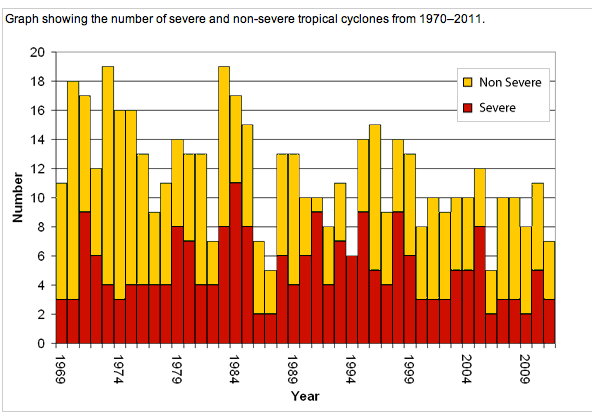
cyclone number
5. Data from the Bureau of Meteorology shows no increase in the number or severity of cyclones impacting Australia or the Great Barrier Reef. Click on the image for a better view…
This is contrary to a claim in the De’ath et al. 2012 paper that “cyclone intensities are increasing with warming ocean temperatures”.


6. While it is generally assumed, and inferred, that water quality at the Great Barrier Reef is deteriorating, these claims are not supported by the hard data as detailed in part 1 of this series… http://evacuationgrounds.blogspot.com.au/2013/05/the-great-barrier-reef-have-we-really.html
For example, chlorophyll monitoring on the Great Barrier Reef shows:
“Results to date show that compared with coastal regions in other parts of the world, chlorophyll a concentrations in the GBR lagoon are generally low. Chlorophyll a concentrations vary across the shelf seasonally and also with latitude. There are also persistent local gradients in chlorophyll a concentration, usually away from the coast. Consistent long-term trends in chlorophyll a concentrations haven’t yet been discerned.”. Download this text from AIMs website on April 4, 2013
http://www.aims.gov.au/docs/data-centre/chlorophyllmonitoring.html

Furthermore the De’ath et al. 2012 study states: “The disturbance data for COTS and cyclones show periodic and random fluctuations but no systematic long-term variation over the 27 year observation period.”
 
This article was first published at jennifiermarohasy blog
Permission for this cross post was given by Jennifer Marohasy 

Saturday, 11 May 2013

The Great Barrier Reef: Have we Really Lost Half of It? [Part 1: Water Quality]

by Jennifer Marohasy
 
IT was all over the news again this morning, that unless action is taken to improve water quality the Great Barrier Reef could be placed on the World Heritage list of sites in danger and by the way, there has already been a 50 percent decline in coral cover at the Great Barrier Reef.
No wonder the average person is concerned about the environment! Such casual reporting that we have already lost a full half of the Great Barrier Reef!


Photograph by Walter StarckThis publicity is all part of a campaign to stop the development of new port facilities along the Queensland coastline. But rather than just come out and say they don’t want more development– that in fact they despise industry– the activist scientists dress it up as the end of the Great Barrier Reef as we know it.
I have written extensively about the water quality scare campaigns of the late 1990s and early 2000s [1,2,3]. They weren’t about new port developments, but they did prostitute science just like this new campaign.

Photograph by Walter Starck

It is still my contention that while agriculture is having a measurable impact in Great Barrier Reef catchments i.e. in river and streams that flow into the GBR, there is no measurable negative water quality impacts on the Great Barrier Reef proper [1,2,3].
This is a highly contentious claim. But it’s supported by the data [4]. Indeed the Australian Institute of Marine Science has been measuring water quality across the GBR for decades –- cross shelf and seasonal patterns of water column nitrogen (nitrite, nitrate, dissolved organic nitrogen, particulate nitrogen) and chlorophyll a concentrations –- and the data shows no trend of eutrophication. Indeed both nearshore and offshore reefs appear to be developing, for the most part, in a generally low-nutrient environment.
Nevertheless, hundreds of millions of dollars have been spent over the last 10 or more years ostensibly to improve reef water quality. Just a week ago I was told by a Central Queensland landholder that she has received a little over A$100,000 in government grants over the last few years to undertake improvements on her farm as part of the Reef Rescue program [5]. She said she doubted that any of the several projects could conceivably have an impact on reef water quality, but they have significantly improved the value of her property. Indeed, there is money to construct water troughs and increase ground cover and the list goes on [6]. That is the power of the agricultural lobby, they couldn’t beat the WWF campaign that painted them as destroying the reef [2], but they were encouraged to put their handout for government money and got A$400 million to be distributed to landholders and hangers-on.
All this money, and still the perception that reef water quality is deteriorating! Then again, I guess there wouldn’t have been the extra $200 million announced recently for rural industry, and extension of the same tax-payer-funded program to 2018, if there were a perception that the perceived water quality problem had been solved.
But what about this claim of a 50 percent decline in coral cover? The claim was recently made in the preamble to a petition by a group of “respected coral reef scientists” and promoted by Scientific America [7]. They reference a peer-reviewed paper entitled ‘The 27-year decline of coral cover on the Great Barrier reef and its causes’ published in the Proceedings of the National Academy of Science by Dr Glenn De’ath et al 2012. [8]
I’ll start to dissect this claim in Part 2 of a planned series on the Great Barrier Reef.
***
References/Further Reading
1. Great Barrier Reef ‘research’ – A litany of false claims By Jennifer Marohasy, October 2011 http://www.onlineopinion.com.au/view.asp?article=12719
2. WWF Says ‘Jump’, Governments Ask ‘How High’? By Jennifer Marohasy, March 2002 http://pandora.nla.gov.au/pan/33869/200304300000/www.ipa.org.au/pubs/ngounit/wwffs.html
3. Deceit in the name of conservation By Jennifer Marohasy, March 2003 http://jennifermarohasy.com/wp-content/uploads/2011/08/Review55-1DeceitinNameConservation.pdf
4. For example… Chlorophyll monitoring on the Great Barrier Reef “Results to date show that compared with coastal regions in other parts of the world, chlorophyll a concentrations in the GBR lagoon are generally low. Chlorophyll a concentrations vary across the shelf seasonally and also with latitude. There are also persistent local gradients in chlorophyll a concentration, usually away from the coast. Consistent long-term trends in chlorophyll a concentrations haven’t yet been discerned.” Download this text from AIMs website on April 4, 2013 http://www.aims.gov.au/docs/data-centre/chlorophyllmonitoring.html
5. Reef Rescue  “In the first phase of the Caring for our Country Reef Rescue program, the Australian Government committed $200 million over five years (2008-09 to 2012-13) to improve the quality of water entering the Great Barrier Reef lagoon. Over the course of the program more than 3200 individual land managers received water quality grants for on-farm projects. Through the second phase of Caring for our Country, the Australian Government has committed a further $200 million to continue efforts to protect the Great Barrier Reef through improvements to the quality of water flowing into the Great Barrier Reef lagoon. Over a further five year period the Reef Rescue program will enhance the reef’s resilience to the threats posed by climate change and nutrients, pesticides and sediment runoff through a number of complimentary approaches. The next phase of Reef Rescue will support activities that will contribute to both the Sustainable Environment and Sustainable Agriculture streams of Caring for our Country.” Downloaded from government website on April 4, 2013 http://www.nrm.gov.au/funding/reef-rescue/
6. $200m to extend Reef Rescue program Beef Central, April 29, 2013 http://www.beefcentral.com/p/news/article/3062
7. Coal Development Threatens Great Barrier Reef by Stephanie Paige Ogburn, April 30, 2013 http://www.scientificamerican.com/article.cfm?id=coal-development-threatens-great-barrier-reef
8. De’ath, G., K. E. Fabricius, H. Sweatman, and M. Puotinen. 2012. The 27–year decline of coral cover on the Great Barrier Reef and its causes. Proceedings of the National Academy of Sciences. 109(44): 17995-17999.
***

This article was first published at jennifiermarohasy blog
Permission for this cross post was given by Jennifer Marohasy 

Monday, 18 March 2013

Science panel looks at water, not sick fish

From the Queensland Telegraph and also published at The Great Barrier Reef Blog
http://www.greatbarrierreef.org.au/new-science-panel-looks-at-water-not-sick-fish-by-john-mikkelsen-the-queensland-telegraph/


By John Mikkelsen
SPECULATION has been running hot over membership of the State Government’s new science panel to oversee Gladstone Harbour water quality, with claims there is no focus on the health of marine animals.
Makeup of the panel under the leadership of marine scientist Dr Ian Poiner was announced recently by Environment Minister Andrew Powell, but in local media comments, some Gladstone residents have pointed out the notable omission of a scientist who has already conducted independent research in the harbour, aquatic veterinarian  Dr Matt Landos.
Dr Landos yesterday confirmed to the Telegraph there was no one on the panel with veterinary fish health expertise.  He said the Australian and New Zealand College of Veterinary Scientists had an aquatic animal health chapter, of which he was a long term member.
“None of the members are on the panel. Only registered vets are qualified under the Veterinary Surgeons Act to make a diagnosis as an act of veterinary science.
“You go to a doctor when you are sick for a diagnosis.....not some other scientist. 

“They are obsessed with looking at indirect measures of health- for example, water quality, rather than look at the outcome- which is the animals living in the toxic soup they are creating.

“A classic case of they don’t know, what they don’t know, so a multi-disciplinary team approach is warranted…” he  said. (Dr Landos recently released a detailed scientific report on behalf of charity group, the Gladstone Fishing Research Fund, which blamed major dredging as the most likely cause of continuing disease in marine life).


Mr Powell said the science panel was tasked with providing independent expert advice about the long term management of water quality in Gladstone Harbour . It would provide open, transparent, peer-reviewed science to the Gladstone Healthy Harbour Partnership.
"The Independent Science Panel brings the key experts together at one table to integrate research and monitoring into a report card that gives a picture of the management of Gladstone Harbour and its surrounds," Mr Powell said.
He said the other panel members were chosen by Dr Poiner and were experts in their particular field. Local expertise was also being sought on the panel  from Central Queensland University.
Panel members to date include: Dr Richard Brinkman – hydrodynamics; Dr Michele Burford – biogeochemistry; Dr Rob Coles - marine biodiversity; Dr Cathy Dichmont - decision support and modeling; Dr Britta Schaffelke - water quality;Dr Jenny Stauber - marine toxicology; Dr Eva Abal - ecosystem health.
 Mr Powell said some of the first tasks the panel would undertake included mapping existing monitoring and research in the harbour to identify duplication and knowledge gaps.
"They will make recommendations to the Gladstone Healthy Harbour Partnership on actions required to address any emerging science issues.
"The group will also develop the design for future Gladstone Healthy Harbour Report Cards,” Mr Powell said.
"This is an important step that sees industry, government, research and the local community all working together to achieve and maintain a healthy Gladstone Harbour."