Showing posts with label history. Show all posts

Monday, 14 April 2014

NEW PIONEERS & A NEW WILD FRONTIER – THE BRIGALOW SCHEME

In 1976 I moved to Central Queensland to work with local Stock & Station Agent.
Not many years before in the 1960’s a whole new frontier was opened up to new settlers with the Brigalow Development Scheme. If you were lucky you might be able to go into a ballot with the Queensland Government to draw a block. The block you drew was virgin Brigalow scrub and once you had pulled, burnt, grassed and watered your block, and satisfied the government’s development conditions, you would get title to it.
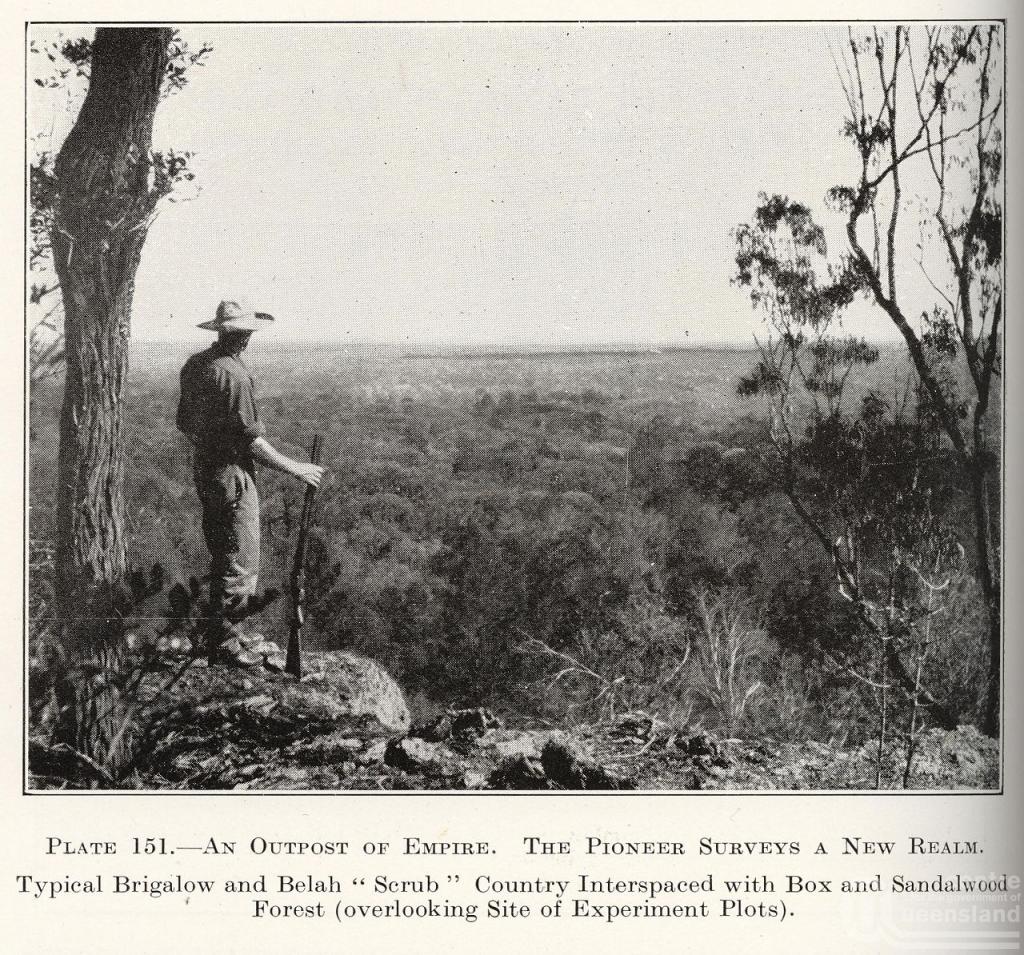
<span class="caption-caption">Typical Brigalow and Belah 'scrub' country interspaced with Box and Sandalwood Forest (overlooking site of experimental plots)</span>. <br />From <span class="caption-book">Queensland Agricultural Journal</span>, 1930, collection of <span class="caption-contributor">Fryer Library, UQ</span>.
Photo sourced Queensland Places - Brigalow belt
As most new settlers had little money to back them they had to spend most of their earnings developing their blocks so many lived in basic camps and sheds in what was a new frontier. Many stories abounded about life on the Brigalow blocks.

One such story was about a settler (who we shall call Settler) who had drawn a block that had two bores for water beside a creek that was also just near the neighbour’s boundary.
As mentioned, almost without exception, Brigalow settlers were always strapped for cash and so when the neighbour approached Settler with a suggestion that he knew someone, who had a property some distance away, who was looking for agistment and that he was offering an extremely generous price, Settler readily accepted.
As Settler had no yards, the cattle were unloaded at the neighbour's and put through the fence between the two bores.
On Settlers first inspection of the agisted cattle, after their arrival, he felt that there were far more cattle in his property than had been agreed.
In those days they had no phones at all, let alone mobiles and no electricity, so communicating something like a complaint about excessive cattle numbers could take some days.
So Settler approached the neighbour about it and was informed that he was also agisting cattle for the same person and that they were from the same mob. The neighbour suggested that some cattle may have got through the fence, which was in poor condition, to get back with their mates, but he would contact the stock owner about it. Settler asked for a paddock count.
Apparently it took some time before the stock owner and the neighbour arrived with horses to muster and do a paddock count, certainly far longer than any reasonable person would expect, so consequently, Settler was already well and truly “off side” when they arrived.
The cattle were mustered into a corner at one of the bores where the stock owner suggested that Settler count them along the fence whilst the stock owner and the neighbour held them back.
Each time the count started, Settler could hear the stock owner ” boring it into them” so that they raced along the fence 10 or twelve abreast, impossible to count and it was obvious that they didn’t want an accurate count.
The count was subsequently abandoned with Settler insisting that three quarters of the mob be removed. This was done with reluctant help from the stock owner.
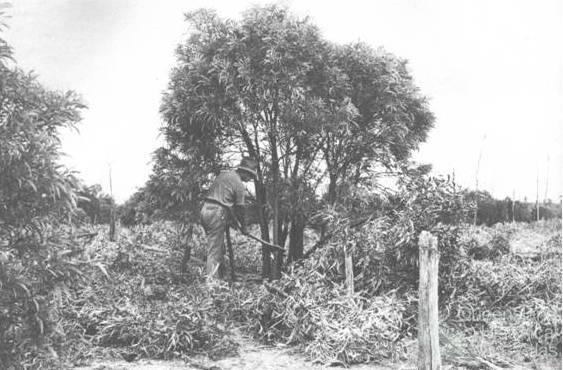
Brigalow suckers axed at Hannasford, 1939
Photo sourced Qld historical Atlas

Back at camp, Settler declared that the stock owner was not to be trusted and sent someone to patrol the boundary each morning on horseback to look for tracks. There often were.
Settler would also drive his old truck down to the bore in the evenings and check to see if anything was going on. He usually took a .303 rifle with him.
One evening, it was just coming on dark, when Settler encountered the stock owner and the neighbour with a mob of cattle near the bore. Settler was enraged.
Settler was not sure what they were doing, but it appeared they had just bought a mob into Settlers property and were holding them at the bore. They certainly had no right to be there and tried to beat a hasty retreat.
It was dark enough not to be able to see clearly but there is no doubting who they were and Settler pulled out the .303 and fired a shot in their direction. At this, there were cattle running in all directions, men yelling and general pandemonium. Settler quickly jumped into the truck and returned to his camp. Settler had an awful feeling that he may have shot someone.
A few days later the Police Sergeant from a nearby town paid Settler a visit. After the Police sergeant left Settler said that a complaint had been made by the stock owner and that one of his men had been shot through the leg and his horse had been killed. There was, however, no dead horse at the location of the shooting.
Whether someone had been shot or grazed by the bullet or not, we still don’t know. Settler felt that the whole complaint to the Police may have been an exaggeration in the hopes that the Police visit to Settler would deter him from any further action.
In any case, apparently the Sergeant had given him a lecture on the consequences of shooting someone.
The whole agistment deal was a disaster, the stock owner hadn’t paid and owing to the overstocking Settler had no grass, so you can only imagine Settler’s utter amazement when he looked up one morning, at the sound of a vehicle, to see the stock owner coming down the track.
At the sight of the stock owner, Settler was heading inside for the gun. The stock owner stopped about 100 metres from the camp and got out of his vehicle with his hands in the air (like you would if you were being arrested at gunpoint).
The stock owner then shouted:-
”Settler, I hear you want to sell the place”.
On hearing these words Settler’s demeanour changed in an instant and he said:-
“Come in and have a drink”

Saturday, 25 January 2014

WHY AUSTRALIA DAY MATTERS


By Leo Maglen
First published at Quadrant Online, January 24th 2014  \ Why Australia Day Matters
http://quadrant.org.au/opinion/qed/2014/01/australia-day-matters/


The heroes of our nationhood were not resistance leaders or freedom fighters, but politicians and statesmen, most now forgotten or only half-remembered. Their creation is an achievement worth celebrating

 
australiaAn amazing, but little remarked, fact in the current concern about securing Australia’s borders – cue ‘Operation Sovereign Borders’ – is that they are entirely maritime.  We have no land borders, and Australia is the largest country in the world not to have any any.  According to Geoscience Australia, we have a coastline of almost sixty thousand kilometres (mainland plus islands).  The perimeter of our territorial waters is probably longer, and the outer edge of our exclusive economic zone (EEZ) longer again.  Back on shore we have, of course, state borders, and we once built a rabbit-proof fence over thousands of kilometres of outback, but only at sea do we share international borders with other countries (PNG Indonesia and East Timor).

Australia is the only inhabited continent that is not criss-crossed with international boundaries and a patchwork of nation states.  Not for us razor-wire fences, concrete barriers, guard-posts, check-points, manned border-crossings, heavily armed border patrols, disputed terrain.  We are one country, one nation, spanning an entire continent and its offshore islands.  The shape is so iconic, so much the image of our country, that we take it for granted.

It is pertinent to ask how this happy situation came about.  It was not, it must be said, anything to do with the first inhabitants, the Aborigines and Torres Strait islanders.  Whilst they had spread across the entire continent and adjacent islands, and shared a nomadic hunter-gatherer existence, they were divided into around 250 separate tribal groups, each with its own traditions, customs, language and territory, with which it had a strong and deep affinity.  Whilst there was, of course, contact between adjacent groups, it is doubtful whether there was any knowledge of, or affinity with, groups beyond this range of contacts, with those living on the other side of the continent.  Nor is it likely that the first inhabitants had any concept of the country, of the continent, of Australia, in its entirety.  This awareness could only come in the modern era.

It was the British, at the end of the eighteenth century, who changed all that.  It was an Englishman, Arthur Phillip, who with a small ceremony on the shore of Botany Bay on 26 January, 1788, began the annexation of the continent for the British Crown.  It was another Englishman, Matthew Flinders, who first circumnavigated the continent and revealed in detail its size and shape, and it was he who bestowed upon it the name Australia.  In just a mere 113 years after Arthur Phillip established the first British settlement at Sydney Cove, Australia became a united sovereign nation, taking its own place in the world.  This it achieved freely, and with the encouragement and consent of Britain.  There was no ‘throwing off of the British yolk’, no need for an independence struggle.  The heroes of Australia’s nationhood were not resistance leaders or freedom fighters, but politicians and statesmen, most now forgotten or only half-remembered.

From the moment of Phillip’s annexation Australia became part of the British Empire, and through this the Anglosphere, that group of English-speaking countries that subscribe to the same values and share the same heritage of democratic institutions, parliamentary system of government, separation of church and state, equality before the law, respect for private property, strong civil society, protection of basic freedoms.  It has been upon this base that Australians, old and new, have built our remarkably prosperous, free, open, tolerant, outward-looking, progressive and enterprising way of life.  It is this bedrock, not the continent’s great wealth of natural resources, that makes Australia a ‘lucky country’.

It is, of course an article of faith amongst Aboriginal activists and the grievance industry generally to see things in a different, much darker, more doom-laden way, to view the running up of the Union Jack by Phillip on that day as the beginning of the end, the start of an invasion, one that would lead to the subjugation of the first inhabitants and the destruction of their culture and way of life.

What this view overlooks, of course, is that such an ‘invasion’, or even a succession of them, was inevitable.  On no other continent have the original inhabitants been successful in holding on to their lands and traditional ways of life.  Through waves of invasion, conquest, migration, settlement, by people ever more technologically and organisationally advanced, similarly nomadic hunter-gatherers either adapted, or were forced into ever more remote, inaccessible and inhospitable terrain, as in Asia, Africa and the Americas, or driven to extinction, as in Europe and the Middle-East,.  What is remarkable in the case of Australia is that it hadn’t happened earlier, and that the first inhabitants were able to enjoy their idyll for as long as they did.

So it if hadn’t been the British, it would have been someone else, or a bunch of others, contesting the terrain, carving it up, claiming it as their own.  Given the location of ‘the Great South Land’, there was, however, only a shortlist of likely contenders, with the requisite technological and organisational capacity, the global reach and the territorial ambitions, to accomplish the feat, either on a full-scale or piecemeal basis.

No-one else in the region, the Papuans, the Javanese, the Japanese or the Chinese, for example, felt so inclined or had the logistics to invade the place.  Otherwise, presumably, they would have done so ages before.  Arab traders, who for centuries had conducted business as far east as the spice islands to our north, and who brought their religion with them, apparently never reached these shores or contemplated coming here.  Even the Moluccans, who for a long time had fished and traded along the northern coast, failed to establish any permanent settlements on the Australian mainland.  By the modern era, therefore, it was most likely that it would be a European maritime power that would do it and, of those, there were only four other real contenders – the Portuguese, the Spanish, the Dutch and the French.    As it happened, it was the British.  It was they who brought the country into the global community.

But we could pause, perhaps, to contemplate had it been otherwise.  The Portuguese and the Spanish, of course, had been around Australian waters for hundreds of years before 1788, but did not take the extra step of planting settlements in Australia.   Had they done so, then the country certainly would have been different, and perhaps more akin to Latin America today.  The Spanish and the Portuguese had a record for being less enlightened and more despotic colonisers than the British ever were, and their legacy in the lands they did conquer has not been as stable, democratic or economically as successful.  The Dutch were in the East Indies, also, for centuries before, without seriously contemplating colonising the great land to the south.  Had they done so, then perhaps Australian settlement would have been much more like that of the Afrikaaners in South Africa, where they did put down roots, with all that would have entailed, particularly for the original inhabitants.  The French, like the British, were much later on the scene, and had La Perouse not been pipped at the post by Phillip’s First Fleet, then New South Wales, or whatever other name it would have had, could possibly have become French territory.

Many Anglophobes and Francophiles, of course, would perhaps think that would have been a better outcome, but one thing is certain, Australia today would be much more French than it is recognisably British.  The French, of course, have had a different attitude to de-colonization to that of the British.  They, the French, have been most reluctant to give up any of their colonies, and in those in which the locals have not been able to force them out, they remain to this day, as they do in nearby New Caledonia and French Polynesia.  Contemporary Australia is clearly no longer outwardly British, (despite some republican assertions to the contrary). Indeed, it hasn’t been so for some time, and it is difficult to say when it was the British actually left. That would not be the case, I venture, with the French, had the country started out as a colony of France.

The other possibility, already mentioned, is that the continent of Australia could easily have been not a single nation, but one divided into competing European colonies, with all the likelihood of frontier disputes and inter-colonial wars.  Australia was spared this because British claims to the whole continent were never successfully challenged by either the inhabitants or by other European or regional powers. 

Not having to share a land border with another nation has bestowed upon us huge benefits, especially in the areas of defence, quarantine, customs, immigration and in terrorism prevention.  Australia is its own customs union, free-trade area and common currency block.  It has only one official language and a unified legal system.  If we think that protecting a sea border is a difficult enough exercise, and that the interstate rivalries and constitutional wrangles that bedevil the federation are often tedious and troublesome, we should spare a thought for what it may have been like had Australia been not one country but many.

So, all in all, the country could have done worse than have Arthur Phillip plant the Union Jack on its soil 226 years ago.  Although they didn’t appreciate it at the time, Phillip probably gave the first inhabitants as good a chance of surviving in, and adapting to, the global world as any ‘invader’ could have given them, and the waves of immigrants that subsequently came, and are still coming, to these shores, a much freer, safer, fairer, equitable, open, tolerant and prosperous place in which to start a new life than might otherwise have been the case.

January 26 1788 is well worth commemorating, and celebrating, as Australia’s Day.
.

Monday, 11 November 2013

Remembering red poppys; forgetting white feathers

Today is Remembrance day where we stop on the 11th hour of the 11th day of the 11th month to mark the end of World war 1. This war had a profound affect on Australia; the loss of life as a percentage of this young federated nation was massive. The loss of those young men in the years following the war was sorely felt.
In no way is the posting of this poem is intended to devalue the loss and sacrifice of World war 1. It is done so to remember all of our historical past.

White Features and the Great War
'Unconscionable hectoring',  she said, crushing the feather.
  'Two brothers I've lost. And you, your father and sister.
How much of family must family give? What kin can remain?
  They who sent this decline to give their names,
yet pit your conscience against you and are doubly cowards.
  Show me, George, a singular courage and ignore them.
Attend to me, your pregnant wife and sole companion.
 Stay for the birth; deny this war more death.'
But his eyes were far away and his manner agitated;
  to stay he'd have to volunteer and go.
'Here I have to live', he said, 'whatever I do,
  and here my son, or daughter, will question me.
Unlike some men, I'm capable, have height and health
  and no excuse not to offer; I have to go.'
'It's kicking', she cried of their unborn child. 'Put your hand here.'
  It kicked again. 'It must be a boy', he said.
'I'll keep my head down', he told his wife, embracing fullness.
  He'd cup that kick in his hand till the day he returned.
 
By Timoshenko Aslanides
This is the entry for the 18th July out of the book AnniVeraries: 366 Linked poems, one based on an historical event for every day of the Australian Year.
 
Previously published poem by Timoshenko Aslanides
 
.