Tuesday, 17 June 2014

Peter Spencer: Finally will present his case

NSW farmer Peter Spencer outside the High Court, Canberra
 
 
Peter Spencer will finally be allowed to comprehensively present his case to the court on the 24th November after over six years of overcoming many obstacles. If successful the case will set a precedent to make governments of all descriptions to think twice before the arbitrarily taking property rights


The case centres around the right of the Australian Commonwealth to acquire carbon credits from farm land, without compensating the farmers, or landholders. The 2010 Senate Inquiry found that the carbon credits available from the various States’ Vegetation Management acts were used by the Commonwealth to meet the Kyoto protocol.

Peter Spencer has been out of the media for some time as a result of a media blackout imposed by the NFF’s Australian Farmer’s Fighting Fund which was for a time funding him. Now with the end in sight the AFFF has withdrawn their funding.
 
 
Please follow [this link] and listen to the audio of the interview with ABC radio NSW Country Hour reporter, Michael Condon. 
 

Sunday, 15 June 2014

Powerlink update for the PRA conference field trip

By Kerry Ladbrook, PRA Board Member 
Kerry Ladbrook with microphone & PRA chair Joanne Rea centre at the field trip to "Sydeva", Yuleba June 12 2014

Powerlink Qld , a Government Owned Corporation, have been contracted by the private Coal Seam Gas Companies to supply high voltage power to Origin & Santos infrastructure in the North West Surat Basin.
In 2013 landholders in this area highlighted  through an e-petition that was presented to Parliament that this was resource requested infrastructure for the benefit of the coal seam gas industry and should not be coming under the the Acquisition of Land Act 1967 but the Petroleum & Gas Act.
In this particular area, landholders are impacted by multiple high voltage infrastructure.  “Sydeva” has three high voltage powerlines interconnecting between 3 switching stations on neighbouring properties.  All three of the lines on “Sydeva” enter or exit from the Yuleba North Substation which is located on our property “Bulah” approx. 7 kms to the North West.  Yuleba North Substation is the central hub & has 5 high voltage powerlines emanating from the substation. These range from 275000 volt Tower construction to 132 000 volt concrete pole construction. There will be an estimated 9000 vehicle movements associated with its construction. In total there are 8 sub or switching stations and all are interconnected with high voltage power lines in the North West Surat area.
With the support of Howard Hobbs, the local member for Warrego, our issues have been raised with his colleagues in State Parliament. 
Landholders are still experiencing difficulties with the Powerlink approach although minor policy changes have been implemented that enable landholders to access expert costs required to detail compensation earlier at the release of the Draft Environmental Impact Stage and before Community Designation. 
Before this policy change, landholders were expected to meet their own costs until compensation was agreed upon which negatively impacted on their ability to negotiate.  Powerlink Qld does require quotations to be provided and accepted before the new process can commence.
Powerlink Qld has tremendous power under the Acquisition of Land Act, so do make sure they act responsibly with clean weed washdown certificates prior to any entry (which has been a serious issue not adequately addressed when PQ first began to access our land), consult properly resulting in line or substation movements if needed and detail compensation early utilising the new policy change process. 
PRA board members Trent Hindman & Kerry Ladbrook
at the PRA field trip to "Sydeva", Yuleba, June 12 2014
 
If there are major issues do not hesitate to beat on the door of your local members Office or involve the Resource Company requesting the infrastructure and make them take responsibility for what is really just another one of their contractors.
 
 
Once Community Designation occurs, landholders lose significant rights.  There is only one avenue to follow under the ALA and that is community designation.  There is no second tier for commercial linear infrastructure which is a serious flaw that needs changing in the Acquisition of Land act 1967.
There are a number of points as landholders we have raised that we would like detailed in legislation for this type of development to protect our rights & address the impacts from this type of development  and these include:
·        Recognition and payment of landholder time throughout the process.
·        Payment of compensation at a commercial rate
·        Ongoing annual payments for the life of the projects- expected to be 50-80 years .
·        Acceptable access protocols with emphasis on fresh & current weed washdowns prior to entry to landholdings. 
Origin and Santos to their credit have recognised that this high voltage infrastructure is resource requested and not community driven, and are now detailing annual “ goodwill” commercial payments for the life of the Coal Seam Gas Industry or 30 years (whichever is the lesser). 
This is a separate payment to the “one off” payment made under the Acquisition of Land Act by Powerlink  and  the two are not connected. .
 

Previously published related articles

It's time to recognise time  


Wednesday, 11 June 2014

Cooling Temperature Trend Establishing Across Northeastern Australia


Reblogged (with permission) fromJennifer Marohasy.com

The Hon Greg Hunt MP,
Minister for the Environment.
Dear Minister Hunt,
I wrote to you on 4th March 2014 with concerns that the claims made by the Bureau of Meteorology that 2013 was Australia’s hottest year on record, are somewhat deceptive. In that letter I explained that the official temperature record has been truncated to begin in 1910 (thereby excluding the hot years of the Federation drought) and that the method used to calculate the annual average temperature for Australia is not transparent.
I’ve since come to understand that the annual average temperature for 2013, which the Bureau claimed was a record, is in fact a wholly contrived valued based on modeling of temperatures, rather than the averaging of actual recorded values. That is, careful scrutiny of the Bureau’s methodology shows that recorded temperatures at locations across Australia are submitted to a two-step homogenization process that can have the effect of changing the entire temperature trend at specific locations. A weighted mean of these ‘homogenized’ values is then used in the calculation of the Australian annual mean temperature. In turn, the ‘homogenized’ values are used by the Intergovernmental Panel on Climate Change (IPCC), which gives advice back to the Australian government on global and Australian temperature trends.
A problem with this approach is that it can deliver an impression of climate change which accords wholly with expectations. But, it is reality that Australians should be planning for, so it would be better if the Bureau used real data, rather than modeled output when reporting temperature trends. Indeed to quote Aldous Huxley, ‘Facts don’t cease to exist because they are ignored.’
At the invitation of the Sydney Institute, I will be giving a talk on 25th June 2014, that shows the detail of how this methodology is applied, using the locations of Bourke in western NSW and Amberley in Queensland as case studies. I encourage attendance from the Bureau to scrutinize my presentation for accuracy. Indeed, all Australians should have a clear understanding of the nature of the data used in the calculation of important and highly publicized temperature statistics. All Australians should also have access to a realistic assessment of current temperature trends.
Very recently it was brought to my attention that Graham Williamson wrote to Rob Vertessy, Director of Meteorology at the Bureau, also querying the claimed increase in temperatures. Mr Williamson, in his letter of 27th May 2014, specifically asked why the Bureau of Meteorology did not acknowledge the 15-year hiatus in global warming as detailed in the recent report from the Intergovernmental Panel on Climate Change (IPCC, Chapter 10, AR5). In reply to Mr Williamson, Neil Plummer from the Bureau has suggested that the IPCC is simply referring to a slow down in the rate of global warming, rather than a pause as such. Given the IPCC reports are based on temperature trends derived from ‘homogenized’ data, rather than real observational records, I am concerned that they may also not be giving a true picture of recent climate change. To reiterate, even the IPCC is using modeled output rather than real data.
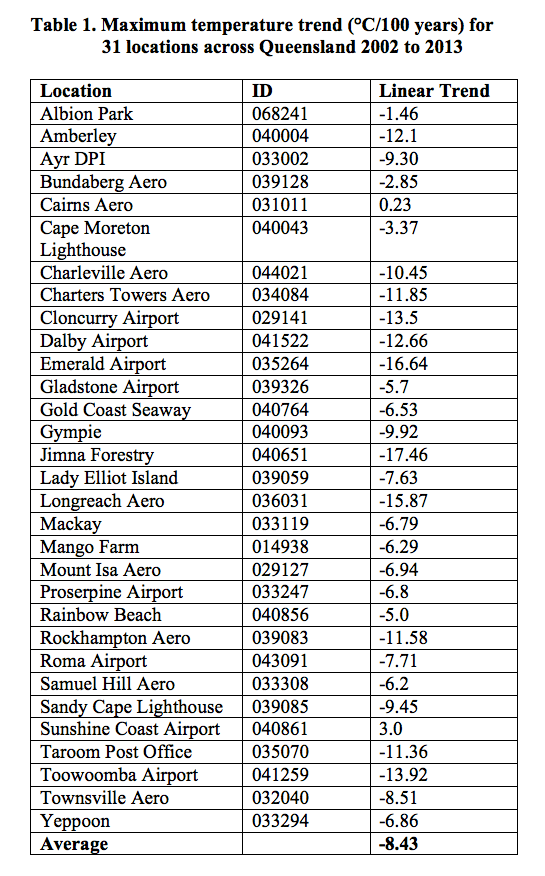
As part of ongoing research into natural rainfall patterns in Queensland, Professor John Abbot and I have been studying the temperature record for northeastern Australia, as temperature is a key input variable in our neural network models (e.g. Abbot and Marohasy 2014). Considering the data from the late 1800s until 1960, a cooling trend is evident, followed by warming between 1960 and 2001. In contrast, the last 12 years show quite dramatic cooling, Table 1. All three periods have occurred while greenhouse gases, particularly carbon dioxide, have been increasing in concentration in the atmosphere.
temps
Our analysis of the maximum temperature trend for the years 2002 to 2013 is based, not on the modeled temperature values used to generate official temperature statistics, but on the unadjusted observed temperatures also available from the Bureau of Meteorology website. The thirty-one sites across Queensland were chosen on the basis that there is a continual temperature record for the period 2002 to 2013 at each of the locations. We choose 2002 as the start date, as the data suggests a change in trend at about this year from warming to cooling. This is consistent with published studies by astrophysicists and physicists (e.g. Nicola Scafetta 2010, Abdussamatov 2012, and Lu 2013) and closely follows the timing of the last solar maximum (eg. NASA update 02/05/2014,http://solarscience.msfc.nasa.gov/predict.shtml). While Table 1 is limited to Queensland, preliminary assessment of data from NSW, Victoria and the Northern Territory also suggests the onset of a cooling trend.
This information is in stark contrast to the information in the State of the Climate Report 2014 recently published by the Bureau and also CSIRO. The report states that “warming over Australia has been consistent” and temperatures are “projected to continue to increase, with more hot days and fewer extremely cool days.”
In order to reconcile the information in Table 1, with the claims in the State of the Climate Report 2014, it is important to realize that, like the calculation of the annual mean temperature for Australia, data present in the report is based wholly on modeled output. That is observed temperature values have been first passed through a two-step homogenization process involving the application of complex mathematical algorithms.
It is important to make a distinction between output from a computer model and real data. In his bookScience and Public Policy: The virtuous corruption of virtual environmental science Aynsley Kellow, Professor and Head of the School of Government at the University of Tasmania, shows through many examples, including from climate science, how a reliance on computer models over the last 30 years as well as the infusion of values, has produced a preference for virtual over observational data. But the Australian public and Australian industry deserve much better from the Bureau.
As an Australian scientist with a keen interest in public policy and temperature records, I ask you as the Minister ultimately responsible for the activities of the Australian Bureau of Meteorology, to consider how you might reconcile increasing atmospheric concentrations of carbon dioxide with a falling temperature trend, and what needs to be done if we are to adequately prepare as a nation for the possible onset of a period of sustained cooling.
Yours sincerely
Dr Jennifer Marohasy
Adjunct Research Fellow
Central Queensland University
Links/References
Letter from Jennifer Marohasy to Minister Greg Hunt, 4th March 2014
http://jennifermarohasy.com/questions-for-the-australian-bureau-of-meteorology/
John Abbot and Jennifer Marohasy, 2014. Input Selection and optimization for monthly rainfall forecasting in Queensland, Australia, using artificial neural networks, Atmospheric Research, Volume 138, Pages 166-178.
Nicola Scafetta, 2010. Empirical evidence for a celestial origin of the climate oscillations and its implications, Journal of Atmospheric and Solar-Terrestrial Physics, Volume 72, Pages 951-970.
Habibullo I. Abdussamatov, 2012. Bicentennial decrease of the total solar irradiance leads to unbalanced thermal budget of the Earth and the Little Ice Age, Applied Physics Research, Volume 4. DOI: 10.5539/apr.v4n1p178
Qing-Bu Lu, 2013. Cosmic-ray driven reaction and greenhouse effect of halogenated molecules: culprits for atmospheric ozone depletion and global climate change, International Journal of Modern Physics B, Volume 27, DOI: 10.1142/S0217979213500732

Saturday, 31 May 2014

Ancient maps, Antarctica ice free

by Viv Forbes

sourced [here]

There is nothing unusual about ice caps melting, ice sheets splitting, icebergs calving or glaciers advancing or retreating. This has been happening naturally for eons.

In 1513, a Turkish sea captain, Piri Reis, using ancient maps, produced an accurate chart of the coastline of Antarctica which is now covered by a kilometre of ice. Geological evidence suggests it was ice-free just 6,000 years ago. Several past eras of icing and melting follow the natural cycles of the solar system, totally ignoring man’s puny activities.

It is not surprising that most glaciers and ice sheets show melting and calving while snow is being added at their source. If this did not occur, much of Earth’s water would eventually become tied up in the ever-growing ice sheets, as happened in the Ice Ages. And when land-based ice caps melt during periodic warm eras, the sea level inevitably rises and all life-forms must adapt to the new shoreline.

sourced [here]
Sea levels rose swiftly by some 130 metres as ice sheets melted at the end of the latest ice age just 13,000 years ago. This made islands out of many coastal hills. We are all descendants of a long line of survivors who had the sense to adapt to these dramatic sea level changes without needing edicts from climate witch-doctors prohibiting camp fires and ordering villagers to abandon their seaside settlements.

There is no evidence that man’s production of carbon dioxide is having any effect in Antarctica. Despite rising levels of atmospheric carbon dioxide, global surface temperatures are steady, global sea levels are rising very gently and the Antarctic Ocean is cold because the sea-ice surrounding Antarctica has increased to record levels.

Examination of ice cores suggests that it takes several hundred years for Earth’s vast oceans to fully adjust to cycles of global warming and cooling. Thus today’s oceans may be still warming, expanding and degassing in gradual adjustment to the medieval warm era which peaked about 700 years ago.

Ice caps grow and shrink naturally, depending mainly on the relative temperatures of the atmosphere and the surrounding oceans. A warm ocean with a cold atmosphere is a recipe for rapid accumulation of snow and ice on adjacent land. Moisture evaporates rapidly from the warm ocean, and then the cold air over the land triggers precipitation. A warm atmosphere and a cool ocean will reverse that process and see the ice caps return to the ocean. It is all about the ratio of precipitation vs outflow and melting.

The Arctic is a totally different story, because here, there is no land – just the Arctic Ocean. Floating sea ice comes and goes, depending on the temperature and direction of winds and ocean currents, but the melting of floating ice has no effect whatsoever on global sea levels.

Undersea volcanism is adding warmth to oceans at both poles and under-ice volcanoes may well be melting and undermining ice sheets in the West Antarctic.

Someday the huge Antarctic ice cap may melt, or large slabs of ice may slip off the continent into the sea. When that happens, the seaside homes of Al Gore and Tim Flannery will be submerged and other shore-dwelling humans must evacuate or drown.

These are all un-stoppable natural events. There is no chance that polar ice will be affected in the slightest by carbon taxes in Australia, wind turbines in the North Sea, or solar panels plastered all over California.

Alarmists see a man-made calamity in every change in the Antarctic ice cap.


For those who would like to read more:

Piri Reis map of Antarctica – Antarctica ice free!
http://www.ancientdestructions.com/piri-reis-map-of-antarctica/
http://www.youtube.com/watch?feature=player_embedded&v=BA73tcg5yYc

Sea levels rose by 130 m at the end of the last Ice Age just 13,000 years ago:
http://carbon-sense.com/index.php?s=guy&Submit=Go

Sea Level Change – Living with Uncertainty:
Full report (PDF)

Antarctic Sea Ice at record levels:
http://thesiweather.com/2013/12/03/1215-pm-global-sea-ice-areal-extent-at-highest-level-since-1994-southern-hemisphere-continues-on-a-record-run-for-this-time-of-year/

A warning of Antarctic melting, dated 1922:

http://stevengoddard.wordpress.com/2014/05/12/scientists-recycling-scare-stories/

Volcanic Activity beneath the West Antarctic Ice sheet:
https://news.wustl.edu/news/Pages/25611.aspx

Mt Erebus – the most active volcano in Antarctica:
http://news.nationalgeographic.com.au/news/2013/13/131118-antarctica-volcano-earthquakes-erupt-sea-level-rise-science/

Fire Under Arctic Ice: Volcanoes Have Been Blowing Their Tops In The Deep Ocean:
http://www.sciencedaily.com/releases/2008/06/080625140649.htm

Gullible Green Sailors trapped in Arctic sea ice:
http://www.cfact.org/2013/09/19/gullible-green-sailors-trapped-in-the-arctic/

Gullible Green Scientists trapped in Antarctic sea ice:
http://www.dailymail.co.uk/news/article-2531159/Antarctic-crew-build-ice-helipad-help-rescuers.html


Viv Forbes,
forbes@carbon-sense.com
Viv Forbes has studied geology, physics, chemistry and climatology at Tertiary level and has spent a lifetime continuing those studies. He is Chairman of the Carbon Sense Coalition, a sheep breeder and a non-executive director of a small Australian coal exploration company.

Monday, 26 May 2014

Occupational Confidence

Recently I received an email with this observation:
"It’s a bit ironic, really. Farmers and farm managers are the least confident, whereas food trade workers are the second most confident"
The observation was made to a publication by Roy Morgan Research into the Consumer confidence by profession, April 2014, Perk of the job or occupational hazard? Consumer Confidence by profession.

Let me explain why it is not ironic, really the lack of confidence is understandable especially after looking at these graphs that agricultural economist, Ben Rees, is very handy at putting together. Both are available in the paper, Reconstruct or Rationalize Agriculture?
 
In Chart 2 immediately below look at the red line and blue line.
Note the widening gap between Net Value Farm Production (NVFP) or in other words the dollars received at the farm gate and Gross value Farm Production (GVFP) or in other words how much agricultural production is worth to the economy.

The food trade workers are beneficial to that widening gap and their prospects have been rising every year.

Graph sourced:  Reconstruct or Rationalize Agriculture? Ben Rees; B. Econ.; M. Litt. (econ.)

Next look at the green line in chart 2; this is the real future killer for farmers - debt. The graph shows what many of us know in rural areas, that debt has got out of hand against what is received at the farm gate.

Then how are farmers able to service these increasing debt levels. In Chart 5 the story is told that would sink the heart of any optimist. The red line is the prices paid or the input costs to the farm, what the farmer has to outlay to keep the farm going. The blue line is the prices received or the farmers income.

No wonder there is a lack of confidence in the farm sector.

Graph sourced:  Reconstruct or Rationalize Agriculture? Ben Rees; B. Econ.; M. Litt. (econ.)

Thursday, 22 May 2014

Carbon credits turn to debt

Cate Stuart at Mount Morris
THE boxes are packed, the last of the cattle have been rounded up and the ute is loaded with chairs, saddles and tools.
Cate and Mark Stuart will be evicted from their historic Charleville cattle station, Mount Morris, on Thursday after rural lender Rabobank last year called in the receivers Ferrier Hodgson to ­recoup an outstanding debt of $2.6 million.
The Stuarts are heartbroken. But the tough outback family, which has run the 20,000ha far-west Queensland spread for the past six years, isn’t going without a fight. A very modern fight.
They say the bank has failed to recognise their wild and sprawling home is more than just a cattle farm: it is a carbon bank.
For the past four years, the ­Stuarts have worked with the specialist carbon farming company Australian Carbon Traders to capture and store carbon on 5000ha of their mulga tree ­reserves.
They planned to earn up to $400,000 every three years in valuable carbon credit payments.
But the bank is blocking the carbon-storage scheme’s go-ahead on Mount Morris, even though the Stuarts say the project is eligible for verified credits under the federal government’s Carbon Farming Initiative.
Rabobank says the problem with carbon farming is that it ties up farmland for too long.
In emails sent to the Stuarts, the bank states that it views the stored carbon mulga reserves, set aside for 100 years under federal government rules, as effectively a liability if the property was to be sold in the future. The bank does not see the carbon as an asset.
It’s an issue that goes to the heart of the Abbott government’s commitment to direct action as the best way to tackle climate change. The Carbon Farming Initiative is designed to benefit farmers and sequester carbon in soils and trees to cut carbon in the atmosphere.
For Cate Stuart, it is a situation that would be ludicrous — if it were not so tragic. “Here we are trying to do the right thing and store carbon in our mulga trees under the CFI, which is just what the Liberal Party, the Nationals, Labor and the Greens all say we should be doing, and the banks aren’t letting us do it,” she says.
“All we were trying to do is diversify our own income stream using mulga reserves on the property to store carbon, while at the same time looking after the land; instead we get thrown off our farm and our whole family is broken up.”
She sees Rabobank is doubly liable for their current financial woes. Not only did the bank refuse to give its approval to allow the mulga reserve scheme to go ahead on Mount Morris, but it also then blocked recognition of any potential income from carbon credits in its assessment of the farm’s financial viability.
Australian Carbon Traders chief executive Ben Keogh says the problem is being experienced by farmers across Australia. “This is a perfectly legitimate way of farming and an alternate land use that is a perfect fit for farmers in many of Australia’s drier zones,” says Mr Keogh.
“But the banks don’t see carbon farming as a serious way of earning income; they don’t think carbon credits will ever happen and so they don’t allow the systems to be proven and legitimised on properties where they hold a mortgage.”
Rabobank’s country banking chief, Peter Knoblanche, denies that his bank has any policy categorically opposed to all carbon farming projects on rural properties. While he did not know the specifics of the Mount Morris case, such carbon storage schemes were difficult for banks to handle. “It’s an interesting and complex topic and each proposal is different; but because land is often locked up under these schemes for such long periods of time, like the current 100-year rule, it does have the potential to restrict the other uses the land might be put to by future buyers if the farm is sold.”
The Australian Bankers Association recently held talks with the federal government to voice its concerns about the impact of carbon farming on farm valuations and long-term viability.
A spokesman for federal Environment Minister Greg Hunt said the government was establishing a 25-year option in addition to the current 100-year carbon farming rule. “This should significantly deal with some of the restrictions created by Labor’s insistence on an unrealistic 100-year requirement (for verified carbon storage projects),” the spokesman said.
Mr Keogh says the scale of the mulga tree carbon storage possible on Mount Morris is immense. In the past three years, the 5000ha of the Stuart’s mulga scrub regenerated to produce an extra four tonnes per hectare of timber or stored carbon.
At current rates of $20 a tonne, the price is current until February next year. Under previous government rules, the Stuarts were in line for a windfall of $400,000 in their first payment — if their bank had agreed to the project being formalised. Instead, project approvals are so limited that just 4.7 million credits worth $9.4m have been generated under the government’s vaunted Carbon Farming Initiative so far, to be sold back into the Emissions Reduction Fund.
Cate Stuart says all the excitement about carbon farming is now little solace for her family. With growing healthy mulga trees on her farm, but no carbon payment cheques flowing in, the receivers drove up her front drive last month, asking for the farm keys.
“We have tried to do the right thing and be good stewards of the land; instead we have lost everything we owned.”

Tuesday, 13 May 2014

PRA 2014 Conference - Proactive protection of your rights

Property Rights Australia media release:
Proactive protection of your rights – Coal Seam Gas & beef roundtables  

Property Rights Australia is offering those who attend their 11th annual conference a couple of opportunities seldom available on their own let alone packaged in the two day event in
Roma on 12 – 13 June 2014.
 
 
Speaking about the conference theme of, proactive protection of your rights PRA chair Joanne Rea said, “a field trip and presentations will give practical insights how you can be pre-emptive in protecting your rights. The main subjects covered at this conference will be the resource sector especially coal seam gas impact on landowners and also the proposed Global roundtable for sustainable beef.”
Day one has a full itinerary of property visits including a full scale developing coal seam gas field; not usually available for the general public. Connecting infrastructure for CSG fields such as high voltage Powerlink transmission lines will also be covered on the field trip. Attendees will be able to view infrastructure and talk directly to the landholders about their experiences.
On day 1 visit to Brett Griffin’s property “Sydeva”, north of Yuelba which has over 100 coal seam gas wells under development

Day two is the full-day conference with expert guest speakers including from leading legal firms. Mrs Rea said that, “PRA has endeavoured to bring together law firms who specialise in representing landholders and have an active hands-on presence in the Surat Basin. This creates the opportunity for attendees to access the combine expertise rarely gathered together at the one venue.”

 Member for Warrego Howard Hobbs will open the conference and Senator Barry O’Sullivan, proposer of the “Square Table” for beef will be the keynote speaker.

There will be one session of three speakers and a question & answer time devoted entirely to the crucial underground water resource. “Even if you are totally unaware of any imminent resource projects there are simple practical measures the landholder can undertake now with property bores that will give some protection to water supply in the future.”, Mrs Rea said, “This conference is planned to cater to provide knowledge from the absolute novice to those experienced in negotiations with resource companies with targeted talks by high calibre speakers.”

The conference is open to all and the cost has been reduced as far as possible so as to be affordable. Considering the access throughout the day to leading law firms the conference offers high value for money.

Please contact Property Rights Australia 07 4921 3430 to book your place.
.