Saturday, 11 May 2013

Old hands tell good reef story

For those who only get to read the scaremongering of the "experts" who sit in their ivory towers in front of a computer in some far off office, a story published today in the Cairns Post gives a different perspective.
This perspective is one which locals and those who actually know the reef have agreed upon consistently.
Ben Cropp has been diving reefs worldwide and particularly the Great Barrier Reef for sixty years. He is a marine life filmmaker. 

One would expect that he would be more qualified to comment on the health of the reef than those who sit in offices theorising about what "might" happen and trying to damage the integrity of the reef in our areas.
Why would someone in America or Brisbane/Sydney/Melbourne etc. in the comfort of their air-conditioning be more qualified to have their theories believed than those who actually love, live and work in the area consistently for decades?
Anna Bligh came to Cairns for one day a few years ago and was able to go away claiming that the damage from run-off was so terrible. Her expertise was that she put her hand over the side of a boat for a picture shoot!!!!!!! How would she know and where is she now?? 


I am including a link to a story published in the Port Douglas Newsport last year. Peter Wright and Ben Cropp both marine experts with decades spent on the Great Barrier Reef.

http://www.tourismportdouglas.com.au/Reef-report-misleading-says-local-expe.8417.0.html

Here is another story which was in the paper earlier this week:
More scaremongering from those who want to stop any industry or enjoyment. The Reef is shown to be in good condition by those who actually know the area.
http://www.cairns.com.au/article/2013/05/09/242077_local-news.html


The Great Barrier Reef: Have we Really Lost Half of It? [Part 1: Water Quality]

by Jennifer Marohasy
 
IT was all over the news again this morning, that unless action is taken to improve water quality the Great Barrier Reef could be placed on the World Heritage list of sites in danger and by the way, there has already been a 50 percent decline in coral cover at the Great Barrier Reef.
No wonder the average person is concerned about the environment! Such casual reporting that we have already lost a full half of the Great Barrier Reef!


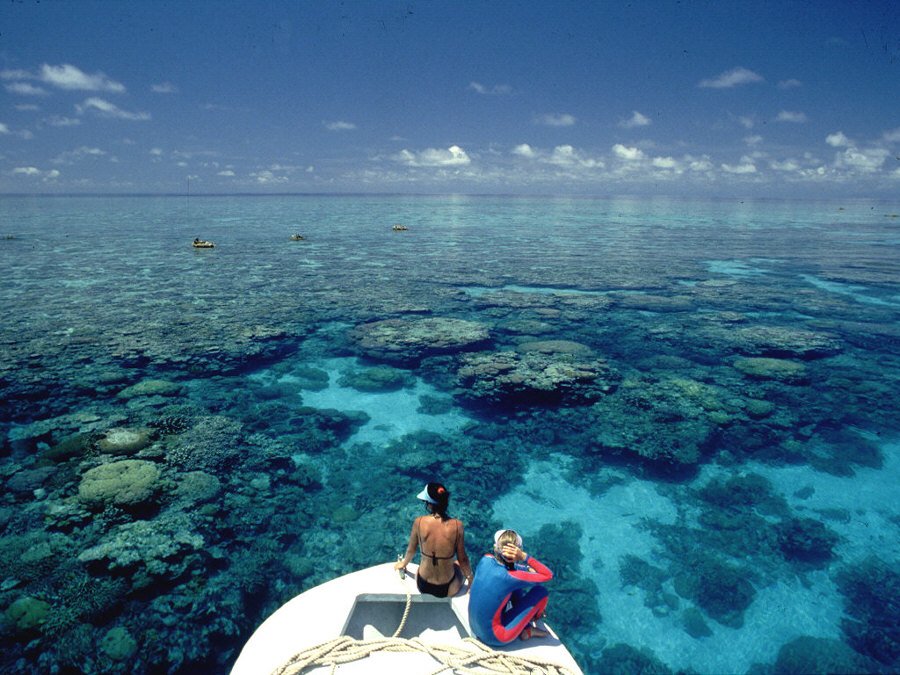
Photograph by Walter StarckThis publicity is all part of a campaign to stop the development of new port facilities along the Queensland coastline. But rather than just come out and say they don’t want more development– that in fact they despise industry– the activist scientists dress it up as the end of the Great Barrier Reef as we know it.
I have written extensively about the water quality scare campaigns of the late 1990s and early 2000s [1,2,3]. They weren’t about new port developments, but they did prostitute science just like this new campaign.

Photograph by Walter Starck

It is still my contention that while agriculture is having a measurable impact in Great Barrier Reef catchments i.e. in river and streams that flow into the GBR, there is no measurable negative water quality impacts on the Great Barrier Reef proper [1,2,3].
This is a highly contentious claim. But it’s supported by the data [4]. Indeed the Australian Institute of Marine Science has been measuring water quality across the GBR for decades –- cross shelf and seasonal patterns of water column nitrogen (nitrite, nitrate, dissolved organic nitrogen, particulate nitrogen) and chlorophyll a concentrations –- and the data shows no trend of eutrophication. Indeed both nearshore and offshore reefs appear to be developing, for the most part, in a generally low-nutrient environment.
Nevertheless, hundreds of millions of dollars have been spent over the last 10 or more years ostensibly to improve reef water quality. Just a week ago I was told by a Central Queensland landholder that she has received a little over A$100,000 in government grants over the last few years to undertake improvements on her farm as part of the Reef Rescue program [5]. She said she doubted that any of the several projects could conceivably have an impact on reef water quality, but they have significantly improved the value of her property. Indeed, there is money to construct water troughs and increase ground cover and the list goes on [6]. That is the power of the agricultural lobby, they couldn’t beat the WWF campaign that painted them as destroying the reef [2], but they were encouraged to put their handout for government money and got A$400 million to be distributed to landholders and hangers-on.
All this money, and still the perception that reef water quality is deteriorating! Then again, I guess there wouldn’t have been the extra $200 million announced recently for rural industry, and extension of the same tax-payer-funded program to 2018, if there were a perception that the perceived water quality problem had been solved.
But what about this claim of a 50 percent decline in coral cover? The claim was recently made in the preamble to a petition by a group of “respected coral reef scientists” and promoted by Scientific America [7]. They reference a peer-reviewed paper entitled ‘The 27-year decline of coral cover on the Great Barrier reef and its causes’ published in the Proceedings of the National Academy of Science by Dr Glenn De’ath et al 2012. [8]
I’ll start to dissect this claim in Part 2 of a planned series on the Great Barrier Reef.
***
References/Further Reading
1. Great Barrier Reef ‘research’ – A litany of false claims By Jennifer Marohasy, October 2011 http://www.onlineopinion.com.au/view.asp?article=12719
2. WWF Says ‘Jump’, Governments Ask ‘How High’? By Jennifer Marohasy, March 2002 http://pandora.nla.gov.au/pan/33869/200304300000/www.ipa.org.au/pubs/ngounit/wwffs.html
3. Deceit in the name of conservation By Jennifer Marohasy, March 2003 http://jennifermarohasy.com/wp-content/uploads/2011/08/Review55-1DeceitinNameConservation.pdf
4. For example… Chlorophyll monitoring on the Great Barrier Reef “Results to date show that compared with coastal regions in other parts of the world, chlorophyll a concentrations in the GBR lagoon are generally low. Chlorophyll a concentrations vary across the shelf seasonally and also with latitude. There are also persistent local gradients in chlorophyll a concentration, usually away from the coast. Consistent long-term trends in chlorophyll a concentrations haven’t yet been discerned.” Download this text from AIMs website on April 4, 2013 http://www.aims.gov.au/docs/data-centre/chlorophyllmonitoring.html
5. Reef Rescue  “In the first phase of the Caring for our Country Reef Rescue program, the Australian Government committed $200 million over five years (2008-09 to 2012-13) to improve the quality of water entering the Great Barrier Reef lagoon. Over the course of the program more than 3200 individual land managers received water quality grants for on-farm projects. Through the second phase of Caring for our Country, the Australian Government has committed a further $200 million to continue efforts to protect the Great Barrier Reef through improvements to the quality of water flowing into the Great Barrier Reef lagoon. Over a further five year period the Reef Rescue program will enhance the reef’s resilience to the threats posed by climate change and nutrients, pesticides and sediment runoff through a number of complimentary approaches. The next phase of Reef Rescue will support activities that will contribute to both the Sustainable Environment and Sustainable Agriculture streams of Caring for our Country.” Downloaded from government website on April 4, 2013 http://www.nrm.gov.au/funding/reef-rescue/
6. $200m to extend Reef Rescue program Beef Central, April 29, 2013 http://www.beefcentral.com/p/news/article/3062
7. Coal Development Threatens Great Barrier Reef by Stephanie Paige Ogburn, April 30, 2013 http://www.scientificamerican.com/article.cfm?id=coal-development-threatens-great-barrier-reef
8. De’ath, G., K. E. Fabricius, H. Sweatman, and M. Puotinen. 2012. The 27–year decline of coral cover on the Great Barrier Reef and its causes. Proceedings of the National Academy of Sciences. 109(44): 17995-17999.
***

This article was first published at jennifiermarohasy blog
Permission for this cross post was given by Jennifer Marohasy 

Friday, 10 May 2013

IPA: Let farmers do what they do best

By
First published [here] by the Institute of Public Affairs
Cross posted under the terms & conditions of IPA's copyright


The Colac Otway Shire council has faced local outrage over the proposed new laws that will place “draconian” restrictions on how farmers manage their land.  The council encompasses some of the great Western district farming areas of Colac, Cressy and Beeac, including the popular coastal destinations of Wye River and Apollo Bay.


The Shire has brought in the new laws to keep it in step with the Department of Environment and Primary Industries plans to remap the biodiversity and native vegetation maps across Victoria, leading some to warn that other councils may follow suit.

The Weekly Times notes that the proposed overlays on private property “can restrict ploughing of native grass, removal of fallen tree limbs for use as firewood, timber harvesting from purpose-planted native trees and even removal of rocks.”   What is perhaps the most galling about the proposed rules is that it in fact punishes farmers who have striven to be good conservationists by planting and caring for native species on their properties, and yet those who have stripped the land back will have no restrictions placed on them at all.  Local Beech Forest cattle breeder and business man, Ray Cooper, explains that farmers have been less considerate in their treatment of  the land “won’t end up having these overlays because they don’t have the native trees.”
Beeac farmer and former president of the Colac Shire, John Daffy, states that this is a prohibitive intrusion into private citizens’ lives.
What it means is they’ve got control of your property…Their fines are so prohibitive that you could be nearly forced off your property…
Concern has been so great that Daffy has formed a local action group to try and prevent the changes.  Yesterday’s deadline for the public outcry to the proposed changes illustrated that
Agriculture is the primary economic driver [for the Shire]. Why would you crucify your farmers?
Furthermore, it will affect the local economy, as farmers and businesses will be driven to trade in different areas as the new law will make it “very, very difficult for people to do business.”  The Institute of Public Affairs has written before on the impact that native vegetation and environmental laws have: please read them here and here.  The end result of making the good conservationist practices that Australian farmers are renowned for prohibitively expensive and overly regulated, will be to actively discourage the preservation of native species.  Perhaps more importantly though, it will decimate local farming communities, as people flee to make an easier, less micro-managed, career and businesses elsewhere


About Vivienne Crompton

Vivienne Crompton is a Researcher for the Legal Rights Project. Undertaking her Bachelor of Arts at the University of Melbourne, she majored in both History and Archaeology, focusing on Medieval and Early Modern Europe. Furthering her studies, Vivienne undertook the Juris Doctor, the University of Melbourne’s new graduate degree in law.
.

Monday, 6 May 2013

PRA: Qld reforms to Vegetation management act


Hats off to Premier Campbell Newman for having the courage to make much needed reforms to the Vegetation Management Act. With many of the worst attacks on our civil rights such as reversal of the onus of proof, denial of the right to silence and mistake of fact, to be reversed. These rights have long been considered basic principles of the Westminster system and their removal has received criticism from jurists and legal academics.


The Queensland government has acknowledged that it will not stay in power without the support of the South East corner and that a well organised and vocal environmental front will seek to portray any reforms as environmental vandalism. We are mindful of that.
Photo sourced Courier Mail


Property Rights Australia (PRA) appreciates and applauds the reforms made on behalf of rural Queenslanders by the Newman government.

The Vegetation Management Act 1999 had almost 400 amendments made during the terms of the Beattie and Bligh ALP governments with about half being retrospective. Clearly it was hastily drafted and unworkable.

The prosecution of the Act was shambolic with the Department of Environment and Resource Management (DERM) and its predecessors completely forgetting that as a government agency it was required to be a model litigant which requires it to adhere to the highest standards of probity and fairness in its conduct of litigation. It is also required to spend taxpayer's money with due cause and due process. Many who believed they were innocent were charged but were unable to field the resources to challenge against the might of the State. Charged but exonerated were landowners such as Ashley McKay who had a legal permit to clear.

Using taxpayer funds to chance their arm and to the ire of some Magistrates the Department brought cases which were out of time, where correct certified vegetation maps as specified by the legislation were not produced and one case where a government officer was charged with contempt of court. Other examples can be found of cases where fabrication of evidence and perjury were a feature.

Fines have been exorbitant and appear to have been administered in an ad hoc manner, with the penalties being many times higher than mining companies are commonly required to pay under other environmental protection regulations. Given the stress and financial hardship caused to landowners by these regulations, the amendments to this Act are well overdue and much appreciated.
Property Rights Australia has long advocated the necessity for reform and we are prepared to defend the Amendments against criticism in any forum


Saturday, 4 May 2013

JESTS, JOKES AND JOLLITY

JESTS JOKES AND JOLLITY by JAN
(nothing serious allowed)
I wish that I could write a poem or a witty piece of prose
But all that comes is doggerel which is somewhat on the nose.
I miss the place where we used to post exclusively for fun
Where nobody posted worries about the stuff that bothers everyone.
Where the jokes were hectic and eclectic in a column owned by Bro.Al
Where we liked to post our funnies, and it all went very well.
However, now we are on EG the format is of different kind
And Al’s eclectic site is plagued by the problems on folk’s minds.
John Miko said “C’mon Jano have a go” when I lamented the loss of fun.
So, “Jests, Jokes and Jollity” is what I’ve gone and done.
Now beware all those who would dare to post things to make us frown,
For I will ask the lovely Dale to moderate and take it down.

 
Image sourced from Fotonomy
 
 
Thanks Jan, who was saying they couldn't write, that's a brilliant little introduction
Everyone Jan has set the rules for this discussion, Jest, Jokes and Jollity, nothing that makes us frown.
Cheers,
Dale

Acceptable cruelty for seven months?

 Acceptable cruelty for seven months? - Activists allow cruelty to suit agenda


by Sherrill Stivano


The Australian cattle industry has voluntarily suspended export to Egypt while a new animal cruelty complaint is investigated by DAFF.


It appears that further acts of cruelty in one of our live export markets (this time Egypt) have been identified. They are unspeakable and terrible and I find it hard to believe humans are capable of such cruelty. I also find it extremely appalling that some of this footage was shot in October 2012 and some in April 2013.


Photo sourced from The Land


I am not going to condone this in any shape or form. I do not care if they are Australian animals or Egyptian or Somali. All animals of every nationality deserve to be treated with the highest level of animal welfare including at the point of slaughter. I would to know the following however:
  • 1. Why are we only hearing about it now?
  • 2. Why when you witness these terrible acts, and take the time to film them (without stepping in at any point to suggest it is wrong) do you then not immediately do anything?
  • 3. Why do you not immediately take the footage to the authorities so it can be acted upon straight away?
  • 4. How can you sit on the footage knowing full well that more of the same could be occurring in the following months, more animals suffering unnecessarily?
  • 5. Surely by reporting such an incident in October 2012 there is a good chance the second incident April 2013 would not have occurred?
 
I give you the following reasons for being able to film such cruelty and wait 7 months before approaching authorities………….
  • 1. We have an election coming up and the likes of Animals Australia want to bring Live Export into the forefront as an election issue especially since both parties have said they will not ban it permanently.
  • 2. The general public understand that industry has been very proactive and addressed many issues in our Live Export markets. They also understand that by Australia being present in these markets and educating them, introducing technologies and improving infrastructure we make a difference not only to the welfare of Australian animals, but all animals. Animal activists want to shock people into changing their beliefs. They give the impression this happens everywhere all the time. They receive donations to assist them in their advertising campaigns. All money that does not directly reach or benefit a single animal and its welfare as they are not about animal welfare, but rather animal rights which are two totally different things.
  • 3. And finally the ultimate agenda held by Animals Australia………..veganism for all. They are setting about to change the consumers views through scaremongering and misinformation in all livestock industries, from dairy to pork to chicken to beef to sheep.
 
I am not asking you to condone the cruelty or even to support Live Exports, but I am asking you to think about how those who film these acts are benefiting from the very same cruel acts. We have seen awards, monetary gain for groups and publicity all off the back of the cruelty filmed in the past. If they were not intent on gaining something they would be reporting it immediately, not 7 months later
.

Thursday, 2 May 2013

Political fiasco drawing to an end, but the pain will linger on

An opinion piece written by Senator Barnaby Joyce which was published in The Canberra Times on 2 May 2013 and also sent out by Senator Joyce's office to all on email mailing list.


Julia Gillard told us that the economy was going so well that the deficit had blown out to $12 billion. The debt went up by another half a billion and now the earnest scribes who swore black and blue that the debt was not a problem are now looking earnestly at the camera saying it is. Meanwhile, Labor delivered a similarly confused explanation from the Windsor book of high Athenian rhetoric.

Cartoon sourced from here
Although from the US, all that needs changing is swapping the White House for Parliament House.


But we do have one cost that is proportionally going down and that is unfortunately, our defence spending, which is now at its lowest level since 1937. I find that the most powerful tool to engage the electorate is to suggest what would happen to our nation if we let this Green-Labor-independent political fiasco continue in the job.

At the current Wollomombi Falls trajectory, there would not be much among the rocks at the bottom to pick up.

The Greens want everything ever dreamt of in their Kubla Khan, Xanadu euphoria, otherwise known as party meetings, to be paid for by a mining tax. The fact that they can never nominate a mine they support or wish to expand seems irrelevant in the land of little pink clouds of happiness and chatty tea parties with hesitant girls, tardy rabbits, and mad milliners.

From our side of the political debate, my friend Clive has not been helping out. Clive, please, starting a party is what Bob Katter has made into an art house film. Why join him on the set? It is a little more difficult than what is first anticipated and new parties gather new ideas at about the same rate as they gather self-appointed messianic figures who wish to grace Australia with their unrecognised talent.

Business is sitting back biting their nails. Business wants certainty, sanity and honesty; it sees the government crab walking to a new tax to cover the National Disability Insurance Scheme because they have no money for its promises.

It is a genuinely essential program to look after those severely disabled, but to be genuine in your belief in this, the government must suggest what current plans would be cut to pay for it. Anything recurrent you borrow for is a sign of bad management and temporary in its sustainability.

Taxes are always a drag on economic growth. If you keep putting on a little new tax that won't hurt you, you will ultimately get to one that, in combination with all the others, economically kills you.

At this juncture my feelings are not excitement at what the polls say is an impending election win; my choice to stand in New England makes my participation in that event a lot less likely. My feelings live somewhere between apprehension and anger.

How did this harlequin political crowd manage to formulate such a financially disastrous voyage? If they had done nothing more than continue on from where the Coalition left off, if they had basically gone on holidays, giving instructions that nothing much should happen beyond the set course of 1997, then our position would be vastly better than it currently is.

I remember very well the excited glee as Labor members went around a barbecue in the Parliament House courtyard at the start of the global, but actually more US and Europe - financial crisis. They proclaimed that government had to "go hard, go early, go household".

I remember thinking they should have added "go off your head and go broke". It was like the kid who had just learnt a rude word in a foreign language and was showing all in the school yard how smart they were.

They had no knowledge or desire to genuinely delve into the vast complexities of the financial grammar or even to undertake the sober step backwards, to have a good sleep, cold shower and observe the situation and our very minor global role soberly.

Now, Michael Chaney, chairman of National Australia Bank and Woodside Petroleum, is comparing our financial fate to that of Ireland. I wish him better luck than I had a few years ago.

 Barnaby Joyce is the Nationals’ Senate Leader and the Opposition Spokesman for Regional Development, Local Government and Water.