Well poor old Bob is blaming LNP advertising for the severe loss of his support base!!!!.
He is so delusional that he cannot see that his support base left him after the last Federal election - for many - those of us who are a bit quicker on the uptake left him years ago.
He thinks they left him after LNP's advertising during the campaign and is trying to blame that for his dismal result in 2013.
That is how out of touch with the electorate Bob Katter is and what I have been saying for some time on this and other forums.
Now people on another forum of which I was a member previously may realise I was not talking through my hat (or they may have thought worse things - lol).
Anyway this picture of Bob is on the front page of the "Tablelander" this morning. I couldn't stop laughing when I saw it.
This is the real Bob Katter. :-) :-)
In case you think I am enjoying this result, you sure are not wrong!!
Tuesday, 10 September 2013
Post politics jokes and elclectic thoughts

The federal election is now over, it's time to lighten up a bit. This is a post for you to place jokes and eclectic thoughts. It's open to all subjects, not just politics. In fact the less politics the better.
We haven't had a post like since JESTS JOKES AND JOLLITY by JAN (nothing serious allowed) and Jan's one rule was to comment nothing that will make us frown.
To start off I'm copying this comment by Peter from the Open Thread.
Some little gems that I came across.
We hang petty thieves and appoint the great ones to public office.
~Aesop, Greek slave & fable author
Those who are too smart to engage in politics are punished by being governed by those who are dumber.
~Plato, ancient Greek Philosopher
Politicians are the same all over.
They promise to build a bridge even where there is no river.
~Nikita Khrushchev, Russian Soviet politician
When I was a boy I was told that anybody could become President; I'm beginning to believe it.
~Quoted in 'Clarence Darrow for the Defense' by Irving Stone.
Politicians are people who when they see light at the end of the tunnel, go out and buy some more tunnel.
~John Quinton, American actor/writer
Politics is the gentle art of getting votes from the poor and campaign funds from the rich, by promising to protect each from the other.
~Oscar Ameringer, "the Mark Twain of American Socialism."
I offered my opponents a deal:
"if they stop telling lies about me, I’ll stop telling the truth about them"
~Adlai Stevenson, campaign speech, 1952..
A politician is a fellow who will lay down your life for his country.
~Texas Guinan. 19th century American businessman
I have come to the conclusion that politics is too serious a matter to be
left to the politicians.
~Charles de Gaulle, French general & politician
Instead of giving a politician the keys to the city…
it might be better to change the locks.
~Doug Larson (English middle-distance runner who won gold medals at the 1924
Olympic Games in Paris, 1902-1981)
Monday, 9 September 2013
Alternative to The Precautionary Principle?
by Don Aitkin
First published at Online Opinion, cross post via license under a Creative Commons License

I've written about the Precautionary Principle before. With that title it was adopted at the 1992 Rio conference on climate, and it has been used a great deal by proponents of the need to 'combat climate change' internationally. Built into it is Pascal's Wager about the correctness of believing in God, and it has analogies in the medical precept 'first do no harm'. I didn't like it when I first came across it, partly because it was dressed up as a 'principle' and partly because of the capital letters, which suggested importance and longevity.
Image sourced [here]
I've come across a most interesting paper by Max More, an English philosopher and futurist, which offers instead a 'proactionary principle'. There's a lot in it, and it's well worth reading. I'll discuss his alternative in a later post, but use this one to show his demolition of the precautionary principle. It is clear and accessible.
'The precautionary principle has at least six major weak spots. It serves us badly by:
First, the precautionary principle always assumes worst-case scenarios. Any release of chemicals into the environment might initiate a chain of events leading to a disaster. Genetically modified organisms might cause unanticipated, serious, and irreversible problems. By imagining the proposed technology or project primarily in a worst-case scenario, while assuming that refraining from action will have no disastrous consequences, the adherents of the principle immediately tilt the playing field in their favour.
Second, the precautionary principle ignores background risk, distracting our attention from established dangers to health. Nature itself brings with it a risk of harms such as infection, hunger, famine, and environmental disruption. We should apply our limited resources first to major risks that we know are real, not merely hypothetical. The more we attend to merely hypothetical threats to health and environment, the less money, time, and effort will remain to deal with substantial health problems that are highly probable or thoroughly established. The principle errs in focusing on future technological harms that might occur, while ignoring natural risks that are actually occurring.
Third, adherents of the precautionary principle assume that proposed regulations and restrictions will cause no harm to health. Yet the very application of the principle itself can endanger our health. Consider, for instance, the consistent correlation between the health of a nation's citizens and their standard of living. Widespread application of the precautionary principle, by hampering economic activity, will tend to reduce living standards and thereby worsen health. In addition, major efforts to eliminate small, speculative risks can unleash far greater and more likely harms.
Fourth, the precautionary principle fails to treat natural and human threats on the same basis. Users of the principle routinely ignore the potential benefits of technology, in effect favouring nature over humanity. The principle does not account for the fact that the risks created by technological stagnation are at least as real as those of technological advancement. As biochemist Bruce Ames of UCLA has demonstrated, almost all of our exposure to dangerous chemicals comes in the form of natural chemicals. Yet fear and attention are primarily directed toward synthetic chemicals. A particular chemical has the same effects regardless of whether its source is natural or synthetic. Despite this, scientifically unsound activists treat human-derived chemicals as guilty until proven innocent, and naturally occurring chemicals as innocent or insignificant.
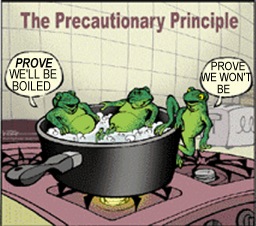
Fifth, the precautionary principle illegitimately shifts the burden of proof by positioning advocates of proposed activities or new technologies as reckless, in contrast with the 'responsible' advocates of 'precaution'. The content - even the very name - of the precautionary principle positions environmental activists and Luddites as friends and protectors of the common person. The innovators are made to prove safety, having already been portrayed as indifferent to the common good and interested only in profiting.
Image sourced [here]
Having illegitimately shifted the burden of proof, activists can impose their values without troubling themselves with evidence and without taking responsibility for the results of overly-precautious policies. For example, the Environmental Working Group opposed the use of pesticides, speculating about possible carcinogenic effects of trace amounts of their residues. They do not seem to have taken into account the probability that restricting pesticides would increase cancer rates.
Activists get away with the burden of proof trick by managing perceptions of risk instead of examining the real risks. This move is particularly dangerous because we have limited resources to address a multitude of risks. We cannot afford to make decisions driven by manipulated perceptions. It's crucial that we rely on a comprehensive, scientifically grounded perspective when choosing which risks have the strongest claim on our attention.
Sixth, and finally, the precautionary principle conflicts with the more balanced approach to risk and harm derived from common law. Common law holds us liable for injuries we cause, our liability being proportionate with the degree of foreseeable risk. By contrast, the precautionary principle dismisses liability and acts like a preliminary injunction, but without the involvement of a court, without the burden of proof, and without taking responsibility for harm caused by the injunction.'
.
Friday, 6 September 2013
FARMERS NOT HAPPY WITH BOB KATTER.
This ad went into the Northern Miner today.
Bob Katter has not served his electorate or farmers well.
The Katter party has preferenced Labor ahead of others on the Senate paper.
Why he is denying this is amazing!!!
He admits that he is Pro-Union and that they have donated six figure amounts to his campaign (reported in the media months ago).
Katter Australia Party has also preferenced Labor in MARGINAL seats of Griffith (Rudd), and Forde (Beattie) as well as another five of six definitely and we do not know how many others. HIs choice will only help Labor.
This has lost him to many.
This ad was produced by some farmers and is really written from the heart.
Wednesday, 4 September 2013
Pauline Hanson talks of water and Agenda 21
Pauline Hanson and Peter Manuel from FLAG Australia (Incorporated)
discuss Agenda 21 and Sustainable Development Bureaucracy that is
affecting the food bowl of Australia and in particular South Australia
under the NRMA Act 2004.
Peter, on the Food Producers Landowners Action Group (FLAG) site writes:
What an absolute privilege to be on stage with Pauline and hear her speak from the heart about Agenda 21 and the privatisation of our water and the restrictions that are being forced upon us farmers by the environmental movement which make it so difficult to supply this great country with a clean healthy food product.
Pauline came to South Australia after a phone call I made to her a few weeks ago in regards to Natural Resource Management issues that control the way we run our freehold land and the uphill battle we have to grow food. Pauline did not hesitate and took time out from her very busy campaigning schedule to come and speak and answer any questions thrown at her.
In the short time I had with Pauline it was very obvious that most that has been written about her over the years in regards to being a conspiracy theorist and racist is absolute rubbish. She is far from a racist, highly intelligent and what you see is what you get. She certainly wouldn’t do any dirty deals behind closed doors if she was fortunate enough to be elected into Parliament.
Tuesday, 3 September 2013
Insight into the Real Bob Katter
The front page of the Eacham Times today had the full page covering the Kennedy Electorate LNP Candidate, Noeline Ikin.
The reporter met up with the LNP candidate at the Ravenshoe Butchery.
The top article that I have posted here relays the words of the Ravenshoe Butchers wife.
The comments by Mrs Jensen is indicative of a lot of once upon a time supporters of Bob Katter (and a growing list of non-supporters over the years). The whole page was a bit big to copy and paste.
The other letters just about say it all.
PREVIOUS RELATED DISCUSSION
The reporter met up with the LNP candidate at the Ravenshoe Butchery.
The top article that I have posted here relays the words of the Ravenshoe Butchers wife.
The comments by Mrs Jensen is indicative of a lot of once upon a time supporters of Bob Katter (and a growing list of non-supporters over the years). The whole page was a bit big to copy and paste.
The other letters just about say it all.
.
Sex Party could help Pauline slip into Senate
My article published at ON LINE Opinion http://onlineopinion.com.au/view.asp?article=15425&page=1
By John Mikkelsen
By John Mikkelsen
While Labor seems to be sailing to a fate similar to the original Titanic come September 7, a swirling maelstrom of murky Senate preference deals could provide life jackets to a very mixed bag of Senate hopefuls, including Pauline Hanson.
She is just one of the strange bedfellows likely to benefit from a series of incongruous deals stitched up by party leaders at odds with their supporters.
How many rootin', shootin', cowboy hat wearin' real men in the north realize that a vote above the line for their doppelganger hero Bob Katter or his minions will flow to Labor and the Greens?
Will those who vote 1 for Big Clive Palmer or his candidates know that they are also voting for Family First, Labor and the Greens?
And if they think that sex will always beat politics (who could blame them for that?) do they know that a vote above the line for the Sex Party will flow down and possibly slide Pauline Hanson into a NSW Senate seat against the dry odds of a six- time loser?
Sex and Aunty ABC's news and current affairs don't normally go hand in glove, but the unlikely alliance between the Sex Party and Pauline Hanson reared its ugly head in a fiery finger-waving clash between the national broadcaster's election analyst Anthony Green and News Breakfast co-host, Virginia Trioli onThursday morning http://www.abc.net.au/news/2013-08-29/preference-deals-could-benefit-micro-parties-at/4920822
Green pointed out the 'flotsam and jetsam' swirling in the minor party preferences, using the Sex Party as an example. He was adamant its supporters would not be supporters of Hanson or One Nation, but in the event that she managed to pick up at least two percent of the vote, that is where their preferences would be directed, possibly helping her win the seat.
He conceded she would be swimming against the tide to obtain the necessary numbers with a position on the extreme right of the ballot papers (which some would say was apt), and that a magnifying glass was necessary to read all the names for the myriad of candidates and parties. The system was undemocratic and must be changed, he insisted.
Trioli said he "must have had his Wheet Bix," he was speaking privately and not for the ABC. She claimed voters may be happy to have their preferences allocated in such a way.
The National's Barnaby Joyce would have found the exchange amusing, having been on the receiving end from Miss Trioli in an off-camera moment following an interview several years ago when the journalist pulled a loopy face (apparently) and twirled a finger alongside her head implying Barnaby was short of the full quid.
But the retiring senator who has a shoe in for the House of Reps seat of New England vacated by Labor- supporting independent Tony Windsor, is in agreement with Green about the current preference deals.
In a Canberra Times column titled 'Don't let your Senate fall prey to vultures,'http://www.canberratimes.com.au/comment/dont-let-your-senate-fall-prey-to--vultures-20130822-2seb6.html#ixzz2cmAYlr4b Joyce writes, "Like native bird populations during a drought, these parties disappear in between elections only to magically appear at an election to funnel votes to the party lucky enough to benefit from back-room preference deals.
"Now, if you would please tell me where your Senate above-the-line preferences go, I will be far more comfortable. But, be honest - you haven't a clue".
He points out the irony of socialists and Greens benefiting from preference deals with Palmer and Katter.
"Indeed, Clive's preferences are a wild ride. In Queensland, if you vote for Clive Palmer, your votes go to Family First, then to the Socialists, then to the Greens, Fishing and Lifestyle, Katter, the LNP, One Nation, Democrats and finally to the Australian Christians, presumably to ask forgiveness…
"The Katter party, which ostensibly is opposed to everything Green, is preferencing the Greens ahead of the Liberals in the ACT, and ahead of Nick Xenophon in South Australia. Bob Katter may be instrumental in helping the Greens keep the balance of power by helping a Green senator to be elected in the ACT.
"Bob has also done a deal with the Labor Party in Queensland. Bob represents a conservative electorate where more than 60 per cent of voters preferred the LNP to Labor at the last election. Bob has been preparing the ground. He needs Labor's preferences, and he needs the money of the trade unions. He has been voting accordingly…."
The ABC points out that the list of Senate Group Voting Tickets shows how preferences are distributed. Group ticket voting works by each group lodging a full ticket of preferences to all candidates on the ballot paper. When a voter selects a party using the group ticket voting square, the vote is deemed to have the full list of preferences lodged by that group.
"More than 95% of voters use the group ticket voting square, effectively meaning that the distribution of preferences in the Senate is determined largely by deals between political parties".
Green and Joyce are right. The present system of preferential voting has been stretched to ridiculous limits and in future it should be changed. Many Australians would be happy with one vote, one value to the party of their choice. Or at least, in taking a leaf from the Queensland State electoral book where preferential voting is optional – vote for your preferred candidate or fill in all the squares, simple as that.
Meanwhile most voters seem to have already made up their mind on how they will cast their primary vote. Last week's final debate between Prime Minister Kevin Rudd and Tony Abbott at Rooty Hill in Sydney won't affect the outcome, with some commentators declaring it a dead heat. Some viewers who gave the nod to Abbott are obviously sick of the exaggerated hand gestures and daily verbose speeches which remain a hallmark of the reincarnated Rudd.
Sportsbet has already paid out more than $1.5 million on a Coalition win http://www.sportsbet.com.au/blog/home/sportsbet-pays-out-early-on-coalition-to-win-2013-election#sthash.ViFTLZno.dpuf/
Abbott seems to have settled in cruise control mode and the week ahead is unlikely to deliver a major upset or provide Rudd with a magic Christmas Pudding - GST moment which lost the so-called unloseable election in 1993 for John Hewson.
Labels:
Barnaby Joyce,
Green,
Katter,
Palmer,
Pauline Hanson,
Sex Party,
Trioli
Subscribe to:
Posts (Atom)


